Transforming Live Streaming TV, One Rack at a Time

Dark promotional graphic titled "Transforming Live Streaming TV, One Rack at a Time." It features a metallic server chassis alongside vibrant, flowing blue and pink light streams, with a illuminated sports stadium stadium blurred in the background.

How Zapping scaled premium low latency streaming using NETINT VPUs across Latin America

Customer Case Study | IBC 2026

AT A GLANCE

Zapping built one of Latin America’s fastest-growing live OTT television platforms by optimizing video infrastructure for density, low latency, and operational efficiency. As subscriber growth accelerated, the company needed to reduce rack space, power consumption, and encoding costs without compromising quality.

This customer case study explains how Zapping scaled Live Streaming with NETINT VPUs, reducing its server footprint from approximately 100 CPU-based servers to 25 VPU servers while lowering encoding power consumption by about 90% and supporting continued expansion across Latin America.
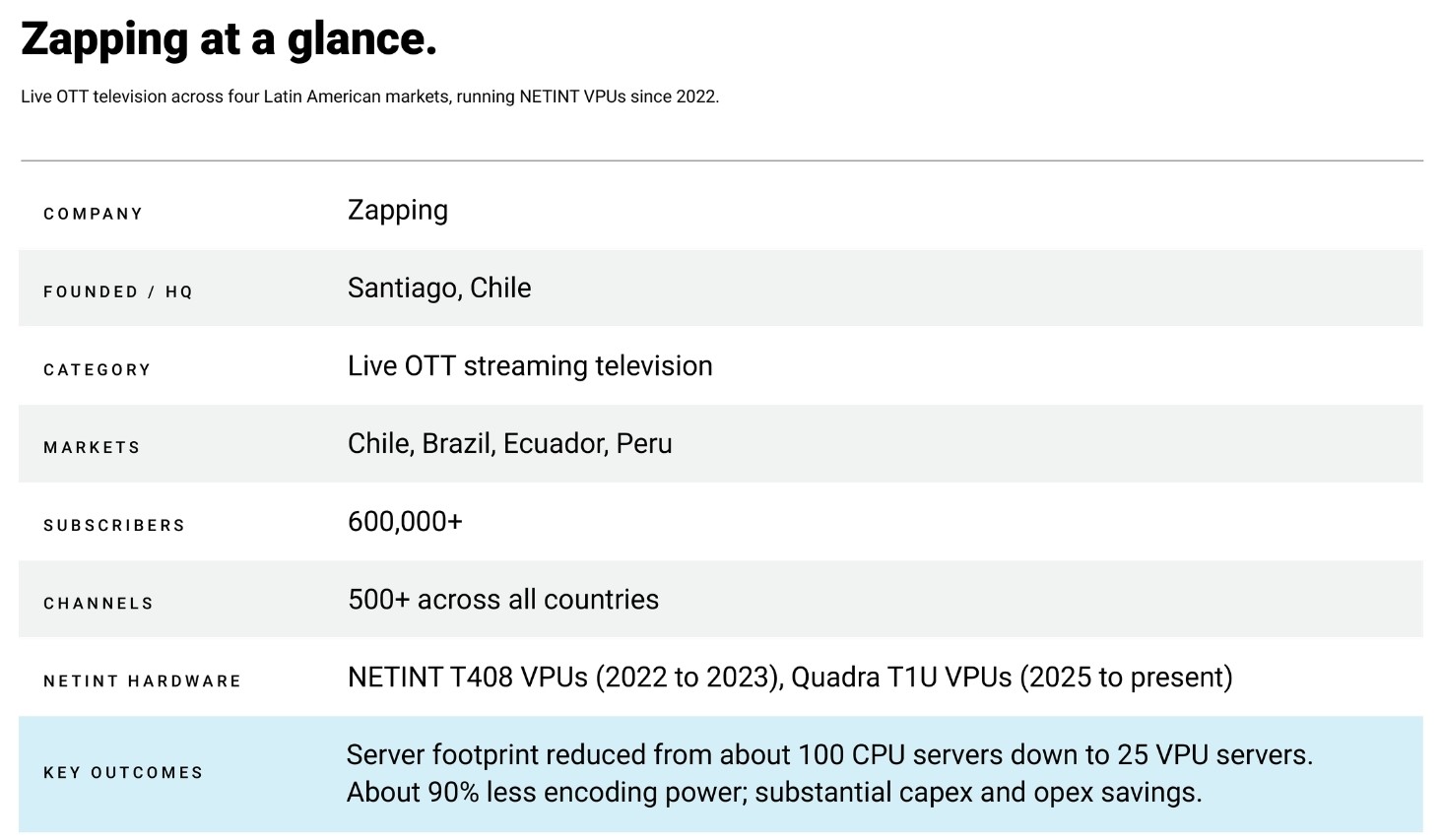
Summary table titled "Zapping at a glance" detailing company facts, including its founding in Santiago, Chile, 600,000+ subscribers, 500+ channels, use of NETINT VPUs, and key outcomes like reducing server count from 100 to 25.

Figure 1. Zapping’s path on NETINT, from first VPU to roadmap.
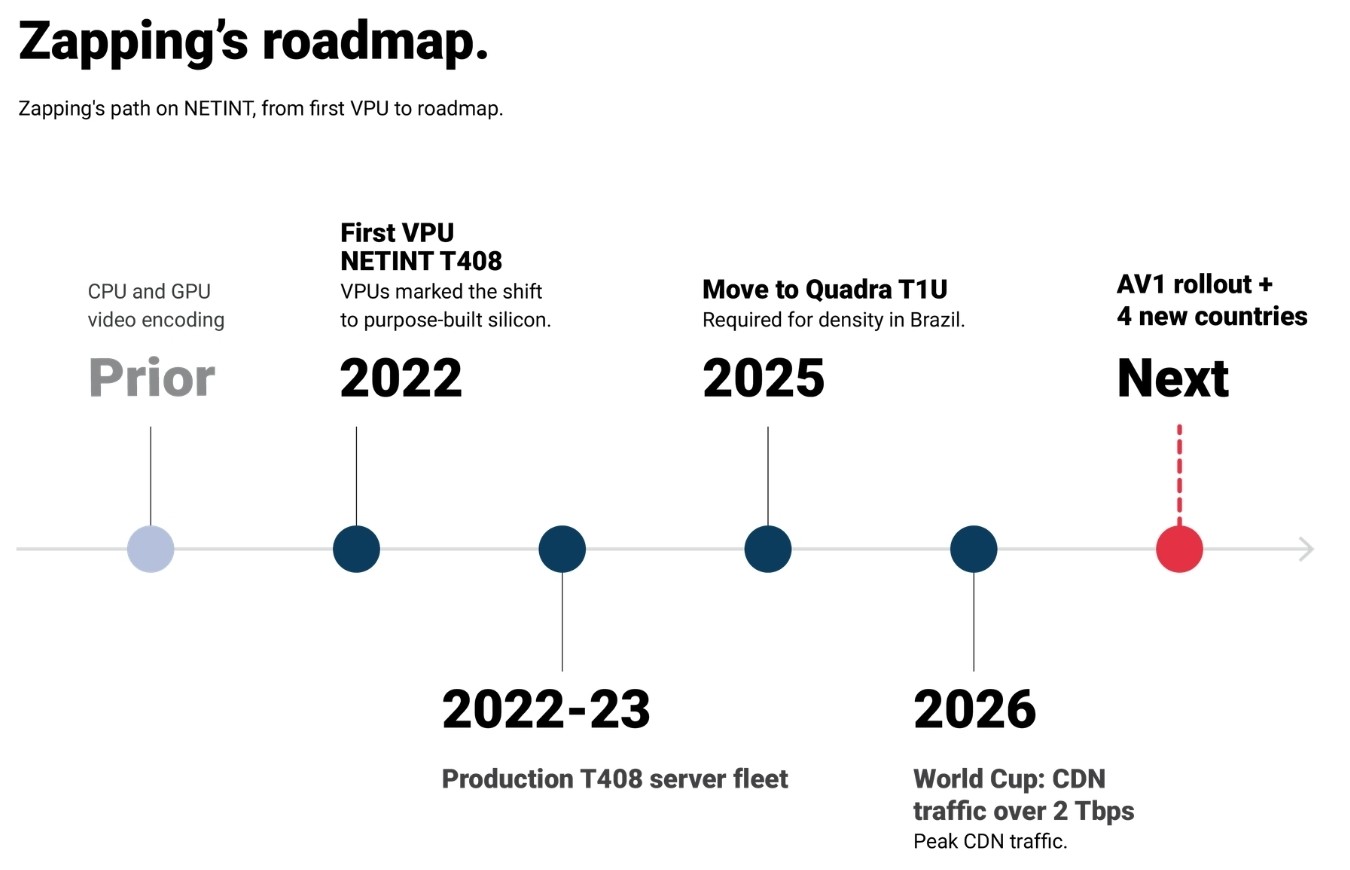
Timeline graphic titled "Zapping's roadmap" tracing the company's video encoding transition from software-based CPUs/GPUs prior to 2022, to NETINT T408 VPUs (2022–2023), Quadra T1U VPUs (2025), peak CDN traffic for the World Cup (2026), and future expansion to AV1 and 4 new countries.

Figure 2. Zapping’s path on NETINT, from first VPU to roadmap.

The Company
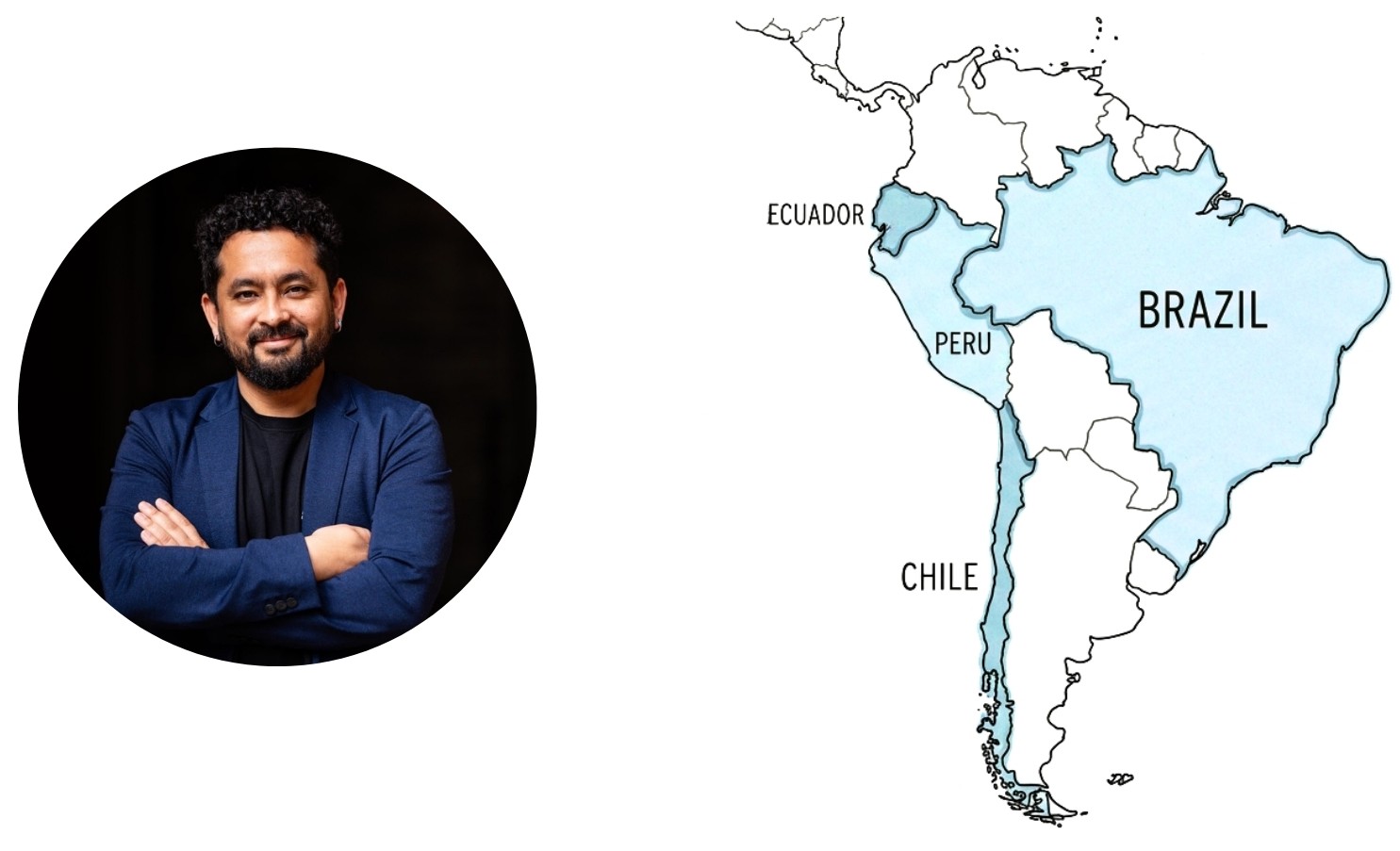
Circular portrait of Nacho Opazo smiling with arms crossed next to a map of South America highlighting Ecuador, Peru, Chile, and Brazil in light blue.

Figure 3. Ignacio “Nacho” Opazo, Co-founder & CTO, Zapping

Zapping set out to do what incumbents said could not be done profitably: deliver premium, cable quality live television, including the region’s most watched soccer, over the internet, with lower latency than local broadcast channels. Founded in Chile and led by co-founder and CTO/CPO Ignacio “Nacho” Opazo, Zapping positions itself as much a technology company as a content company. It built its own encoders, low latency delivery architecture, custom apps, and proprietary CDN. As Nacho puts it:

That vertically integrated approach turned Zapping into one of Latin America’s fastest growing live television streaming platforms and, in the process, made encoding density, power, and cost a competitive advantage.

The challenge: soccer, latency, and the economics of scale

In Latin America, live sports, soccer above all, drive subscriptions. They also create demanding engineering problems, starting with latency. “Here in Chile, the soccer matches are premium. You can hear your neighbor screaming if they have a cable operator with lower latency,” Nacho explains. “In Brazil it is more complicated, because some matches are free to air. So we must be fast enough to try and match free to air.” Soccer is punishing to compress, with wide shots of the field where players are small but jersey numbers must stay visible. With crowds, waving flags, and fast pans, preserving detail and color integrity without inflating bitrate is essential.

“Video files are huge, and when you have a soccer match, thousands of people hit your servers, saturating the region’s internet.” In some markets, inter ISP trunks were as small as 10 Gbps, and Zapping would overload them. That prompted the company to build its own CDN and implement a server cache system within every possible ISP across Latin America. Every one of those requirements had to be met affordably enough to install and operate data center capacity across South America, market by market. This made channel density per rack unit, power draw, and heat dissipation high priority problems to solve.

The journey: from CPU to GPU to VPU

Nacho tested every computing architecture, CPU and GPU, before settling on VPUs. What he ruled out is as instructive as what he chose.
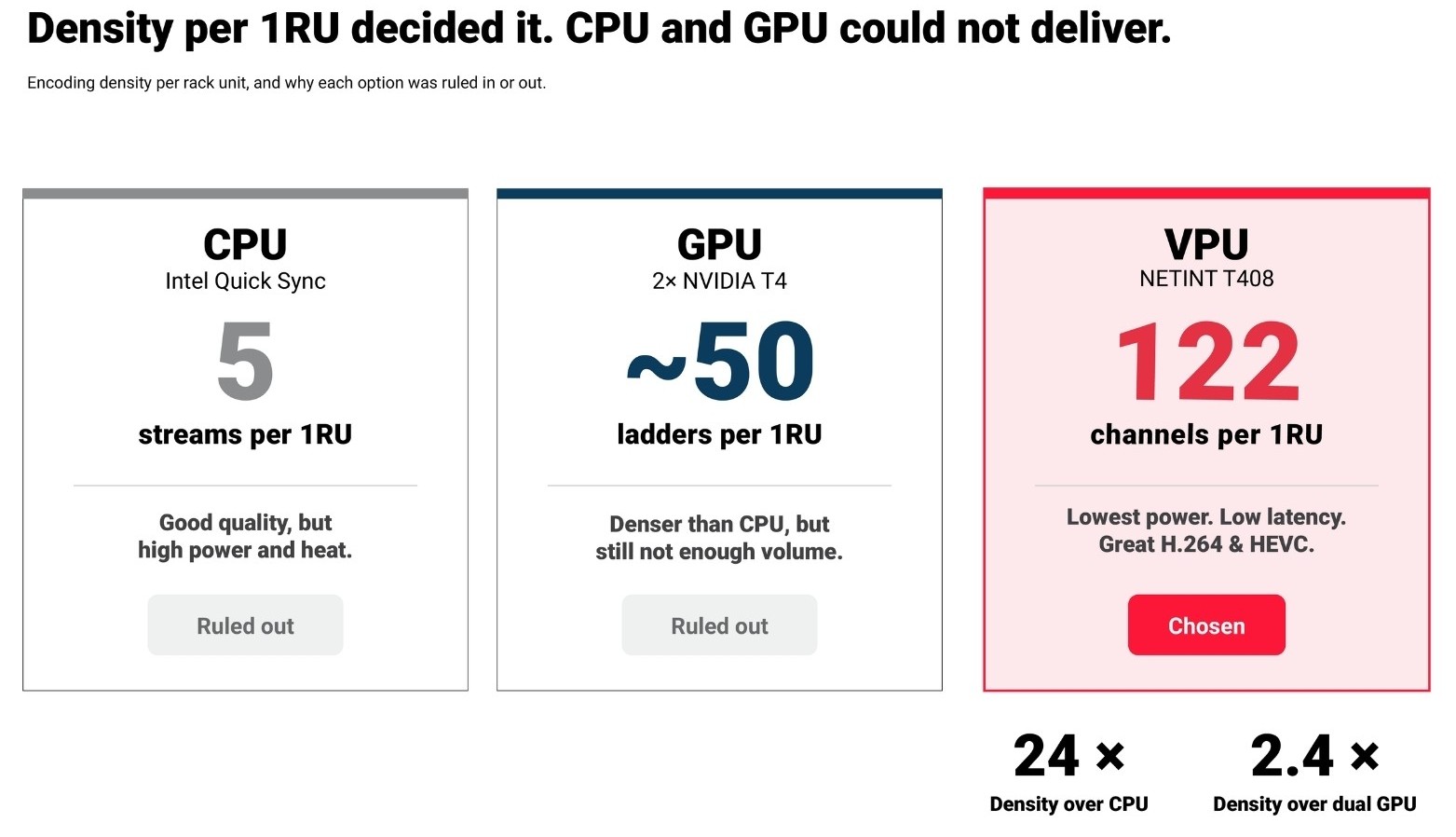
Comparison chart titled "Density per 1RU decided it" showing encoding options: CPU (5 streams/1RU, ruled out), GPU (50 ladders/1RU, ruled out), and NETINT T408 VPU (122 channels/1RU, chosen), highlighting a 24x density increase over CPU and 2.4x over dual GPU.

Figure 4. Density per 1RU decided it: the VPU delivered what CPU and GPU could not.

CPU (Intel Quick Sync) delivered good quality, but “my problem was getting more density for the rack unit. Intel enabled just five streams per 1RU. Plus, the power and heat produced was really high.”

GPU (NVIDIA P2000 to T4) was an improvement, with roughly 50 complete encoding ladders per 1RU on a dual T4, 80 core configuration, “but still insufficient.”

VPU (NETINT Logan to Quadra series). Nacho discovered a NETINT article showing he could achieve 122 channels per rack unit using the first generation T408. “I found the power draw was really low, as was the latency, and the quality of both H.264 and HEVC is really good.” Integration, a common worry with dedicated silicon, was a non issue: “We control the encoders with FFmpeg, and converting over to the NETINT transcoders was really seamless. Really, really easy.”

Zapping moved into production on T408 based streaming servers in 2022 and 2023, then transitioned to the second generation Quadra T1U VPUs in 2025. This provided the density and codec headroom needed to keep pace with expansion into larger markets like Brazil. As Nacho framed it: “I need to get more dense. Brazil is a really big country. We need more power and more density in the rack.”

The density math is what changed the business. Using NETINT VPUs, Zapping reduced the server count needed to serve its ladders from roughly 100 CPU based servers to a fraction of that.

The results

Density and footprint. Zapping went from about 100 software based servers to 25 VPU servers for the same encoding volume, roughly 75% fewer servers. Power and sustainability. Previous infrastructure consumed about 600 watts per server, while the VPU based servers require just 250 watts and provide three to four times the channel density. Across the fleet, that works out to roughly 90% less power for the same encoding workload, which directly reduces both cost and Zapping’s footprint in every data center it deploys.
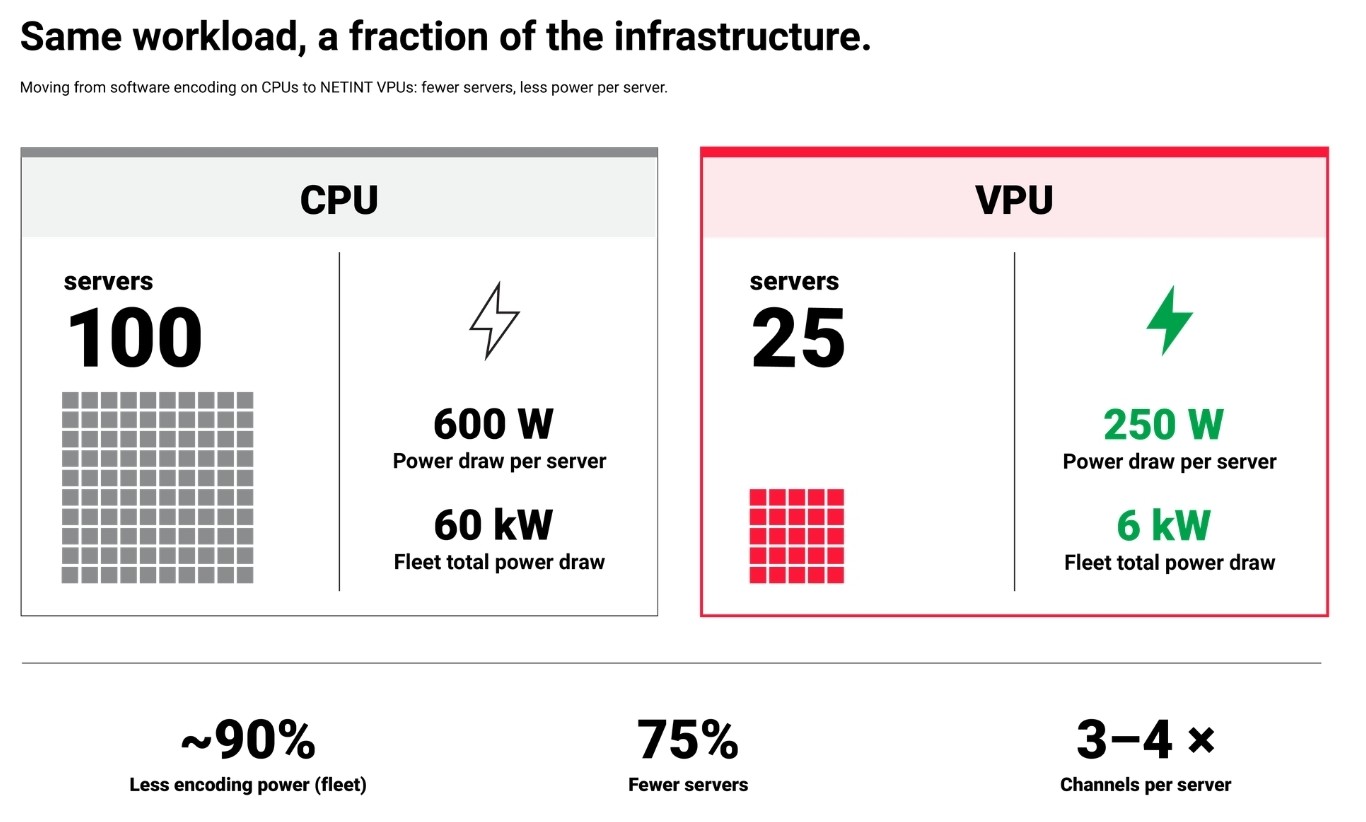
Side-by-side comparison titled "Same workload, a fraction of the infrastructure" contrasting 100 CPU servers drawing 60 kW total power against 25 VPU servers drawing 6 kW total power, representing ~90% less encoding power and 75% fewer servers.

Figure 4. The efficiency gain: same workload on a quarter of the servers..

Cost. Reducing the server count from more than 100 to 25 for the same volume of encoding, together with the drop in power, drives substantial capex and opex savings. As Nacho puts it, NETINT has helped “accelerate our expansion while increasing our profitability.” Latency. By placing a NETINT server inside each broadcaster’s CDN, Zapping originates its streams as close to the source signal as possible. In practice, Zapping lands within a few seconds of free to air, and in some cases ahead of it.
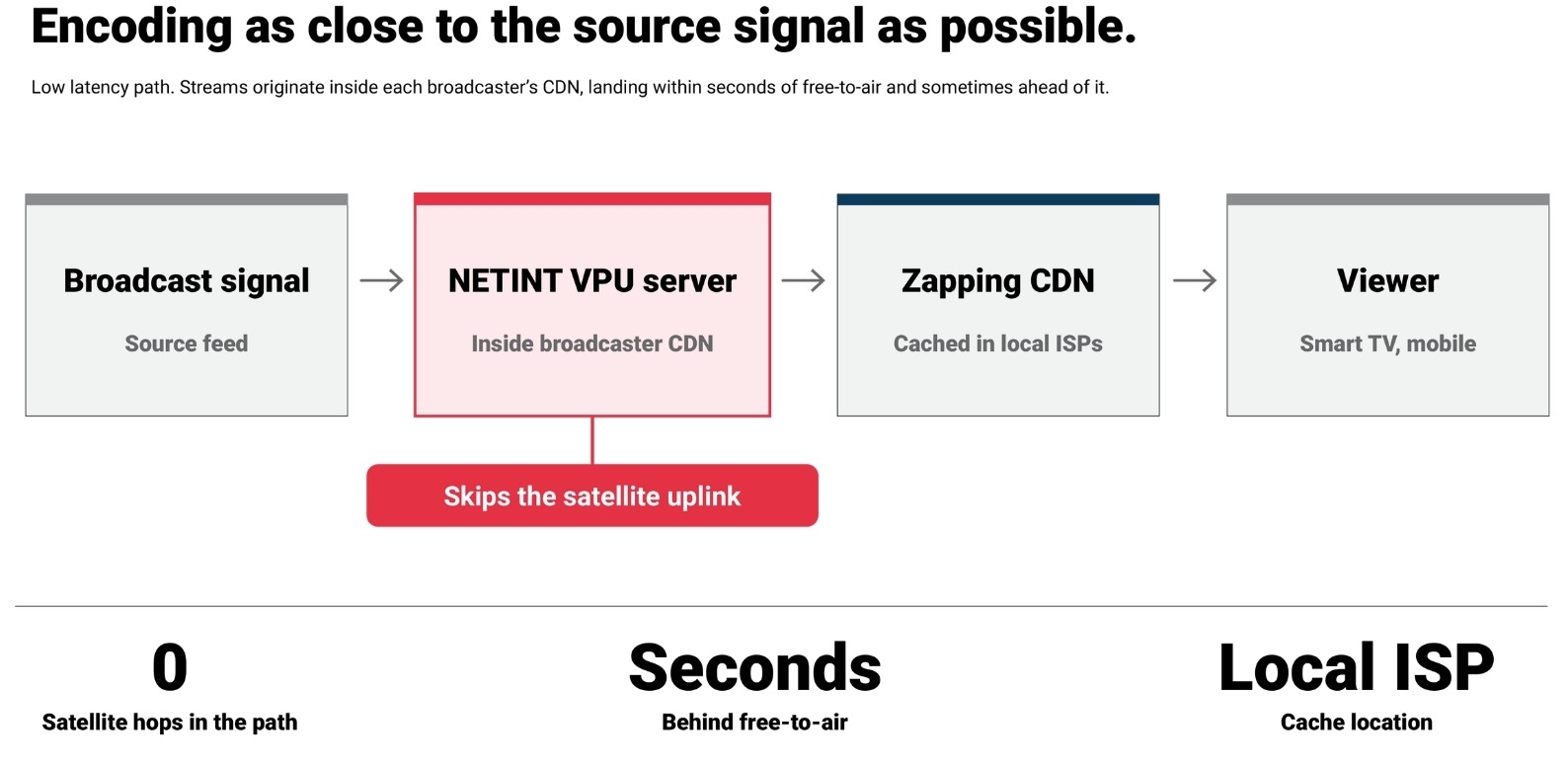
Flowchart titled "Encoding as close to the source signal as possible" mapping the video stream from Broadcast Signal to a NETINT VPU server inside the broadcaster CDN, then to Zapping CDN, and finally to the Viewer, emphasizing 0 satellite hops and low latency.

Figure 5. Encoding inside each broadcaster’s CDN keeps Zapping close to the source signal.

Bandwidth via HEVC and AV1. “HEVC is really important. Using these advanced codecs, we achieve a 40% lower bitrate than H.264 at the same quality; the user can see the difference.” Alongside Super Resolution (4K upscaling), Zapping is now beginning to work with AV1 and hopes to replace HEVC in the near future.

Why it matters for streaming video platforms

Zapping is proof of a thesis at the heart of the VPU Ecosystem: that purpose built video silicon lets an independent operator compete with, and outperform, far larger incumbents. By collapsing the cost, power, and rack space of encoding, VPUs let Zapping put capital into content and its own CDN instead of ever larger data centers.

Zapping continues to advance its software that clusters VPUs and distributes video encoding jobs across its data centers, while unifying these flows with its Stream Gateway. Its Upscaling and SDR to HDR (Super Resolution) technology demands ever more efficient encoding, so the team is now optimizing encoding using neural networks
Transforming Live Streaming TV, One Rack at a Time

Discover how Zapping scaled Live Streaming with NETINT VPUs, cutting server count, reducing power consumption, and improving low-latency OTT delivery.

Dark promotional graphic titled "Transforming Live Streaming TV, One Rack at a Time." It features a metallic server chassis alongside vibrant, flowing blue and pink light streams, with a illuminated sports stadium stadium blurred in the background.

How Zapping scaled premium low latency streaming using NETINT VPUs across Latin America

Customer Case Study | IBC 2026

AT A GLANCE

Zapping built one of Latin America’s fastest-growing live OTT television platforms by optimizing video infrastructure for density, low latency, and operational efficiency. As subscriber growth accelerated, the company needed to reduce rack space, power consumption, and encoding costs without compromising quality.

This customer case study explains how Zapping scaled Live Streaming with NETINT VPUs, reducing its server footprint from approximately 100 CPU-based servers to 25 VPU servers while lowering encoding power consumption by about 90% and supporting continued expansion across Latin America.

Summary table titled "Zapping at a glance" detailing company facts, including its founding in Santiago, Chile, 600,000+ subscribers, 500+ channels, use of NETINT VPUs, and key outcomes like reducing server count from 100 to 25.

Figure 1. Zapping’s path on NETINT, from first VPU to roadmap.

Timeline graphic titled "Zapping's roadmap" tracing the company's video encoding transition from software-based CPUs/GPUs prior to 2022, to NETINT T408 VPUs (2022–2023), Quadra T1U VPUs (2025), peak CDN traffic for the World Cup (2026), and future expansion to AV1 and 4 new countries.

Figure 2. Zapping’s path on NETINT, from first VPU to roadmap.

The Company

Circular portrait of Nacho Opazo smiling with arms crossed next to a map of South America highlighting Ecuador, Peru, Chile, and Brazil in light blue.

Figure 3. Ignacio “Nacho” Opazo, Co-founder & CTO, Zapping

Zapping set out to do what incumbents said could not be done profitably: deliver premium, cable quality live television, including the region’s most watched soccer, over the internet, with lower latency than local broadcast channels. Founded in Chile and led by co-founder and CTO/CPO Ignacio “Nacho” Opazo, Zapping positions itself as much a technology company as a content company. It built its own encoders, low latency delivery architecture, custom apps, and proprietary CDN. As Nacho puts it:

That vertically integrated approach turned Zapping into one of Latin America’s fastest growing live television streaming platforms and, in the process, made encoding density, power, and cost a competitive advantage.

The challenge: soccer, latency, and the economics of scale

In Latin America, live sports, soccer above all, drive subscriptions. They also create demanding engineering problems, starting with latency. “Here in Chile, the soccer matches are premium. You can hear your neighbor screaming if they have a cable operator with lower latency,” Nacho explains. “In Brazil it is more complicated, because some matches are free to air. So we must be fast enough to try and match free to air.” Soccer is punishing to compress, with wide shots of the field where players are small but jersey numbers must stay visible. With crowds, waving flags, and fast pans, preserving detail and color integrity without inflating bitrate is essential.

“Video files are huge, and when you have a soccer match, thousands of people hit your servers, saturating the region’s internet.” In some markets, inter ISP trunks were as small as 10 Gbps, and Zapping would overload them. That prompted the company to build its own CDN and implement a server cache system within every possible ISP across Latin America. Every one of those requirements had to be met affordably enough to install and operate data center capacity across South America, market by market. This made channel density per rack unit, power draw, and heat dissipation high priority problems to solve.

The journey: from CPU to GPU to VPU

Nacho tested every computing architecture, CPU and GPU, before settling on VPUs. What he ruled out is as instructive as what he chose.

Comparison chart titled "Density per 1RU decided it" showing encoding options: CPU (5 streams/1RU, ruled out), GPU (50 ladders/1RU, ruled out), and NETINT T408 VPU (122 channels/1RU, chosen), highlighting a 24x density increase over CPU and 2.4x over dual GPU.

Figure 4. Density per 1RU decided it: the VPU delivered what CPU and GPU could not.

CPU (Intel Quick Sync) delivered good quality, but “my problem was getting more density for the rack unit. Intel enabled just five streams per 1RU. Plus, the power and heat produced was really high.”

GPU (NVIDIA P2000 to T4) was an improvement, with roughly 50 complete encoding ladders per 1RU on a dual T4, 80 core configuration, “but still insufficient.”

VPU (NETINT Logan to Quadra series). Nacho discovered a NETINT article showing he could achieve 122 channels per rack unit using the first generation T408. “I found the power draw was really low, as was the latency, and the quality of both H.264 and HEVC is really good.” Integration, a common worry with dedicated silicon, was a non issue: “We control the encoders with FFmpeg, and converting over to the NETINT transcoders was really seamless. Really, really easy.”

Zapping moved into production on T408 based streaming servers in 2022 and 2023, then transitioned to the second generation Quadra T1U VPUs in 2025. This provided the density and codec headroom needed to keep pace with expansion into larger markets like Brazil. As Nacho framed it: “I need to get more dense. Brazil is a really big country. We need more power and more density in the rack.”

The density math is what changed the business. Using NETINT VPUs, Zapping reduced the server count needed to serve its ladders from roughly 100 CPU based servers to a fraction of that.

The results

Density and footprint. Zapping went from about 100 software based servers to 25 VPU servers for the same encoding volume, roughly 75% fewer servers. Power and sustainability. Previous infrastructure consumed about 600 watts per server, while the VPU based servers require just 250 watts and provide three to four times the channel density. Across the fleet, that works out to roughly 90% less power for the same encoding workload, which directly reduces both cost and Zapping’s footprint in every data center it deploys.

Side-by-side comparison titled "Same workload, a fraction of the infrastructure" contrasting 100 CPU servers drawing 60 kW total power against 25 VPU servers drawing 6 kW total power, representing ~90% less encoding power and 75% fewer servers.

Figure 4. The efficiency gain: same workload on a quarter of the servers..

Cost. Reducing the server count from more than 100 to 25 for the same volume of encoding, together with the drop in power, drives substantial capex and opex savings. As Nacho puts it, NETINT has helped “accelerate our expansion while increasing our profitability.” Latency. By placing a NETINT server inside each broadcaster’s CDN, Zapping originates its streams as close to the source signal as possible. In practice, Zapping lands within a few seconds of free to air, and in some cases ahead of it.

Flowchart titled "Encoding as close to the source signal as possible" mapping the video stream from Broadcast Signal to a NETINT VPU server inside the broadcaster CDN, then to Zapping CDN, and finally to the Viewer, emphasizing 0 satellite hops and low latency.

Figure 5. Encoding inside each broadcaster’s CDN keeps Zapping close to the source signal.

Bandwidth via HEVC and AV1. “HEVC is really important. Using these advanced codecs, we achieve a 40% lower bitrate than H.264 at the same quality; the user can see the difference.” Alongside Super Resolution (4K upscaling), Zapping is now beginning to work with AV1 and hopes to replace HEVC in the near future.

Why it matters for streaming video platforms

Zapping is proof of a thesis at the heart of the VPU Ecosystem: that purpose built video silicon lets an independent operator compete with, and outperform, far larger incumbents. By collapsing the cost, power, and rack space of encoding, VPUs let Zapping put capital into content and its own CDN instead of ever larger data centers.

Zapping continues to advance its software that clusters VPUs and distributes video encoding jobs across its data centers, while unifying these flows with its Stream Gateway. Its Upscaling and SDR to HDR (Super Resolution) technology demands ever more efficient encoding, so the team is now optimizing encoding using neural networks