Efficient silicon is necessary but not sufficient. What it takes to make video processing deployable at data center scale.
The Abstraction Breaks Down
At a modest scale, video infrastructure decisions can remain largely abstract. Engineering teams optimize for throughput or quality and assume the underlying systems will accommodate whatever they build. When concurrency is limited and workloads are intermittent, inefficiency shows up primarily as a higher bill.
At production scale, that assumption stops holding. Video workloads are sustained, power-intensive, and concurrency-driven. As deployments grow, teams hit constraints that no amount of software optimization can solve: power budgets per rack, thermal dissipation limits, floor space availability, and the sheer operational costs of maintaining large server fleets.
In these environments, inefficiency does not simply raise costs. It determines whether a given workload can physically exist within real data center constraints. The question shifts from how fast, to how deployable?
THE PHYSICAL CONSTRAINT STACK
Hard limits that cannot be abstracted away at scale
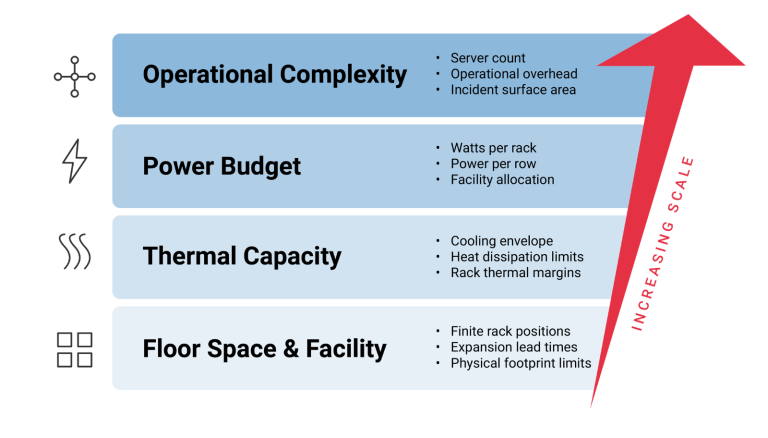
At modest scale, there are budget items. At production scale, they become hard deployment constraints
Exhibit 1: The Physical Constraint Stack. At scale, these limits compound and become non-negotiable.
Why General-Purpose Servers Struggle
Historically, video processing has relied on general-purpose compute, with GPUs added when acceleration was needed. That model provides flexibility, but it introduces challenges when applied to dense, sustained video workloads.
CPU- and GPU-based encoding often exhibits fluctuating power draw depending on workload mix and tuning. High-performance accelerators can concentrate heat in ways that complicate airflow and cooling design. Fewer streams per server means more rack space, more cabling, and more operational overhead. And capacity planning becomes probabilistic rather than deterministic, forcing infrastructure teams to overprovision power, cooling, and space to accommodate worst-case scenarios.
The result is a planning model built on estimates and margins rather than known, repeatable behavior. Every variable that fluctuates adds a layer of uncertainty to facility design, procurement, and operations.
KEY INSIGHT
At production scale, the distinction between a variable workload and a predictable one is not a matter of preference. It is the difference between overprovisioning by 30-40% and sizing to actual demand.
VPUs Change the Planning Model
Within the VPU Ecosystem, Video Processing Units shift the planning model from theoretical performance to predictable physical behavior. From an infrastructure perspective, three changes matter most.
Deterministic power profiles. Dedicated video silicon delivers stable, bounded power consumption per stream. This simplifies power budgeting at the server and rack level. Teams can plan around known energy draw and compute capacity rather than peak estimates.
Higher density per footprint. More streams per server means fewer systems are needed to deliver a given level of video encoding capability. Rack count drops. Cabling simplifies. Operational overhead shrinks.
Thermal predictability. Consistent thermal output improves cooling efficiency and reduces the need for conservative design margins. Airflow planning becomes straightforward rather than defensive.
PLANNING MODEL COMPARISON
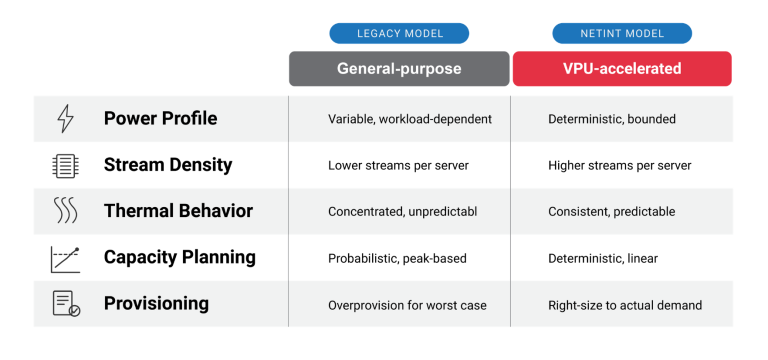
Exhibit 2: How VPU-accelerated infrastructure changes planning assumptions across five key dimensions.
Together, these characteristics let video infrastructure teams plan capacity based on concrete physical constraints rather than peak-performance estimates. With VPUs, the planning model shifts from probabilistic to deterministic.
From Silicon to System: Where Server Design Earns Its Keep
Efficient silicon alone is not sufficient. To be deployable at scale, acceleration must be integrated into systems designed for reliability, serviceability, and lifecycle management.
Server design for sustained video workloads involves considerations that go well beyond raw performance: chassis airflow and component placement, power supply sizing and redundancy, PCIe layout and expansion flexibility, firmware stability and platform validation, and long-term serviceability across multi-year deployments.
This is the kind of engineering that Dell Technologies has refined across decades of enterprise server design. The PowerEdge platform, for example, offers PCIe Gen5 expansion across a range of form factors. The R760 supports up to eight PCIe slots with a mix of Gen4 and Gen5 risers, giving infrastructure teams the flexibility to pair NVMe VPU accelerators alongside networking and storage cards without slot contention. For denser configurations, the XE series delivers higher accelerator counts in validated thermal envelopes. The underlying principle is the same: provide enough expansion headroom so that adding purpose-built acceleration does not require rearchitecting the server.
Thermal management is equally critical. Dell’s Multi-Vector Cooling (MVC) framework combines hardware innovations with AI-driven adaptive fan control. The latest generation uses a fuzzy-logic closed-loop controller that adjusts fan speed based on real-time thermal sensor input and power telemetry, optimizing for both cooling performance and acoustic efficiency. For video workloads, where sustained thermal output is the norm rather than the exception, this kind of adaptive control keeps components within safe operating ranges without the energy waste of running fans at full speed continuously.
In this context, VPUs are not treated as experimental accelerators bolted onto general-purpose hardware. They are production components within validated server platforms, designed to operate reliably under sustained load for years at a time.
This distinction matters. Experimental hardware often works in the lab but creates problems at scale: inconsistent firmware behavior, unvalidated thermal profiles, unclear support paths. Production-grade integration eliminates these risks before they reach the data center floor.
Density Changes Operational Economics
When stream density increases, the operational math changes at every level. Fewer servers mean fewer rack positions. Fewer racks mean less power, less cooling, and less floor space. Fewer systems to manage means fewer failure points, less cabling, and simpler monitoring.
This is not a marginal improvement. When you move from dozens of streams per server to hundreds, you are not optimizing an existing model. You are changing the category of infrastructure required. Deployments that once filled rows of racks can fit in a fraction of the space, with proportional reductions in operational complexity.
Dell’s iDRAC management platform amplifies this advantage. Each PowerEdge server includes an integrated remote access controller capable of streaming real-time telemetry, covering power consumption, thermal sensors, fan speeds, and component health, via the Redfish API. For video deployments, where dozens of servers may run identical sustained workloads, this telemetry makes it straightforward to monitor fleet health from a single pane. When a VPU’s thermal signature shifts or a power supply nears its rated capacity, operations teams can catch the issue before it becomes a service disruption.
For organizations operating multiple facilities or expanding into new regions, this density advantage compounds. Each new deployment starts from a smaller, simpler, more predictable baseline.
Planning for Lifecycle, Not Just Launch
Video infrastructure is rarely static. Platforms evolve, codecs change, and demand grows over time. Deployable systems must account for multi-year support horizons, incremental capacity expansion, hardware refresh cycles, and operational continuity during upgrades.
INFRASTRUCTURE LIFECYCLE
Where pedrictable workload behavior reduces friction
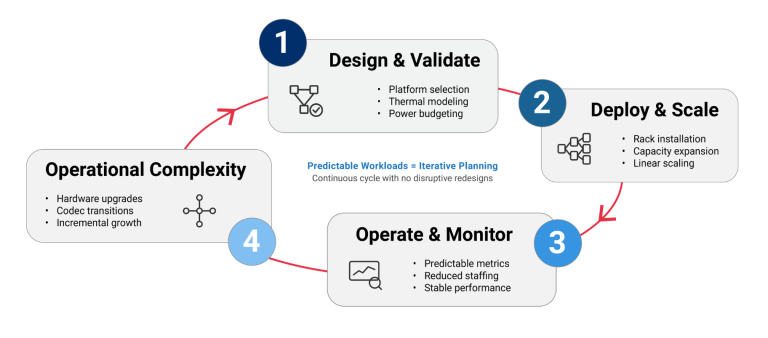
Exhibit 3: The Infrastructure Lifecycle. Predictable workloads make each phase iterative rather than disruptive.
Predictable, efficient workloads reduce the friction at every stage of this lifecycle. When capacity scales linearly and power behavior is stable, infrastructure planning becomes iterative rather than disruptive. A hardware refresh is an upgrade, not a redesign. A capacity expansion is a known quantity, not a new engineering project.
Dell’s OpenManage Enterprise suite is designed to automate precisely these lifecycle tasks across large fleets. It can manage up to 8,000 PowerEdge devices from a single console, handling firmware updates, configuration compliance, and hardware health monitoring through policy-based automation. For video operators who may be deploying dozens or hundreds of VPU-equipped servers, the ability to push firmware updates, validate configurations, and track hardware health across an entire fleet without touching individual machines is a material reduction in operational burden. Combined with Ansible integration for infrastructure-as-code workflows, the management layer scales alongside the hardware
THE BIGGER PICTURE
When servers are designed around predictable, efficient video processing, higher-level architectural decisions become easier. Compute can be placed closer to users when latency matters. Capacity can scale without rearchitecting facilities. Operational teams can support video growth without proportional increases in complexity.
Infrastructure Is the Foundation
Efficiency in video processing is often discussed in terms of cost or performance. At infrastructure scale, it becomes a question of feasibility. Can this workload physically exist in this facility? Can it be supported over time? Can it scale without rebuilding the environment around it?
From silicon to rack, deployable video infrastructure depends on predictable behavior, density, and supportable system design. VPUs change what is possible at the hardware level. Server platforms translate that efficiency into systems that can be deployed, operated, and evolved over time. When the silicon is purpose-built, like the VPU is for video, and the server platform is engineered for sustained, real-world operation, what once required rows of general-purpose machines can fit in a fraction of the space, with a fraction of the operational overhead. This is why the world’s largest video platforms and social networks all use custom silicon to encode and process video.
Within the VPU Ecosystem, infrastructure is not an afterthought. It is the foundation that makes efficiency real.
VPU Ecosystem Series This article is part of a series examining how purpose-built video silicon is reshaping infrastructure, economics, and architecture across the video delivery chain. Each installment explores a different partner’s perspective within the ecosystem.