
The Architecture Beneath the Accelerator

Abstract visualization of underlying architecture powering hardware video acceleration

                                      Why System Design Determines Whether Video Processing Units Deliver on Their Promise

                                       Advantech | NETINT

When Silicon Gets Faster, Systems Must Get Smarter

Traditional video infrastructure evolved around general-purpose CPUs, and later GPUs. The servers that hosted these processors were designed for balanced workloads where compute, storage, and networking shared relatively even resource profiles. A standard 1RU or 2RU server could handle video encoding alongside other tasks without requiring special attention to any single subsystem.

Accelerator-based workloads behave differently. Video processing places sustained, predictable pressure on specific system resources: PCIe bandwidth for moving uncompressed frames between host and device, power delivery for maintaining multiple accelerators under continuous load, cooling pathways for dissipating concentrated heat from devices that never idle, and storage throughput for buffering high-bitrate content.

When these resources are not aligned with workload behavior, system-level bottlenecks appear long before the silicon reaches its limits. An accelerator capable of encoding 80 streams might deliver only 50 if the PCIe bus cannot feed it data fast enough. A card rated for 75 watts might throttle to 60 if the chassis airflow cannot keep it within operating temperature. The result is stranded capacity: hardware that was purchased for its peak specification but can only sustain a fraction of it.

KEY INSIGHT
The performance ceiling of an accelerator-dense system is not set by the accelerator. It is set by the weakest link in the chain of system resources that support it. Purpose-built platforms are designed to ensure that no single resource becomes that bottleneck.

Why Server Design Matters for Accelerator- Dense Workloads
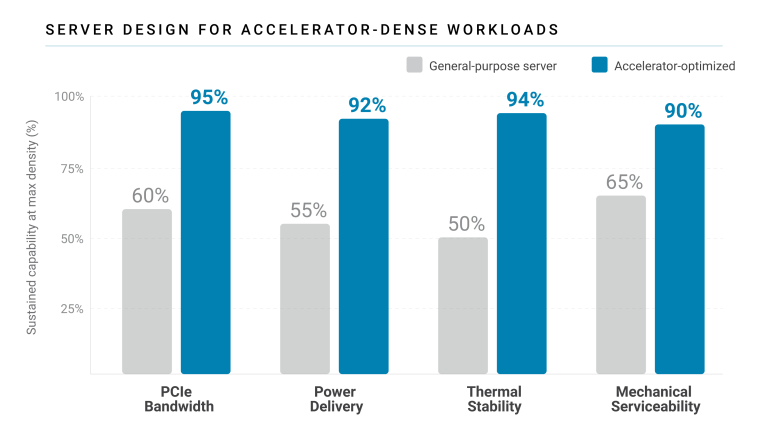
Bar chart comparing general-purpose servers and accelerator-optimized systems, showing higher sustained capability across PCIe bandwidth, power delivery, thermal stability, and serviceability for optimized systems.

Exhibit 1: At high accelerator density, purpose-built platforms sustain significantly more capability across all critical system resources


Density Changes the Planning Model

The efficiency gains from VPUs create a natural incentive to increase density. If one accelerator card can replace an entire CPU-based encoding server, the logical next step is to pack multiple cards into a single chassis and consolidate even further. NETINT’s Quadra family of VPU’s are available in PCIe, U.2, and M.2 form factors, enabling configurations that can scale from two devices to twelve or more on a single platform.

But increasing density introduces compound constraints. Each additional accelerator draws power from the same motherboard, generates heat within the same airflow envelope, and competes for bandwidth on the same PCIe bus. Systems designed for moderate accelerator counts may struggle when those devices operate continuously under sustained load.

Effective system design must anticipate not just peak throughput, but sustained concurrency. A platform that benchmarks well with four accelerators running short test sequences may reveal thermal or power limitations when those same four accelerators encode live streams around the clock. The planning model shifts from ‘how many devices fit?’ to ‘how many devices can operate at full capacity simultaneously, indefinitely?’

The Five Pillars of Accelerator-Ready System Design

The system-level considerations that determine real-world accelerator performance fall into five interconnected categories. Each affects the others, and a weakness in any one can limit the entire platform.

Table 1: System Design Considerations for Accelerator-Dense Video Platforms
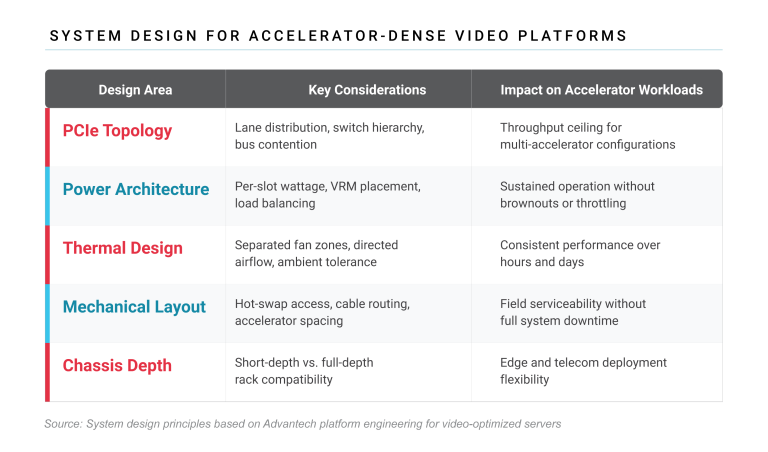
Table outlining system design areas such as PCIe topology, power architecture, thermal design, mechanical layout, and chassis depth, with key considerations and their impact on accelerator workloads.
Layered diagram showing system architecture from workload requirements up to deployment and operations, including accelerator silicon, system board, platform integration, and operational layers, highlighting Advantech and NETINT roles.

Exhibit 2: Purpose-built platforms bridge multiple layers between silicon efficiency and deployable infrastructure


The Hidden Importance of PCIe Topology

Of all the system design factors, PCIe topology may be the least visible and the most consequential. Accelerator-based video systems depend on PCIe communication between the host processor, the accelerator devices, and storage. Every uncompressed video frame that enters an encoder and every compressed bitstream that exits it travels across this bus.

When multiple accelerators share limited PCIe bandwidth, contention can degrade throughput even if individual devices remain underutilized. In high-density systems, the details matter: lane distribution across slots, switch placement on the motherboard, and the hierarchy of the PCIe bus all affect achievable performance. A system with four PCIe x16 slots might deliver excellent bandwidth to each device individually, but if those slots share a common root complex or pass through an oversubscribed switch, concurrent operation may tell a different story.

Well-designed platforms treat PCIe connectivity as a first-order system resource rather than an afterthought. Advantech’s VEGA-7000 series, for example, provides four PCIe expansion slots in a 1U form factor, with lane allocation specifically engineered for sustained accelerator throughput. The goal is predictable, non-contending bandwidth for every device in the system, not just the first one.

Thermal Design Determines Sustained Performance

Accelerator workloads differ fundamentally from burst-oriented compute tasks. Video processing often runs continuously for hours, days, or weeks, particularly in live streaming and broadcast environments. Under these conditions, thermal stability becomes critical.

Poor airflow design can lead to device throttling, reduced encoding throughput, and increased hardware failure rates. The challenge intensifies with density: more accelerators in the same chassis means more concentrated heat, and the thermal output of upstream devices can preheat the air reaching downstream ones.

Advantech’s approach to this challenge includes separated fan zones for CPU and accelerator areas, smart fan control through IPMI that adjusts speeds based on individual component temperatures, and directed airflow paths that ensure each device receives cooling independently of its neighbors. The SKY-6000 series GPU servers, for instance, use separate air tunnels for CPU and accelerator areas to prevent thermal cross-contamination. This is not a minor engineering detail. It is the difference between a system that maintains rated performance at hour one and a system that still maintains it at hour ten thousand.

THE BIGGER PICTURE
Thermal throttling is invisible to operators until it manifests as degraded stream quality or dropped frames. A well-designed platform eliminates the conditions that cause throttling in the first place, making performance predictable rather than aspirational. For 24/7 video operations, this predictability is the foundation of service reliability

Edge Deployments Amplify Every Design Decision

Not all video processing occurs in large, climate-controlled data centers. Edge deployments at regional sites, telecom facilities, or production environments introduce additional constraints: limited power budgets, restricted physical space, constrained cooling capacity, and environmental variability. A platform that performs flawlessly in a temperature-controlled server room may behave very differently in a telecom central office or a broadcast production truck.

These environments are precisely where accelerator density matters most. Edge sites often lack the space and power for multiple large servers, which makes the ability to consolidate more processing into fewer, smaller platforms essential. Advantech’s portfolio addresses this directly, offering both short-depth 1U servers like the VEGA-7030 for space-constrained deployments and full-depth multi-accelerator platforms for regional data centers. The VEGA-7030, designed specifically for video workloads, fits a short-depth rack footprint while still accommodating four PCIe accelerator cards.

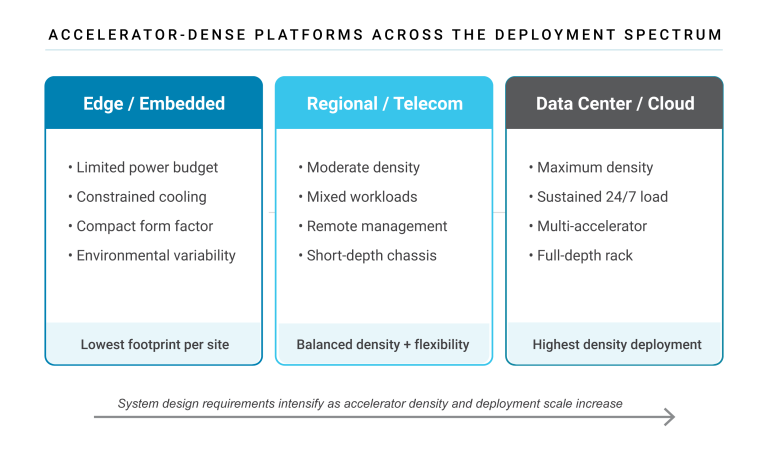
Three-column comparison of deployment environments: edge/embedded, regional/telecom, and data center/cloud, detailing constraints, workload types, and density characteristics.

Exhibit 3: System design requirements intensify as deployments move from controlled data centers to constrained edge environments

The primary benefit of specialized video hardware is predictability. Encoding throughput, power consumption, and performance remain stable under sustained workloads. A VPU server that processes 320 streams or more at a given quality level will continue to process those 320 streams at that quality level for the duration of the workload. This is fundamentally different from CPU-based encoding, where performance can vary with system load, thermal conditions, and competing processes.

Effective platforms therefore extend the predictability of VPUs into the full system. The result is infrastructure where capacity planning can be based on actual, sustained performance rather than theoretical peak specifications.

The Strategic Calculus

Video infrastructure is increasingly shaped by specialized hardware. VPUs dramatically improve the efficiency of video processing, but their real impact depends on how they are integrated into systems. Server architecture, device density, and thermal stability ultimately determine whether efficient silicon becomes deployable infrastructure.

Within the VPU ecosystem, Advantech represents the system design layer: the point where accelerator efficiency becomes operational reality. Rather than treating accelerators as optional add-ons to general-purpose servers, Advantech designs platforms where accelerators are central to the system’s purpose. Optimized PCIe topology ensures predictable bandwidth. Robust power architecture supports sustained multi-device operation. Intelligent thermal management maintains performance over continuous, long-duration workloads.

For platform architects and infrastructure engineers evaluating their next generation of video processing systems, the question is not simply which accelerator to choose. It is whether the system that surrounds it can deliver on the accelerator’s promise, consistently, at scale, in the environments where it actually needs to operate. That question is answered not by the silicon, but by the architecture beneath it.

ACCESS NOW:  ASIC-Based Transcoding
for High-volume Use Cases
Including social media, broadcast, interactive platforms, and service providers


ACCESS NOW

The Architecture Beneath the Accelerator

VPU system architecture determines whether accelerator-dense video infrastructure delivers sustained performance across PCIe, power, and thermal limits.

Abstract visualization of underlying architecture powering hardware video acceleration

                                      Why System Design Determines Whether Video Processing Units Deliver on Their Promise

                                       Advantech | NETINT

When Silicon Gets Faster, Systems Must Get Smarter

Traditional video infrastructure evolved around general-purpose CPUs, and later GPUs. The servers that hosted these processors were designed for balanced workloads where compute, storage, and networking shared relatively even resource profiles. A standard 1RU or 2RU server could handle video encoding alongside other tasks without requiring special attention to any single subsystem.

Accelerator-based workloads behave differently. Video processing places sustained, predictable pressure on specific system resources: PCIe bandwidth for moving uncompressed frames between host and device, power delivery for maintaining multiple accelerators under continuous load, cooling pathways for dissipating concentrated heat from devices that never idle, and storage throughput for buffering high-bitrate content.

When these resources are not aligned with workload behavior, system-level bottlenecks appear long before the silicon reaches its limits. An accelerator capable of encoding 80 streams might deliver only 50 if the PCIe bus cannot feed it data fast enough. A card rated for 75 watts might throttle to 60 if the chassis airflow cannot keep it within operating temperature. The result is stranded capacity: hardware that was purchased for its peak specification but can only sustain a fraction of it.

KEY INSIGHT
The performance ceiling of an accelerator-dense system is not set by the accelerator. It is set by the weakest link in the chain of system resources that support it. Purpose-built platforms are designed to ensure that no single resource becomes that bottleneck.

Why Server Design Matters for Accelerator- Dense Workloads

Bar chart comparing general-purpose servers and accelerator-optimized systems, showing higher sustained capability across PCIe bandwidth, power delivery, thermal stability, and serviceability for optimized systems.

Exhibit 1: At high accelerator density, purpose-built platforms sustain significantly more capability across all critical system resources


Density Changes the Planning Model

The efficiency gains from VPUs create a natural incentive to increase density. If one accelerator card can replace an entire CPU-based encoding server, the logical next step is to pack multiple cards into a single chassis and consolidate even further. NETINT’s Quadra family of VPU’s are available in PCIe, U.2, and M.2 form factors, enabling configurations that can scale from two devices to twelve or more on a single platform.

But increasing density introduces compound constraints. Each additional accelerator draws power from the same motherboard, generates heat within the same airflow envelope, and competes for bandwidth on the same PCIe bus. Systems designed for moderate accelerator counts may struggle when those devices operate continuously under sustained load.

Effective system design must anticipate not just peak throughput, but sustained concurrency. A platform that benchmarks well with four accelerators running short test sequences may reveal thermal or power limitations when those same four accelerators encode live streams around the clock. The planning model shifts from ‘how many devices fit?’ to ‘how many devices can operate at full capacity simultaneously, indefinitely?’

The Five Pillars of Accelerator-Ready System Design

The system-level considerations that determine real-world accelerator performance fall into five interconnected categories. Each affects the others, and a weakness in any one can limit the entire platform.

Table 1: System Design Considerations for Accelerator-Dense Video Platforms
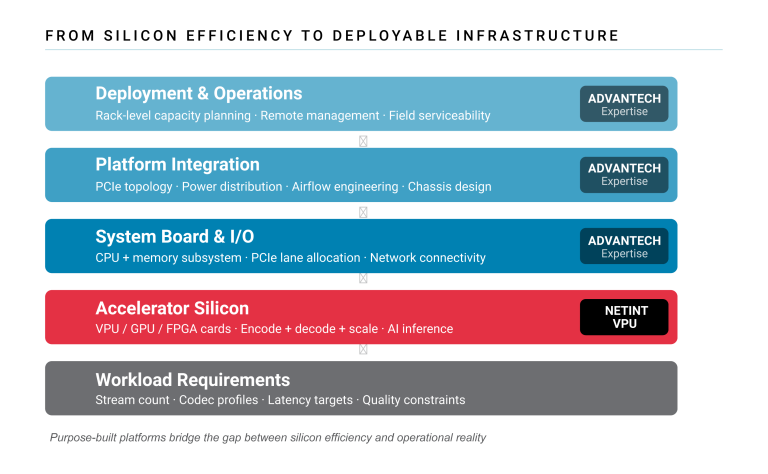
Table outlining system design areas such as PCIe topology, power architecture, thermal design, mechanical layout, and chassis depth, with key considerations and their impact on accelerator workloads.
Layered diagram showing system architecture from workload requirements up to deployment and operations, including accelerator silicon, system board, platform integration, and operational layers, highlighting Advantech and NETINT roles.

Exhibit 2: Purpose-built platforms bridge multiple layers between silicon efficiency and deployable infrastructure


The Hidden Importance of PCIe Topology

Of all the system design factors, PCIe topology may be the least visible and the most consequential. Accelerator-based video systems depend on PCIe communication between the host processor, the accelerator devices, and storage. Every uncompressed video frame that enters an encoder and every compressed bitstream that exits it travels across this bus.

When multiple accelerators share limited PCIe bandwidth, contention can degrade throughput even if individual devices remain underutilized. In high-density systems, the details matter: lane distribution across slots, switch placement on the motherboard, and the hierarchy of the PCIe bus all affect achievable performance. A system with four PCIe x16 slots might deliver excellent bandwidth to each device individually, but if those slots share a common root complex or pass through an oversubscribed switch, concurrent operation may tell a different story.

Well-designed platforms treat PCIe connectivity as a first-order system resource rather than an afterthought. Advantech’s VEGA-7000 series, for example, provides four PCIe expansion slots in a 1U form factor, with lane allocation specifically engineered for sustained accelerator throughput. The goal is predictable, non-contending bandwidth for every device in the system, not just the first one.

Thermal Design Determines Sustained Performance

Accelerator workloads differ fundamentally from burst-oriented compute tasks. Video processing often runs continuously for hours, days, or weeks, particularly in live streaming and broadcast environments. Under these conditions, thermal stability becomes critical.

Poor airflow design can lead to device throttling, reduced encoding throughput, and increased hardware failure rates. The challenge intensifies with density: more accelerators in the same chassis means more concentrated heat, and the thermal output of upstream devices can preheat the air reaching downstream ones.

Advantech’s approach to this challenge includes separated fan zones for CPU and accelerator areas, smart fan control through IPMI that adjusts speeds based on individual component temperatures, and directed airflow paths that ensure each device receives cooling independently of its neighbors. The SKY-6000 series GPU servers, for instance, use separate air tunnels for CPU and accelerator areas to prevent thermal cross-contamination. This is not a minor engineering detail. It is the difference between a system that maintains rated performance at hour one and a system that still maintains it at hour ten thousand.

THE BIGGER PICTURE
Thermal throttling is invisible to operators until it manifests as degraded stream quality or dropped frames. A well-designed platform eliminates the conditions that cause throttling in the first place, making performance predictable rather than aspirational. For 24/7 video operations, this predictability is the foundation of service reliability

Edge Deployments Amplify Every Design Decision

Not all video processing occurs in large, climate-controlled data centers. Edge deployments at regional sites, telecom facilities, or production environments introduce additional constraints: limited power budgets, restricted physical space, constrained cooling capacity, and environmental variability. A platform that performs flawlessly in a temperature-controlled server room may behave very differently in a telecom central office or a broadcast production truck.

These environments are precisely where accelerator density matters most. Edge sites often lack the space and power for multiple large servers, which makes the ability to consolidate more processing into fewer, smaller platforms essential. Advantech’s portfolio addresses this directly, offering both short-depth 1U servers like the VEGA-7030 for space-constrained deployments and full-depth multi-accelerator platforms for regional data centers. The VEGA-7030, designed specifically for video workloads, fits a short-depth rack footprint while still accommodating four PCIe accelerator cards.
Three-column comparison of deployment environments: edge/embedded, regional/telecom, and data center/cloud, detailing constraints, workload types, and density characteristics.

Exhibit 3: System design requirements intensify as deployments move from controlled data centers to constrained edge environments

The primary benefit of specialized video hardware is predictability. Encoding throughput, power consumption, and performance remain stable under sustained workloads. A VPU server that processes 320 streams or more at a given quality level will continue to process those 320 streams at that quality level for the duration of the workload. This is fundamentally different from CPU-based encoding, where performance can vary with system load, thermal conditions, and competing processes.

Effective platforms therefore extend the predictability of VPUs into the full system. The result is infrastructure where capacity planning can be based on actual, sustained performance rather than theoretical peak specifications.

The Strategic Calculus

Video infrastructure is increasingly shaped by specialized hardware. VPUs dramatically improve the efficiency of video processing, but their real impact depends on how they are integrated into systems. Server architecture, device density, and thermal stability ultimately determine whether efficient silicon becomes deployable infrastructure.

Within the VPU ecosystem, Advantech represents the system design layer: the point where accelerator efficiency becomes operational reality. Rather than treating accelerators as optional add-ons to general-purpose servers, Advantech designs platforms where accelerators are central to the system’s purpose. Optimized PCIe topology ensures predictable bandwidth. Robust power architecture supports sustained multi-device operation. Intelligent thermal management maintains performance over continuous, long-duration workloads.

For platform architects and infrastructure engineers evaluating their next generation of video processing systems, the question is not simply which accelerator to choose. It is whether the system that surrounds it can deliver on the accelerator’s promise, consistently, at scale, in the environments where it actually needs to operate. That question is answered not by the silicon, but by the architecture beneath it.


ACCESS NOW:  ASIC-Based Transcoding
for High-volume Use Cases
Including social media, broadcast, interactive platforms, and service providers


ACCESS NOW