How TMPS and Misao Network Used NETINT VPUs to Deliver Ultra-Low-Latency 8K Video over WebRTC
TMPS | Misao Network | NETINT
The Challenge: Three Constraints, One System
High-resolution live video presents a fundamental tension. As resolution and frame rate increase, so do encoding complexity, bandwidth requirements, and latency sensitivity. These three factors pull in different directions, and traditional streaming architectures resolve the tension by sacrificing one of them. HLS and DASH prioritize quality and reliability but accept latencies that can range up to 30 seconds or more. RTMP reduces delay but struggles with modern codecs and high resolutions. WebRTC achieves sub-second latency but has historically been limited to lower resolutions and simpler encoding profiles.
TMPS wanted to know whether it was possible to satisfy all three requirements simultaneously: 8K video at broadcast-quality fidelity, ultra-low latency suitable for interactive or real-time viewing, and operational predictability required for live production environments. The answer, they believed, depended on treating encoding, transport, and system design as a single integrated problem rather than three separate ones.
THE BIGGER PICTURE
The challenge was not simply compressing 8K video quickly. It was maintaining deterministic, predictable behavior across every stage of the pipeline, from capture to display, so that latency could be budgeted and controlled rather than merely hoped for.
System Architecture: Four Stages, Three Partners
Three findings stand out. First, the consistency of results across independent labs, base codecs, and content types from broadcast television to live gaming suggests the efficiency gains are structural, not circumstantial. Second, LCEVC adds easily manageable processing overhead while enabling encoding speeds 3.1–3.6x faster than full-resolution alternatives. Third, the gains hold under real-world conditions including packet loss and low-latency constraints.
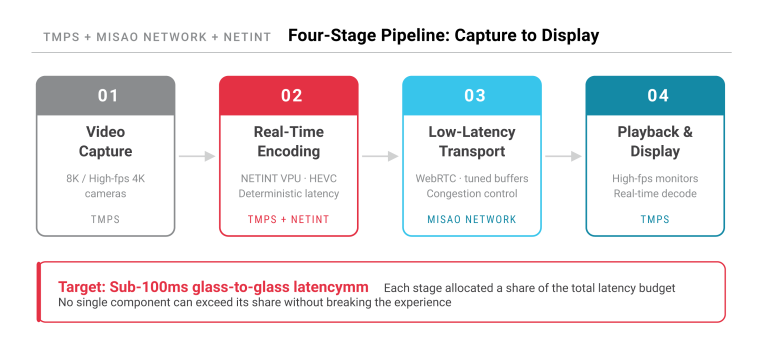
Exhibit 1: The four-stage pipeline from capture to display, with each partner contributing specialized capability
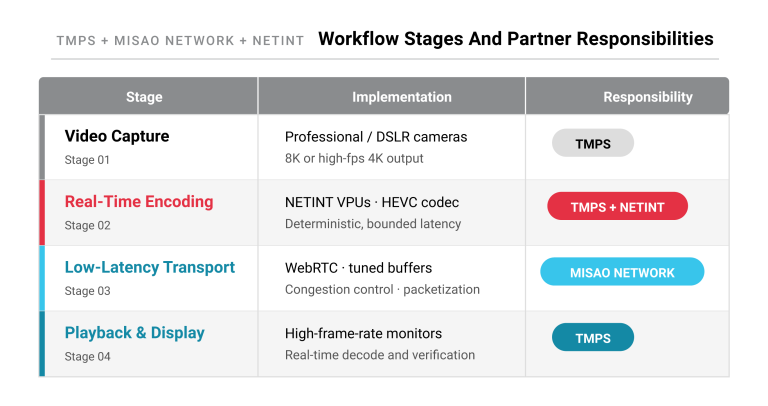
In the first stage, high-resolution video is captured using professional or DSLR-class cameras capable of 8K or high-frame-rate 4K output, depending on the desired configuration. The captured signal is passed directly to NETINT VPUs for real-time HEVC encoding. The encoded bitstream is then handed to Misao Network’s WebRTC transport layer, which handles packetization, buffer management, congestion control, and delivery. Finally, the stream is decoded and displayed on high-frame-rate monitors where viewers can observe motion smoothness, responsiveness, and image detail.
Each stage was designed with a specific latency allocation. The total budget of sub-100 milliseconds glass-to-glass meant that no single stage could consume more than its share without breaking the entire experience.
Why VPUs Were Critical to the Design
Encoding high-resolution, high-frame-rate video in real time introduces several risks in live environments. CPU-based software encoding, while flexible, produces variable encoding latency depending on content complexity, system load, and thermal conditions. A frame of simple content might encode in 8 milliseconds while a complex scene takes 30. That variability cascades downstream: the transport layer cannot optimize buffer sizes when the input timing is unpredictable, and the display stage cannot maintain smooth playback when frames arrive at irregular intervals.
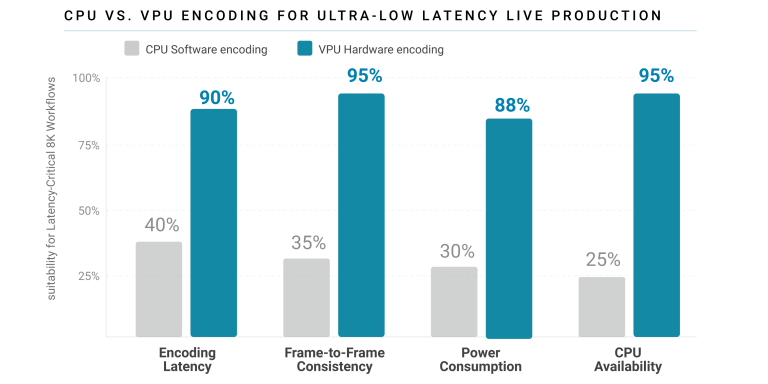
Exhibit 2: VPU hardware encoding outperforms CPU software encoding across every dimension critical to latency-sensitive workflows
NETINT VPUs addressed this challenge through three characteristics that proved essential to the workflow. First, deterministic encoding behavior: the hardware processes each frame in a consistent, bounded time regardless of content complexity, which is critical for latency budgeting. Second, high density per device, which reduced system complexity by eliminating the need for multi-server encoding clusters. Third, bounded power consumption, which was important for the live demonstration environments where the system needed to operate for extended periods without thermal throttling.
By isolating video processing onto dedicated hardware, TMPS was able to focus on transport and workflow optimization without compensating for encoder variability. The VPU became the fixed, predictable element in the pipeline that allowed everything else to be tuned around it.
THE BIGGER PICTURE
In latency-critical systems, predictability is more valuable than peak performance. A slower encoder that delivers every frame in exactly 10 milliseconds is more useful than a faster one that averages 8 milliseconds but occasionally spikes to 25. The TMPS workflow depended on this consistency to maintain its sub-100 ms target across sustained operation.
WebRTC Optimization: Misao Network’s Transport Layer
Misao Network’s contribution focused on the transport problem: how to move a high-bitrate encoded stream from encoder to decoder with minimal added delay. WebRTC was selected as the transport protocol because of its native support for real-time delivery, built-in congestion control, and sub-second latency characteristics. But pushing WebRTC to handle 8K video at production quality required significant optimization beyond its standard configuration.
The key areas of tuning included codec and packetization choices suitable for the high bitrates that 8K HEVC generates, buffer sizes reduced to minimize end-to-end delay without introducing jitter artifacts, jitter and network variability management that maintained visual quality under real-world conditions, and bitrate strategies balanced against WebRTC’s congestion control algorithms, which are designed for conversational video and needed adaptation for high-resolution production streams.
The combination of predictable encoding latency from the VPUs and carefully tuned WebRTC transport produced what the team described as a ‘mirror-like’ viewing experience, where motion on screen appeared immediate rather than delayed. This responsiveness was directly observable during the public demonstrations: viewers could see camera movement reflected on the display monitors with no perceptible lag.
The Latency Budget: Where Every Millisecond Went
Achieving sub-100 millisecond glass-to-glass latency required a disciplined approach to latency allocation across every stage of the pipeline. In traditional streaming architectures, latency accumulates through encoding buffers, segmentation delays, CDN propagation, and player buffering, with each stage adding hundreds of milliseconds or more. The TMPS workflow eliminated most of these sources by replacing segment-based delivery with frame-level WebRTC transport and replacing variable CPU encoding with deterministic VPU processing.
Illustrative Latency Budget: Traditional vs. Optimized Pipeline
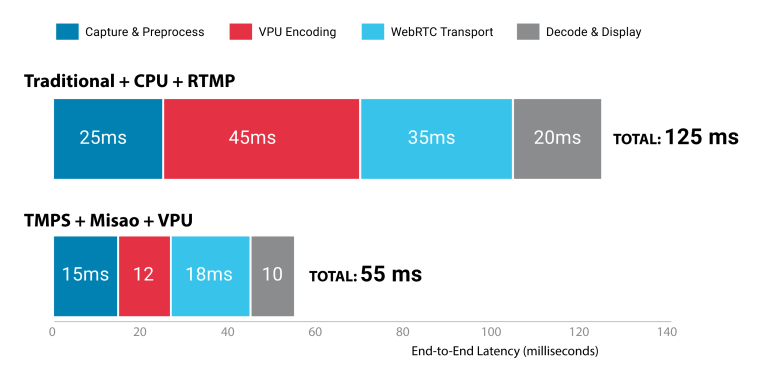
Exhibit 3: Illustrative latency breakdown comparing a traditional pipeline with the optimized TMPS + Misao + NETINT workflow
The practical implication is significant. Traditional live streaming protocols like HLS typically operate with 6 to 30 seconds of end-to-end latency. Low-latency HLS reduces this to 2 to 5 seconds. Standard WebRTC for conversational video achieves 200 to 500 milliseconds. The TMPS workflow targeted a range below even standard WebRTC, pushing into territory typically associated with dedicated hardware video links rather than software-based streaming systems.
Demonstration Results and Practical Lessons
During public demonstrations, the system achieved visually smooth playback at high resolution, extremely low perceived latency, and stable operation over extended demonstration periods. The specific resolution and frame rate varied based on display availability and venue constraints, but the underlying workflow proved adaptable across configurations without requiring fundamental redesign. Several practical lessons emerged from the project that carry implications beyond this specific workflow.
- Display technology matters more than expected. Monitor refresh rate and HDMI capabilities meaningfully affected perceived latency. The team discovered that display-side bottlenecks could undermine encoding and transport optimizations if not addressed, reinforcing the importance of treating the entire pipeline as a single system.
- Predictability beats peak performance. Consistent behavior under sustained load proved more valuable than headline throughput numbers. A system that maintained stable latency for eight hours of continuous demonstration was more useful than one that achieved lower latency in short bursts but degraded over time.
- Live environments amplify complexity. Hardware stability and simplicity reduced operational risk during public showcases. Every additional component in the signal chain represented both a potential failure point and a potential latency contribution. The team’s decision to use VPUs rather than multi-server CPU encoding clusters eliminated an entire category of operational complexity.
KEY INSIGHTThe workflow was designed to be adaptable. Rather than optimizing for a single fixed configuration, the architecture allowed the team to adjust resolution, frame rate, and encoding parameters to match venue conditions without rebuilding the system.
What This Workflow Demonstrates
The TMPS and Misao Network collaboration demonstrates that ultra-low-latency, high-resolution video delivery is achievable when encoding, transport, and operational constraints are treated as a single integrated system. By combining WebRTC expertise from Misao Network with dedicated video-processing hardware from NETINT, the team was able to push resolution and frame rate boundaries while maintaining the responsiveness required for live demonstrations and production-adjacent use cases.
The project also illustrates a broader shift in how professional video workflows are being constructed. Rather than relying on monolithic, proprietary solutions, the team assembled a pipeline from specialized components: purpose-built encoding silicon, optimized transport software, and careful system integration. Each component does what it does best, and the system’s performance emerges from how those components interact rather than from any single technology alone.
For organizations exploring real-time video delivery at high resolution, the TMPS workflow offers a practical reference architecture. The encoding predictability of VPUs, the latency characteristics of tuned WebRTC transport, and the systems integration expertise to bring them together represent a template that extends well beyond trade show demonstrations into live production, remote collaboration, and interactive broadcast.