What 286 video professionals revealed about the decisions reshaping streaming infrastructure in 2026
Four Archetypes, Four Different Conversations
The report’s archetype analysis reveals something the broader trend data can easily obscure. The market does not move as one. Statistical clustering surfaces four distinct buyer profiles:
- Methodical Evaluators (37%)
- Scale Operators (26%)
- Agile Innovators (24%)
- Precision Engineers (13%)
Each operates with fundamentally different constraints, evaluation requirements, and strategic priorities.
Precision Engineers, for example, track the most TCO factors, show the highest AI expansion intent, and prioritize latency at significantly higher rates. Methodical Evaluators, the largest segment, show the widest gap between stated priorities and actual measurement capability.
These are not small variations. They fundamentally shape how technology decisions are made. One segment stands out for its disproportionate influence on the market: Precision Engineers.
At just 12.9% of the market, this group, which includes live sports, betting, and mission-critical broadcast environments, consistently leads in areas that shape the industry’s direction. They show the highest AI/ML expansion intent at 78.8%, alongside advanced adoption patterns across FPGA, VVC evaluation, and edge-side capabilities.
What differentiates this segment is not just technical sophistication, but decision impact. These organizations tend to build or operate hybrid infrastructure models rather than relying on fully outsourced approaches, and they track a broader set of TCO variables than any other group.
Precision Engineers: Small in Number, Large in Influence
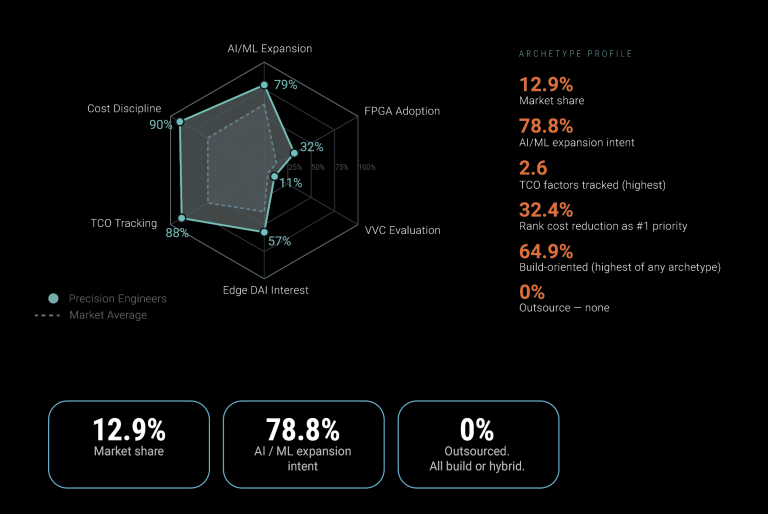
In practice, they function as lighthouse customers. Their infrastructure decisions are closely watched and inform how the rest of the market evaluates new technologies. Winning in this segment does more than drive adoption. It helps define the category narrative.
AV1 is No Longer a Horizon, it’s a Decision Point
At 17% production deployment today, AV1 might look like a codec in the wings. At first glance, the numbers suggest early adoption. The reality tells a different story.
Forty percent of respondents plan to deploy AV1 in 2026, representing a 231% planned growth rate, the highest of any codec in the survey. By year-end, AV1 is projected to reach 57% combined reach across the market. This is the most significant codec transition since H.264 established dominance.
HEVC remains the current-generation workhorse at 65% production deployment, but AV1’s royalty-free model removes the licensing friction that has slowed VVC’s parallel ambitions. The codec progression ladder is also becoming clearer. Organizations already operating more advanced stacks are significantly more likely to adopt AV1, making current architecture a strong predictor of what comes next.
The strategic implication is less about adoption and more about timing. Organizations without an AV1 roadmap by mid-2026 risk falling behind the industry’s bandwidth efficiency curve at exactly the moment when CDN cost reduction has become a top three executive priority.
Codec Adoption Trajectory
Production deployment vs 2026 combined reach
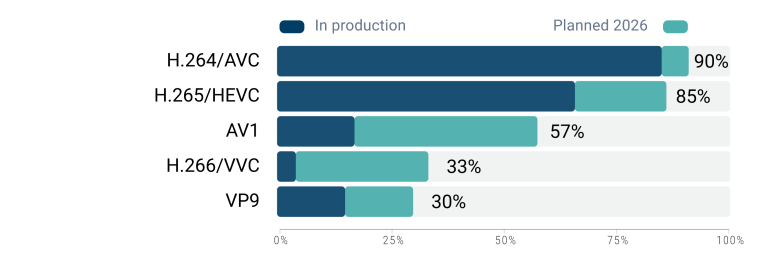
Figure 2.1: Codec adoption and planned deployment (see page 7)
GPU Dominance is Real, but Fragile
GPUs command 72% adoption in hardware acceleration, driven primarily by NVIDIA’s NVENC ecosystem.
But the survey reveals a market in active reconsideration.
GPU-specific friction is mounting on three fronts: power consumption (39%), codec and feature gaps (37%), and insufficient stream density (35%)
Meanwhile, alternatives are no longer theoretical. VPU and ASIC solutions have reached 32% adoption, and 49% of respondents plan to evaluate VPUs in 2026. GPU evaluation intent sits at 53.6%. VPU evaluation intent sits at 51.5%. That near-parity has not appeared in previous cycles.
The shift is subtle but important. This is not a story of GPU replacement. It is a move toward workload specialization, where different hardware types are matched to different encoding demands.
The organizations best positioned for the next 18 months are not those doubling down on a single platform, but those already building flexible, workload-aware infrastructure.
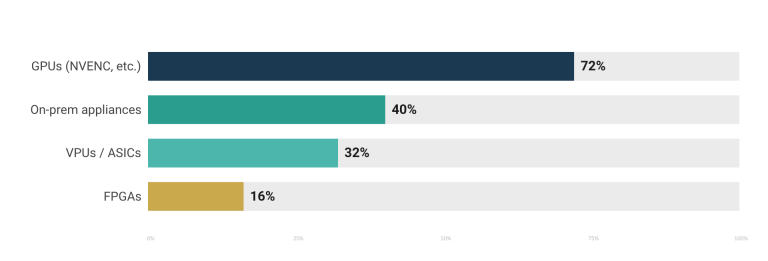
Figure 2.5 Hardware acceleration adoption (see page 9)
AI is No Longer Your R&D Team’s Problem
Sixty percent of respondents currently deploy AI/ML in at least one encoding workflow. Seventy percent plan to expand those capabilities in 2026. This isn’t fringe experimentation. It’s infrastructure migration.
The growth trajectory reveals the real shift. Early AI applications in encoding, such as transcription and scene classification, sat adjacent to the pipeline. The fastest-growing applications in 2026 are moving inside it.
Content-aware ladder generation is projected to grow by 77%. QoE prediction by 50%. Noise reduction and enhancement continue to expand across both live and VOD workflows.
This marks a transition from AI as a supporting tool to AI as core encoding intelligence.
What makes this shift more relevant is where it is happening. AI expansion correlates with operational scale, not company size. High-volume encoding environments are significantly more likely to invest in AI, regardless of headcount. In practice, this means even lean teams are using AI to compensate for limited resources.
The implication is clear. AI is no longer a differentiator. It is becoming a baseline expectation in how encoding systems are evaluated and deployed.
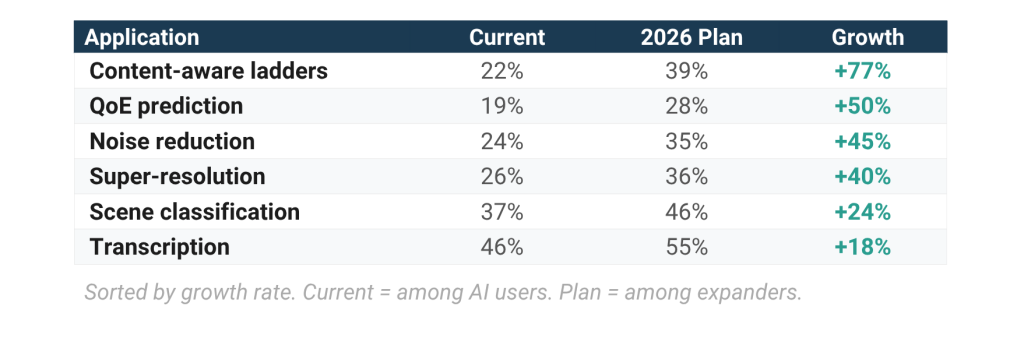
Figure 2.10: AI/ML application growth trajectory (see page 12)
Cost and Quality Are Converging, Not Competing
Perhaps the most category-defining finding in the entire report is how organizations now approach tradeoffs.
Forty-five percent of respondents rank quality-of-experience improvement as a top 2026 priority. Meanwhile, 37 to 38% are targeting encoding OPEX and CDN cost reduction
These priorities are no longer sequential. They are pursued simultaneously.
The era of choosing between cost and quality is ending. Organizations are no longer asking which one to optimize. They are demanding both, from the same system, at the same time.
The organizations building durable infrastructure advantages in 2026 are those that have stopped treating these as opposing forces and started designing workflows where improvements in one reinforce the other.
The Full Picture Is in the Report
This post captures the signals that matter most, but the full report goes deeper across every dimension: codec adoption barriers, hardware trade-offs, AI integration patterns, and archetype-specific strategies.
If you are making encoding infrastructure decisions in 2026, this is the data your roadmap should be built on.
Download the full 2026 State of Video Encoding Report.