Encoding Efficiency, Power, and Resilience in Streaming Infrastructure

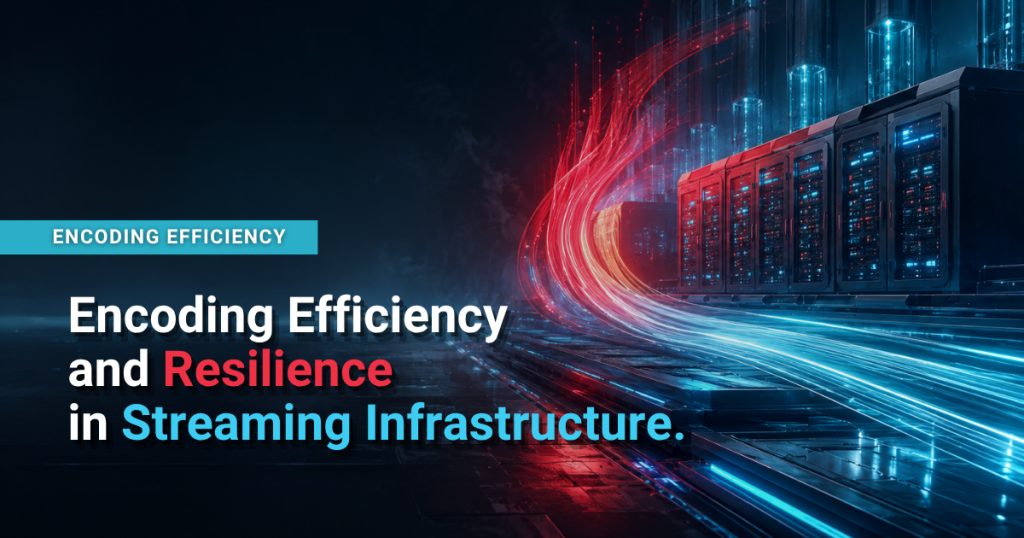
Server racks with red and blue data streams flowing through a data center, representing encoding efficiency and resilience in streaming infrastructure.

Watts per useful stream is not merely a sustainability metric. It determines how much capacity, redundancy, and growth can fit inside a fixed infrastructure envelope.

SERIES: STREAMING ARCHITECTURE & ENCODING EFFICIENCY

AT A GLANCE

Power efficiency in streaming infrastructure is about far more than lowering electricity costs. The amount of power consumed per delivered video stream directly influences rack density, cooling requirements, redundancy, edge deployments, and the long-term scalability of a streaming platform.

This article explains why watts per stream is a more meaningful metric than processor power alone, how encoding efficiency improves resilience and infrastructure planning, and why power, density, and operational reliability should be evaluated together when designing modern video workflows.

Power efficiency is often discussed as a way to reduce an electricity bill. In streaming infrastructure, that is only the first-order effect. Power also limits rack density, cooling, backup runtime, edge deployment, and the amount of redundant capacity that can remain online.

The useful metric is therefore not the nameplate power of a processor or server. It is watts per delivered workload: per channel, rendition, adaptive ladder, or completed transcode profile at the required quality and latency.

Component power can mislead

A low-power device is not automatically an efficient system. It may require a large host, repeated frame transfers, or several devices to complete the workload. Conversely, a server with a higher total draw may be more efficient if it replaces many lower-density systems.

NETINT’s published specifications illustrate the distinction. A Quadra T1U is rated at a typical 17 watts and up to 32 1080p30 encodes. The complete 1RU Quadra Video Server, which contains ten T1U VPUs, is rated at approximately 500 watts and up to 320 1080p30 encodes.[1]

At those maximum ratings, the VPU-only ratio is about 0.53 watts per 1080p30 encode, while the complete-server ratio is about 1.56 watts. The second figure is more useful for infrastructure planning because it includes the host. Neither is a production guarantee, and both will change with codec, frame rate, quality tools, and actual utilization. The calculation demonstrates why boundaries must be stated when watts-per-stream claims are compared.

Nameplate watts mislead. Watts per useful stream do no.

Lower is better - power per delivered 1080p30 encode.
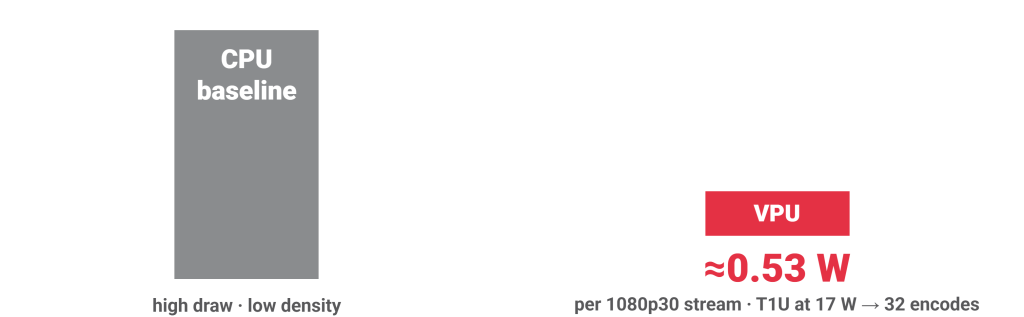
Comparison of CPU baseline high power consumption versus VPU low watts per stream, highlighting improved efficiency and density.

A low-power device is not automatically an efficient system, measure the delivered workload.
NETINT Technologies – Quadra product specifications.

Density changes the facility footprint

Higher stream density reduces more than server count. It reduces power supplies, network ports, cables, boot devices, fans, management controllers, spares, and the number of operating-system instances that require patching and monitoring. It can also improve rack utilization by leaving physical space and electrical capacity available for growth.

This is especially important for 24/7 live workloads. A batch cluster can power down or release instances when a job completes. A live channel maintains steady demand and usually carries reserved failover capacity. Small differences in watts per stream compound across every hour of the year.

Power becomes heat

Nearly all electrical energy consumed by processing equipment ultimately becomes heat inside the facility. The cooling system must remove it. A lower-power media tier reduces both the direct compute load and the secondary cooling burden. The facility benefit depends on its design and efficiency, but the direction is unavoidable: less electrical load produces less heat to manage.

Thermal margin also affects reliability. Dense systems that operate close to cooling limits are more exposed to throttling, fan failures, clogged airflow paths, and hot spots. Efficient processing does not eliminate these risks, but it creates more room to manage them.

Redundancy competes for the same power envelope

Resilience architectures are easy to draw and expensive to energize. Active-active processing, N+1 nodes, spare ladder capacity, and geographic failover all consume real power. If the primary encode tier fills the available electrical envelope, redundant capacity may exist in procurement plans but not in a state that can be powered and cooled continuously.

Lower watts per stream allow more reserve capacity within the same limit. During a facility or utility event, a lower load also reduces demand on uninterruptible power supplies and generators. The exact runtime benefit depends on battery capacity, conversion losses, and the rest of the site load, but reducing the encode tier’s demand increases the options available to the operator.

The power envelope is fixed. Efficiency decides what fits inside it.
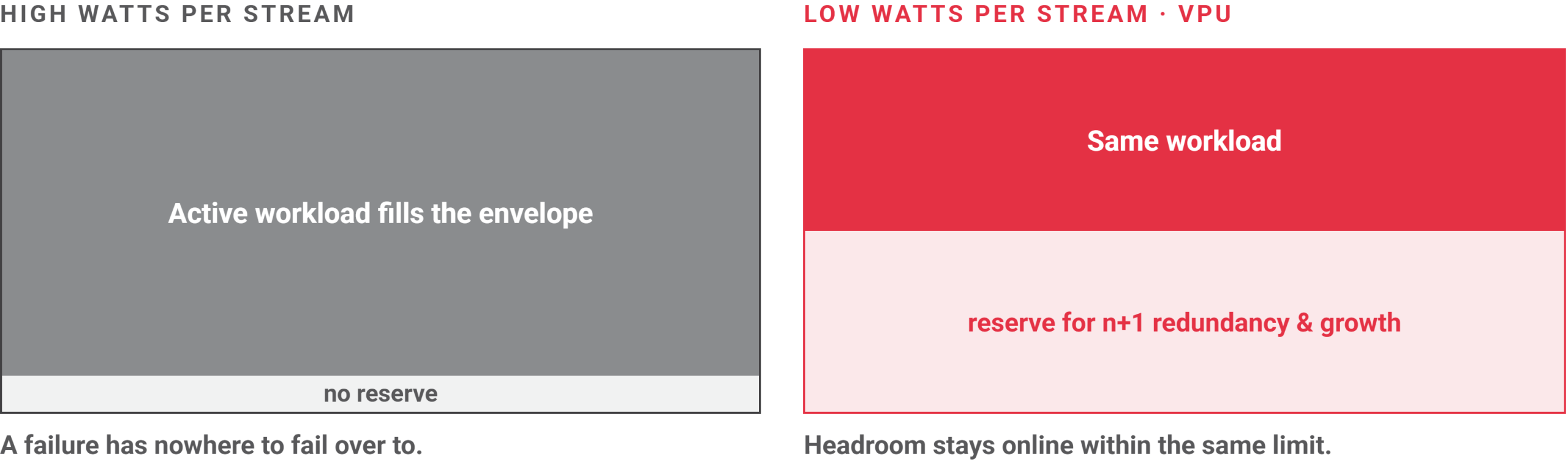
Comparison of power usage per stream showing CPU with no reserve capacity versus VPU with headroom for redundancy and growth.

Power also limits cooling, backup runtime, and redundant capacity.
Source: NETINT Technologies — Quadra product specifications..

Edge sites make the constraint visible

Regional and edge locations usually have less space, power, cooling, and hands-on support than central data centers. NETINT’s Quadra Mini Server is specified at 138 watts with up to 20 1080p30 or five 4Kp30 encodes in a half-rack-width, 1RU system.[1] That type of density can make local contribution, event processing, or regional stream preparation feasible where a conventional multi-server deployment would be impractical.

The edge case also exposes the value of operational simplicity. Fewer systems mean fewer failure points and less remote maintenance, provided the remaining system is monitored and protected appropriately. Density concentrates capacity, so redundancy and replacement procedures must be designed rather than assumed.

Cloud pricing still reflects physical efficiency

Cloud users may see instance hours rather than kilowatts, but the underlying economics do not disappear. Providers price hardware, power, cooling, utilization risk, and operations into the service. General-purpose instances are valuable for burst and uncertainty. Steady-state video workloads should be compared against purpose-built instances or owned capacity using cost per delivered profile, not the hourly price of an isolated machine.

Use a defensible measurement method

A credible power comparison should define the measurement boundary, workload, and service target. Measure power at the server or rack input when possible. Record the number of valid outputs, codec, resolution, frame rate, bit depth, encoder settings, filters, and utilization. Include host overhead and report whether redundancy is active. Do not divide maximum stream capacity by idle power or compare a tuned hardware path with an untuned software default.

Power-efficient encoding is therefore not a separate sustainability project. It is a capacity and resilience strategy. The architecture that produces more compliant video within a fixed electrical and thermal envelope gives the operator more room for growth, failover, and geographic distribution. Watts per stream belongs beside bitrate, quality, and latency in every serious encoding review.

Technical sources

[1] NETINT, Quadra Product Line Specifications: https://info.netint.com/hubfs/TechnicalSpec/Quadra-T1-T2-T4_TechSpec.pdf

[2] NETINT, Quadra Video Server product page: https://netint.com/products/quadra-video-server/

[3] NETINT, Quadra Mini Server product page: https://netint.com/products/quadra-mini-server/

STREAMING ARCHITECTURE & ENCODING EFFICIENCY | Stockholm Technical Series 

NETINT and SCALSTRM brought together video engineering and infrastructure professionals in Stockholm for a practical discussion on encoding efficiency, hardware acceleration, cost, power, and live workflow design. This article series captures the key technical themes from the event, from silicon architecture and CPU vs VPU performance to FFmpeg integration and carrier-grade live workflows. 

    1. Encoding Efficiency Is Becoming an Infrastructure Decision (What We Learned in Stockholm) 
    2. Stop Asking Which Encoder. Start Asking Which Silicon. 
    3. How Video Encoding Actually Runs
    4. VPU Migration Without Rebuilding Your Video Pipeline
    5. From libx265 to h265_ni_quadra_enc
    6. From VPU Acceleration to Carrier-Grade Live Workflows
    7. Encoding Efficiency, Power, and Resilience in Nordic Streaming Infrastructure 

Encoding Efficiency, Power, and Resilience in Streaming Infrastructure

Learn how encoding efficiency improves power use, resilience, rack density, and streaming infrastructure while reducing watts per stream.

Server racks with red and blue data streams flowing through a data center, representing encoding efficiency and resilience in streaming infrastructure.

Watts per useful stream is not merely a sustainability metric. It determines how much capacity, redundancy, and growth can fit inside a fixed infrastructure envelope.

SERIES: STREAMING ARCHITECTURE & ENCODING EFFICIENCY

AT A GLANCE

Power efficiency in streaming infrastructure is about far more than lowering electricity costs. The amount of power consumed per delivered video stream directly influences rack density, cooling requirements, redundancy, edge deployments, and the long-term scalability of a streaming platform.

This article explains why watts per stream is a more meaningful metric than processor power alone, how encoding efficiency improves resilience and infrastructure planning, and why power, density, and operational reliability should be evaluated together when designing modern video workflows.

Power efficiency is often discussed as a way to reduce an electricity bill. In streaming infrastructure, that is only the first-order effect. Power also limits rack density, cooling, backup runtime, edge deployment, and the amount of redundant capacity that can remain online.

The useful metric is therefore not the nameplate power of a processor or server. It is watts per delivered workload: per channel, rendition, adaptive ladder, or completed transcode profile at the required quality and latency.

Component power can mislead

A low-power device is not automatically an efficient system. It may require a large host, repeated frame transfers, or several devices to complete the workload. Conversely, a server with a higher total draw may be more efficient if it replaces many lower-density systems.

NETINT’s published specifications illustrate the distinction. A Quadra T1U is rated at a typical 17 watts and up to 32 1080p30 encodes. The complete 1RU Quadra Video Server, which contains ten T1U VPUs, is rated at approximately 500 watts and up to 320 1080p30 encodes.[1]

At those maximum ratings, the VPU-only ratio is about 0.53 watts per 1080p30 encode, while the complete-server ratio is about 1.56 watts. The second figure is more useful for infrastructure planning because it includes the host. Neither is a production guarantee, and both will change with codec, frame rate, quality tools, and actual utilization. The calculation demonstrates why boundaries must be stated when watts-per-stream claims are compared.

Nameplate watts mislead. Watts per useful stream do no.

Lower is better - power per delivered 1080p30 encode.
Comparison of CPU baseline high power consumption versus VPU low watts per stream, highlighting improved efficiency and density.

A low-power device is not automatically an efficient system, measure the delivered workload.
NETINT Technologies – Quadra product specifications.

Density changes the facility footprint

Higher stream density reduces more than server count. It reduces power supplies, network ports, cables, boot devices, fans, management controllers, spares, and the number of operating-system instances that require patching and monitoring. It can also improve rack utilization by leaving physical space and electrical capacity available for growth.

This is especially important for 24/7 live workloads. A batch cluster can power down or release instances when a job completes. A live channel maintains steady demand and usually carries reserved failover capacity. Small differences in watts per stream compound across every hour of the year.

Power becomes heat

Nearly all electrical energy consumed by processing equipment ultimately becomes heat inside the facility. The cooling system must remove it. A lower-power media tier reduces both the direct compute load and the secondary cooling burden. The facility benefit depends on its design and efficiency, but the direction is unavoidable: less electrical load produces less heat to manage.

Thermal margin also affects reliability. Dense systems that operate close to cooling limits are more exposed to throttling, fan failures, clogged airflow paths, and hot spots. Efficient processing does not eliminate these risks, but it creates more room to manage them.

Redundancy competes for the same power envelope

Resilience architectures are easy to draw and expensive to energize. Active-active processing, N+1 nodes, spare ladder capacity, and geographic failover all consume real power. If the primary encode tier fills the available electrical envelope, redundant capacity may exist in procurement plans but not in a state that can be powered and cooled continuously.

Lower watts per stream allow more reserve capacity within the same limit. During a facility or utility event, a lower load also reduces demand on uninterruptible power supplies and generators. The exact runtime benefit depends on battery capacity, conversion losses, and the rest of the site load, but reducing the encode tier’s demand increases the options available to the operator.

The power envelope is fixed. Efficiency decides what fits inside it.

Comparison of power usage per stream showing CPU with no reserve capacity versus VPU with headroom for redundancy and growth.

Power also limits cooling, backup runtime, and redundant capacity.
Source: NETINT Technologies — Quadra product specifications..

Edge sites make the constraint visible

Regional and edge locations usually have less space, power, cooling, and hands-on support than central data centers. NETINT’s Quadra Mini Server is specified at 138 watts with up to 20 1080p30 or five 4Kp30 encodes in a half-rack-width, 1RU system.[1] That type of density can make local contribution, event processing, or regional stream preparation feasible where a conventional multi-server deployment would be impractical.

The edge case also exposes the value of operational simplicity. Fewer systems mean fewer failure points and less remote maintenance, provided the remaining system is monitored and protected appropriately. Density concentrates capacity, so redundancy and replacement procedures must be designed rather than assumed.

Cloud pricing still reflects physical efficiency

Cloud users may see instance hours rather than kilowatts, but the underlying economics do not disappear. Providers price hardware, power, cooling, utilization risk, and operations into the service. General-purpose instances are valuable for burst and uncertainty. Steady-state video workloads should be compared against purpose-built instances or owned capacity using cost per delivered profile, not the hourly price of an isolated machine.

Use a defensible measurement method

A credible power comparison should define the measurement boundary, workload, and service target. Measure power at the server or rack input when possible. Record the number of valid outputs, codec, resolution, frame rate, bit depth, encoder settings, filters, and utilization. Include host overhead and report whether redundancy is active. Do not divide maximum stream capacity by idle power or compare a tuned hardware path with an untuned software default.

Power-efficient encoding is therefore not a separate sustainability project. It is a capacity and resilience strategy. The architecture that produces more compliant video within a fixed electrical and thermal envelope gives the operator more room for growth, failover, and geographic distribution. Watts per stream belongs beside bitrate, quality, and latency in every serious encoding review.

Technical sources

[1] NETINT, Quadra Product Line Specifications: https://info.netint.com/hubfs/TechnicalSpec/Quadra-T1-T2-T4_TechSpec.pdf

[2] NETINT, Quadra Video Server product page: https://netint.com/products/quadra-video-server/

[3] NETINT, Quadra Mini Server product page: https://netint.com/products/quadra-mini-server/

STREAMING ARCHITECTURE & ENCODING EFFICIENCY | Stockholm Technical Series 

NETINT and SCALSTRM brought together video engineering and infrastructure professionals in Stockholm for a practical discussion on encoding efficiency, hardware acceleration, cost, power, and live workflow design. This article series captures the key technical themes from the event, from silicon architecture and CPU vs VPU performance to FFmpeg integration and carrier-grade live workflows. 

    1. Encoding Efficiency Is Becoming an Infrastructure Decision (What We Learned in Stockholm) 
    2. Stop Asking Which Encoder. Start Asking Which Silicon. 
    3. How Video Encoding Actually Runs
    4. VPU Migration Without Rebuilding Your Video Pipeline
    5. From libx265 to h265_ni_quadra_enc
    6. From VPU Acceleration to Carrier-Grade Live Workflows
    7. Encoding Efficiency, Power, and Resilience in Nordic Streaming Infrastructure