From VPU Acceleration to Carrier-Grade Live Workflows

Futuristic data center with glowing blue data streams illustrating high-speed video processing, with headline “From VPU Acceleration to Carrier-Grade Live Workflows.”

A VPU supplies efficient media processing. A control plane turns that capacity into a live service that can survive imperfect inputs, variable demand, and downstream failures.

SERIES: STREAMING ARCHITECTURE & ENCODING EFFICIENCY

AT A GLANCE

Building a carrier-grade live streaming service requires more than high-performance video processing. Reliable live workflows depend on orchestration, monitoring, packaging, and recovery mechanisms that keep channels running when production conditions become unpredictable.

This article explains how VPU acceleration, a control plane, and workflow orchestration work together to improve scalability, resilience, and operational reliability in modern live streaming environments.

A clean input and a short test window can make almost any live transcode look reliable. Production channels are judged by what happens when conditions become imperfect: timing drifts, a source changes, frames arrive late, audio becomes irregular, a packager slows, or a node reaches capacity.

This is why acceleration is necessary but insufficient. A VPU provides the media engine. Carrier-grade operation depends on the software around it: ingest control, scheduling, frame handling, packaging, observability, failure isolation, backpressure, redundancy, and recovery.

The VPU is the media plane

Purpose-built hardware is most valuable when it carries the repetitive work that benefits from deterministic execution: decode, scale, encode, and related frame processing. Capacity can be described in sessions and video profiles rather than inferred from spare CPU cycles.

The host and application remain responsible for everything that changes frequently. They create and place sessions, apply policy, select profiles, handle metadata, expose APIs, and decide what to do when the pipeline cannot proceed normally. This separation preserves software agility while reducing contention in the media path.

A media plane for the repetitive work, a control plane for everything that changes.
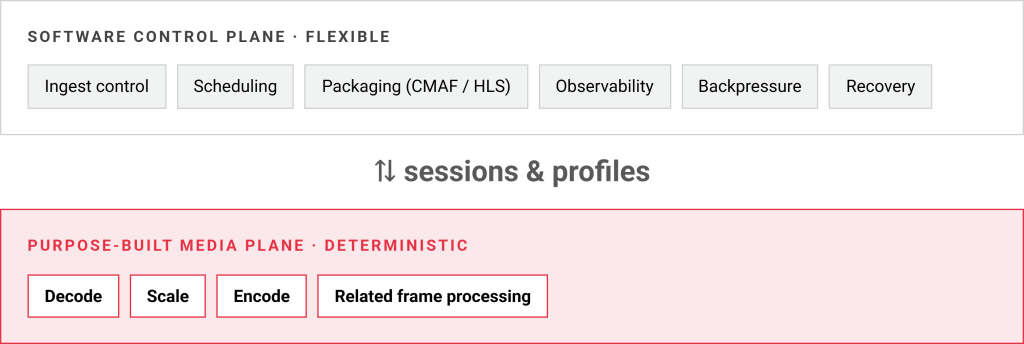
Diagram comparing a flexible software control plane (ingest control, scheduling, packaging, observability, backpressure, recovery) with a deterministic media plane (decode, scale, encode, frame processing).

Acceleration is necessary but insufficient – the software around the engine makes it carrier-grade.
NETINT Technologies — Streaming Tech Sweden 2026.

The control plane coordinates the whole pipeline

Modern video systems are not simple linear chains. Each stage can exert pressure on the next. A transcode node may be healthy while a packaging service is falling behind. An input can remain connected while timestamps become unusable. A device can continue accepting work while approaching its session limit.

NETINT’s control-plane analysis argues that orchestration must react to queue depth, available capacity, error rates, and downstream pressure.[1] In practice, that means scheduling workloads according to actual device state, preventing overcommitment, applying backpressure when downstream stages slow, and isolating failures before they cascade across channels.

Frame-level control protects continuity

Live inputs are not guaranteed to be clean. They can contain repeated or missing frames, discontinuities, interlaced material, format changes, or source-specific timing behavior. A workflow layer needs enough frame awareness to detect and respond to these conditions before they become visible outages.

The response may be to repair timing, insert a slate, hold or duplicate a frame, switch to a redundant feed, or degrade the output ladder temporarily. The correct action depends on service policy. The VPU should process the assigned frames efficiently; the control plane should decide which frames should be processed and how the service should behave when the input is wrong.

Packaging is part of reliability

Encoding does not complete the live service. Outputs must remain aligned across renditions, segmented correctly, timestamped consistently, and delivered to an origin or CDN without creating discontinuities. Packaging therefore belongs inside the operational model rather than being treated as a passive step after the encoder.

Scalstrm describes its live transcoding platform as integrated with its packager and CDN and able to use CPU, GPU, or dense VPU architectures.[2] That integration is significant because the scheduler can consider the complete path from media processing through delivery instead of optimizing one isolated component.

Audio, captions, and metadata remain first-class

Video acceleration does not remove the need to manage audio transcoding, channel mapping, loudness, captions, subtitles, SCTE-35 messages, DRM signaling, and other timed metadata. These elements must stay synchronized with the video outputs through source changes, failover, and packaging.

A carrier-grade workflow validates the complete program, not just the compressed video elementary stream. A stable picture with drifting audio or broken ad markers is still a failed service.

Operations need channel-level abstractions

Engineers may build the first path with FFmpeg or GStreamer, but operators should not have to rewrite a command for every channel. Production systems need templates, profiles, APIs, policy, versioned configuration, and role-based control. They also need a clear mapping from channel health to device state.

The operator should be able to answer three questions quickly: Is the channel healthy? If not, which stage is responsible? What action will the platform take next? Hardware counters without service context are insufficient, just as player alarms without infrastructure context are insufficient.

Resilience requires controlled degradation

No live system can eliminate failure. A robust system limits its scope. When capacity is constrained, the platform may reduce ladder complexity, postpone non-critical jobs, or move a channel to another node. When a packager slows, it should prevent upstream queues from growing without bound. When a device becomes unhealthy, it should stop receiving new sessions before existing services collapse.

These behaviors convert acceleration into reliability. They also protect the economic value of the VPU. Without scheduling and visibility, high-density hardware can become a concentrated failure domain. With orchestration, the same density becomes a pool of measurable capacity.

Vendor-reported operational results

Scalstrm reports that its Live Transcoding solution can reduce per-channel cost by 50 percent, server footprint by 75 percent, and power use by 80 percent.[2] These are supplier claims, not universal benchmarks. Operators should validate them against their channel profiles, redundancy model, and deployment environment.

Controlled degradation, not hard failure.
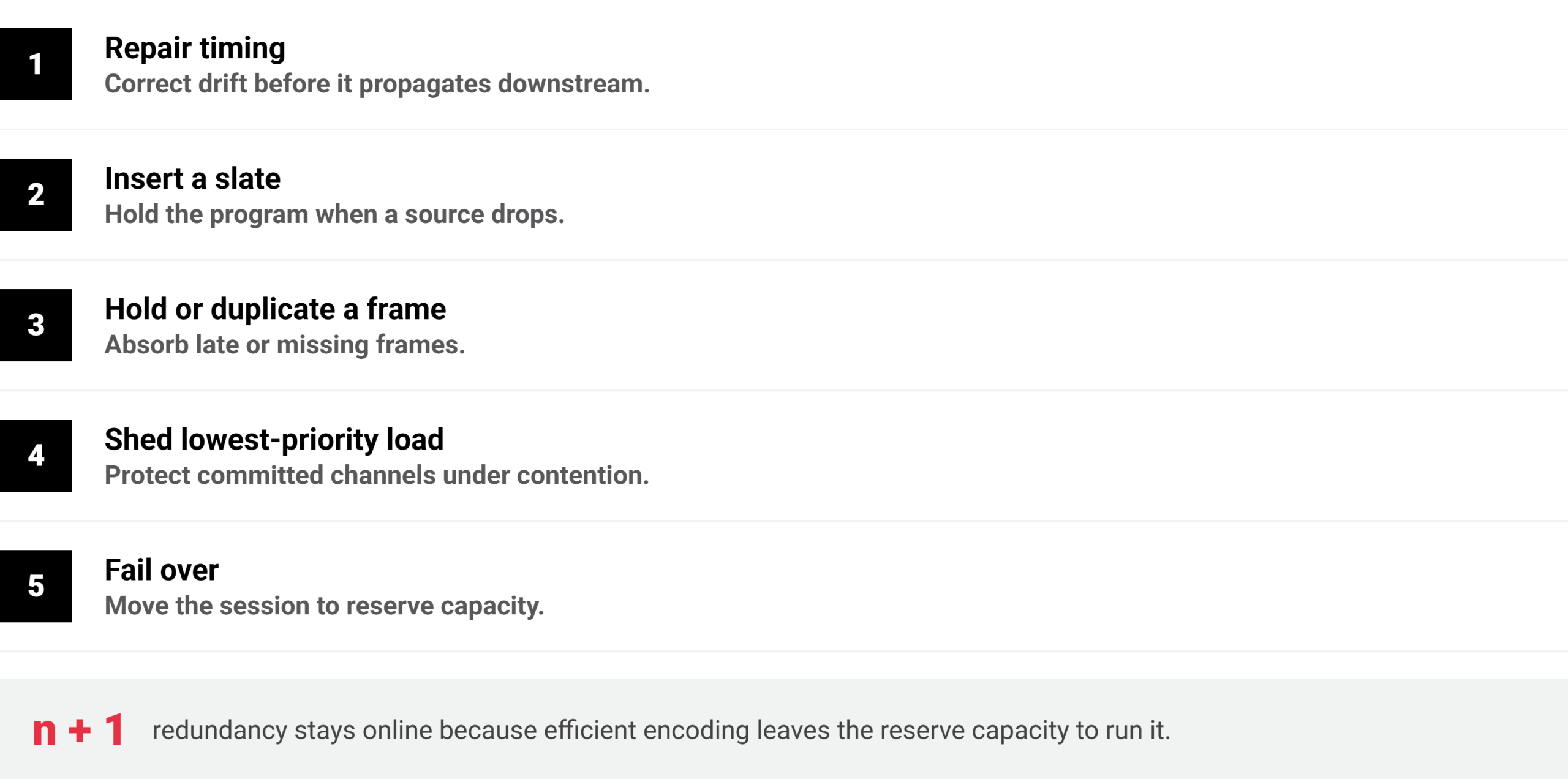
List of five video workflow resilience strategies: repair timing, insert a slate, hold or duplicate frames, shed low-priority load, and failover, with note on n+1 redundancy.

A robust system limits the scope of failure.
Source: NETINT Technologies — Streaming Tech Sweden 2026..

The architecture is a partnership between layers

Carrier-grade live streaming is not achieved by selecting the fastest encoder. It is achieved by assigning clear responsibilities. The VPU handles dense video processing. The control plane manages intent, capacity, and recovery. The workflow layer handles input conditions, audio, metadata, packaging, and delivery. Monitoring connects hardware state to channel outcomes.

Acceleration improves the engine. Orchestration determines whether the service remains predictable when production stops resembling the lab.

Add hardware scaling for an ABR ladder

NETINT’s programming guide provides a multi-output pattern that decodes once, keeps frames in hardware, splits them, scales selected branches, and feeds multiple encoders:

The precise ladder, muxing, audio mapping, and device allocation will differ in production. The architectural point is stable: decode once, minimize frame movement, generate the required sizes in the hardware path, and map each branch to an encoder on the intended device.

Technical sources

[1] NETINT, The Control Plane Imperative: Operating Video at Scale: https://netint.com/video-control-plane/

[2] Scalstrm, Transcoding product page: https://scalstrm.com/transcoding/

[3] NETINT, Quadra Product Line Specifications: https://info.netint.com/hubfs/TechnicalSpec/Quadra-T1-T2-T4_TechSpec.pdf

STREAMING ARCHITECTURE & ENCODING EFFICIENCY | Stockholm Technical Series 

NETINT and SCALSTRM brought together video engineering and infrastructure professionals in Stockholm for a practical discussion on encoding efficiency, hardware acceleration, cost, power, and live workflow design. This article series captures the key technical themes from the event, from silicon architecture and CPU vs VPU performance to FFmpeg integration and carrier-grade live workflows. 

    1. Encoding Efficiency Is Becoming an Infrastructure Decision (What We Learned in Stockholm) 
    2. Stop Asking Which Encoder. Start Asking Which Silicon. 
    3. How Video Encoding Actually Runs
    4. VPU Migration Without Rebuilding Your Video Pipeline
    5. From libx265 to h265_ni_quadra_enc
    6. From VPU Acceleration to Carrier-Grade Live Workflows
    7. Encoding Efficiency, Power, and Resilience in Nordic Streaming Infrastructure 
From VPU Acceleration to Carrier-Grade Live Workflows

Learn how carrier-grade live streaming combines VPU acceleration, video orchestration, and a control plane to improve reliability and scalability.

Futuristic data center with glowing blue data streams illustrating high-speed video processing, with headline “From VPU Acceleration to Carrier-Grade Live Workflows.”

A VPU supplies efficient media processing. A control plane turns that capacity into a live service that can survive imperfect inputs, variable demand, and downstream failures.

SERIES: STREAMING ARCHITECTURE & ENCODING EFFICIENCY

AT A GLANCE

Building a carrier-grade live streaming service requires more than high-performance video processing. Reliable live workflows depend on orchestration, monitoring, packaging, and recovery mechanisms that keep channels running when production conditions become unpredictable.

This article explains how VPU acceleration, a control plane, and workflow orchestration work together to improve scalability, resilience, and operational reliability in modern live streaming environments.

A clean input and a short test window can make almost any live transcode look reliable. Production channels are judged by what happens when conditions become imperfect: timing drifts, a source changes, frames arrive late, audio becomes irregular, a packager slows, or a node reaches capacity.

This is why acceleration is necessary but insufficient. A VPU provides the media engine. Carrier-grade operation depends on the software around it: ingest control, scheduling, frame handling, packaging, observability, failure isolation, backpressure, redundancy, and recovery.

The VPU is the media plane

Purpose-built hardware is most valuable when it carries the repetitive work that benefits from deterministic execution: decode, scale, encode, and related frame processing. Capacity can be described in sessions and video profiles rather than inferred from spare CPU cycles.

The host and application remain responsible for everything that changes frequently. They create and place sessions, apply policy, select profiles, handle metadata, expose APIs, and decide what to do when the pipeline cannot proceed normally. This separation preserves software agility while reducing contention in the media path.

A media plane for the repetitive work, a control plane for everything that changes.

Diagram comparing a flexible software control plane (ingest control, scheduling, packaging, observability, backpressure, recovery) with a deterministic media plane (decode, scale, encode, frame processing).

Acceleration is necessary but insufficient – the software around the engine makes it carrier-grade.
NETINT Technologies — Streaming Tech Sweden 2026.

The control plane coordinates the whole pipeline

Modern video systems are not simple linear chains. Each stage can exert pressure on the next. A transcode node may be healthy while a packaging service is falling behind. An input can remain connected while timestamps become unusable. A device can continue accepting work while approaching its session limit.

NETINT’s control-plane analysis argues that orchestration must react to queue depth, available capacity, error rates, and downstream pressure.[1] In practice, that means scheduling workloads according to actual device state, preventing overcommitment, applying backpressure when downstream stages slow, and isolating failures before they cascade across channels.

Frame-level control protects continuity

Live inputs are not guaranteed to be clean. They can contain repeated or missing frames, discontinuities, interlaced material, format changes, or source-specific timing behavior. A workflow layer needs enough frame awareness to detect and respond to these conditions before they become visible outages.

The response may be to repair timing, insert a slate, hold or duplicate a frame, switch to a redundant feed, or degrade the output ladder temporarily. The correct action depends on service policy. The VPU should process the assigned frames efficiently; the control plane should decide which frames should be processed and how the service should behave when the input is wrong.

Packaging is part of reliability

Encoding does not complete the live service. Outputs must remain aligned across renditions, segmented correctly, timestamped consistently, and delivered to an origin or CDN without creating discontinuities. Packaging therefore belongs inside the operational model rather than being treated as a passive step after the encoder.

Scalstrm describes its live transcoding platform as integrated with its packager and CDN and able to use CPU, GPU, or dense VPU architectures.[2] That integration is significant because the scheduler can consider the complete path from media processing through delivery instead of optimizing one isolated component.

Audio, captions, and metadata remain first-class

Video acceleration does not remove the need to manage audio transcoding, channel mapping, loudness, captions, subtitles, SCTE-35 messages, DRM signaling, and other timed metadata. These elements must stay synchronized with the video outputs through source changes, failover, and packaging.

A carrier-grade workflow validates the complete program, not just the compressed video elementary stream. A stable picture with drifting audio or broken ad markers is still a failed service.

Operations need channel-level abstractions

Engineers may build the first path with FFmpeg or GStreamer, but operators should not have to rewrite a command for every channel. Production systems need templates, profiles, APIs, policy, versioned configuration, and role-based control. They also need a clear mapping from channel health to device state.

The operator should be able to answer three questions quickly: Is the channel healthy? If not, which stage is responsible? What action will the platform take next? Hardware counters without service context are insufficient, just as player alarms without infrastructure context are insufficient.

Resilience requires controlled degradation

No live system can eliminate failure. A robust system limits its scope. When capacity is constrained, the platform may reduce ladder complexity, postpone non-critical jobs, or move a channel to another node. When a packager slows, it should prevent upstream queues from growing without bound. When a device becomes unhealthy, it should stop receiving new sessions before existing services collapse.

These behaviors convert acceleration into reliability. They also protect the economic value of the VPU. Without scheduling and visibility, high-density hardware can become a concentrated failure domain. With orchestration, the same density becomes a pool of measurable capacity.

Vendor-reported operational results

Scalstrm reports that its Live Transcoding solution can reduce per-channel cost by 50 percent, server footprint by 75 percent, and power use by 80 percent.[2] These are supplier claims, not universal benchmarks. Operators should validate them against their channel profiles, redundancy model, and deployment environment.

Controlled degradation, not hard failure.

List of five video workflow resilience strategies: repair timing, insert a slate, hold or duplicate frames, shed low-priority load, and failover, with note on n+1 redundancy.

A robust system limits the scope of failure.
Source: NETINT Technologies — Streaming Tech Sweden 2026..

The architecture is a partnership between layers

Carrier-grade live streaming is not achieved by selecting the fastest encoder. It is achieved by assigning clear responsibilities. The VPU handles dense video processing. The control plane manages intent, capacity, and recovery. The workflow layer handles input conditions, audio, metadata, packaging, and delivery. Monitoring connects hardware state to channel outcomes.

Acceleration improves the engine. Orchestration determines whether the service remains predictable when production stops resembling the lab.

Add hardware scaling for an ABR ladder

NETINT’s programming guide provides a multi-output pattern that decodes once, keeps frames in hardware, splits them, scales selected branches, and feeds multiple encoders:

The precise ladder, muxing, audio mapping, and device allocation will differ in production. The architectural point is stable: decode once, minimize frame movement, generate the required sizes in the hardware path, and map each branch to an encoder on the intended device.

Technical sources

[1] NETINT, The Control Plane Imperative: Operating Video at Scale: https://netint.com/video-control-plane/

[2] Scalstrm, Transcoding product page: https://scalstrm.com/transcoding/

[3] NETINT, Quadra Product Line Specifications: https://info.netint.com/hubfs/TechnicalSpec/Quadra-T1-T2-T4_TechSpec.pdf

STREAMING ARCHITECTURE & ENCODING EFFICIENCY | Stockholm Technical Series 

NETINT and SCALSTRM brought together video engineering and infrastructure professionals in Stockholm for a practical discussion on encoding efficiency, hardware acceleration, cost, power, and live workflow design. This article series captures the key technical themes from the event, from silicon architecture and CPU vs VPU performance to FFmpeg integration and carrier-grade live workflows. 

    1. Encoding Efficiency Is Becoming an Infrastructure Decision (What We Learned in Stockholm) 
    2. Stop Asking Which Encoder. Start Asking Which Silicon. 
    3. How Video Encoding Actually Runs
    4. VPU Migration Without Rebuilding Your Video Pipeline
    5. From libx265 to h265_ni_quadra_enc
    6. From VPU Acceleration to Carrier-Grade Live Workflows
    7. Encoding Efficiency, Power, and Resilience in Nordic Streaming Infrastructure