VPU-Powered Capacity as a Service

NETINT graphic titled “VPUaaS: VPU-Powered Capacity-as-a-Service,” set against a blue abstract digital infrastructure background with VPU Ecosystem IBC Edition branding.

Add encoding capacity without owning every server. When demand has a fixed date, time-to-capacity becomes the metric that matters most.

NETINT VPU ECOSYSTEM · IBC 2026

AT A GLANCE

Adding encoding capacity no longer requires purchasing, deploying, and operating every server. When live events, traffic spikes, or new regional launches demand immediate scalability, time-to-capacity becomes more important than infrastructure ownership.

This article explains how VPU Capacity as a Service enables organizations to access hosted encoding capacity through infrastructure partners, reducing deployment time while improving flexibility, efficiency, and scalability for modern video workflows.

Video engineers usually know they need more encoding capacity well before they know how they will get it. The workload is growing, the live calendar is fixed, the transcoding queue is lengthening, and the cloud bill is climbing. The business still needs capacity.

For some platforms, the practical answer is not to buy, rack, power, and operate more servers right away. It is to access the efficiency of NETINT VPUs through an infrastructure partner, without owning every layer of the deployment.

The real problem: capacity is needed before infrastructure is ready

Traditional planning assumes time. Time to approve budget, procure servers, install and validate them, secure power and space, and integrate everything into the workflow. Video does not always wait for that sequence.

Live events happen on fixed dates. Channels launch, traffic spikes, regions change, and a CPU-based pipeline reaches its limit. When that happens, the question becomes direct: how do we add capacity now, without turning it into a full infrastructure project?

The live data does not move. The build schedule does.
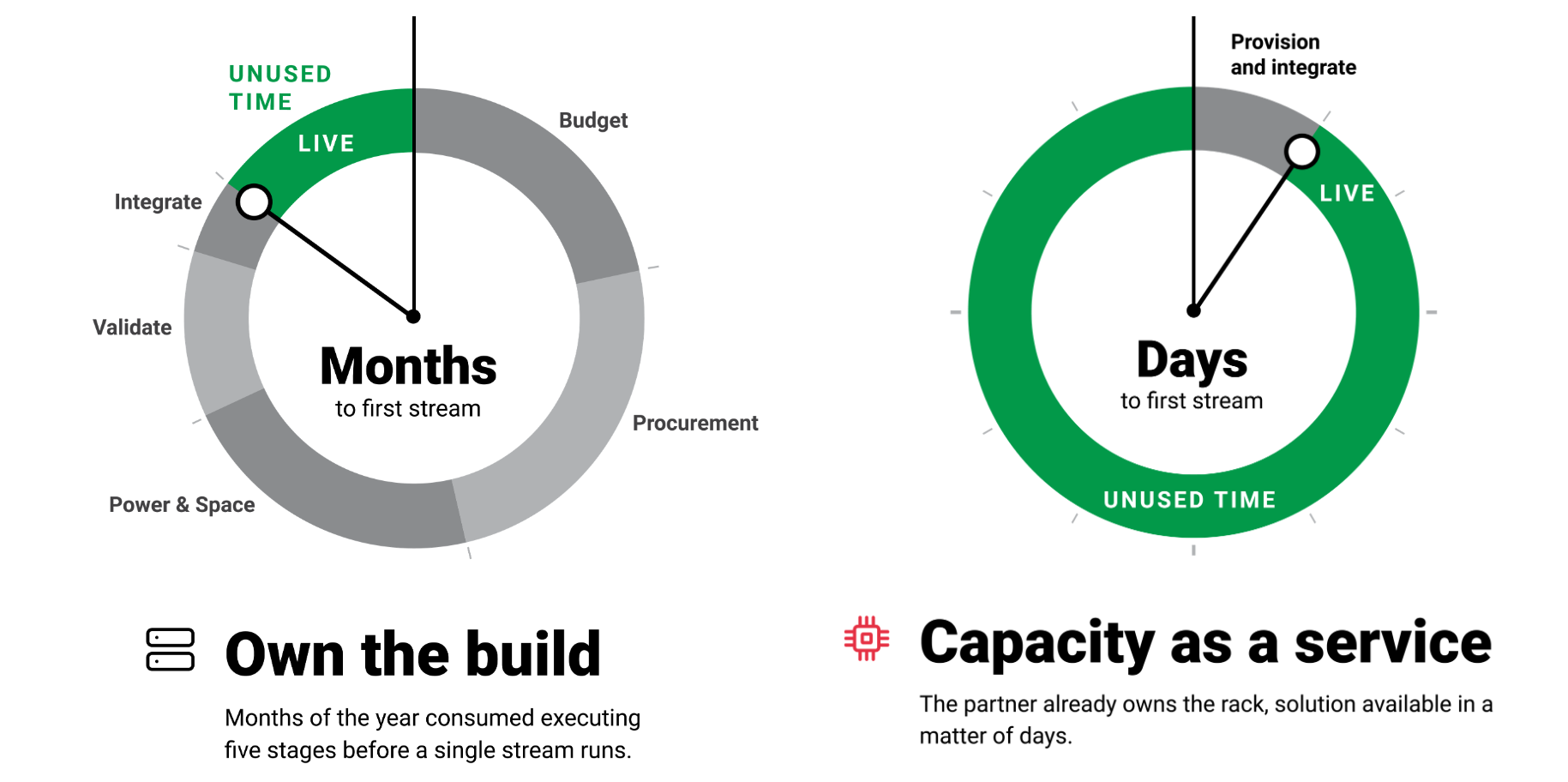
Comparison of deployment time: owning the build takes months across budgeting, procurement, power, validation, and integration, while VPU capacity as a service can deliver the first stream in days.

Figure 1. Two clocks. An owned build runs through budget, procurement, power, and validation; a service model gets a team to a real pipeline in days.

What this model changes

VPU-powered capacity as a service separates the need for video processing from the burden of owning and operating every server. The customer still needs encoding or transcoding, but the infrastructure can be delivered through a partner environment, whether hosted, regional, bare metal, or managed.

Convenience is a bonus. The real value is access to video-specific processing without first solving every internal infrastructure condition. For the customer, that means faster deployment, less upfront hardware commitment, and more flexibility in where capacity sits.

For the partner, VPUs improve the economics of offering video processing. More streams per server, lower power per stream, and higher density make hosted video infrastructure more practical to operate and price.

Why VPUs make the economics work

A hosted model only works if the underlying economics make sense. If each stream consumes too much power, rack space, or general-purpose compute, the service becomes hard to scale for both provider and customer.

NETINT VPUs are designed specifically for video. They let infrastructure partners offer high-density encoding and transcoding at lower power than CPU-only approaches. Akamai, the first cloud provider to offer VPUs, runs NETINT Quadra T1U accelerators behind instances that start around 280 dollars per month, with each card handling roughly 32 live 1080p30 streams at peak power near 13 watts. That is what video-specific infrastructure looks like when it is designed around video from the beginning.

Treating video as a general-purpose compute workload is what makes hosted transcoding expensive. When the infrastructure is designed around video instead, predictable cost, density, and power efficiency follow, which is what lets a provider price the service and a customer trust the economics. The same purpose-built silicon that lowers a buyer’s owned-infrastructure cost also improves the math for the partner offering it as a service.

The live data does not move. The build schedule does
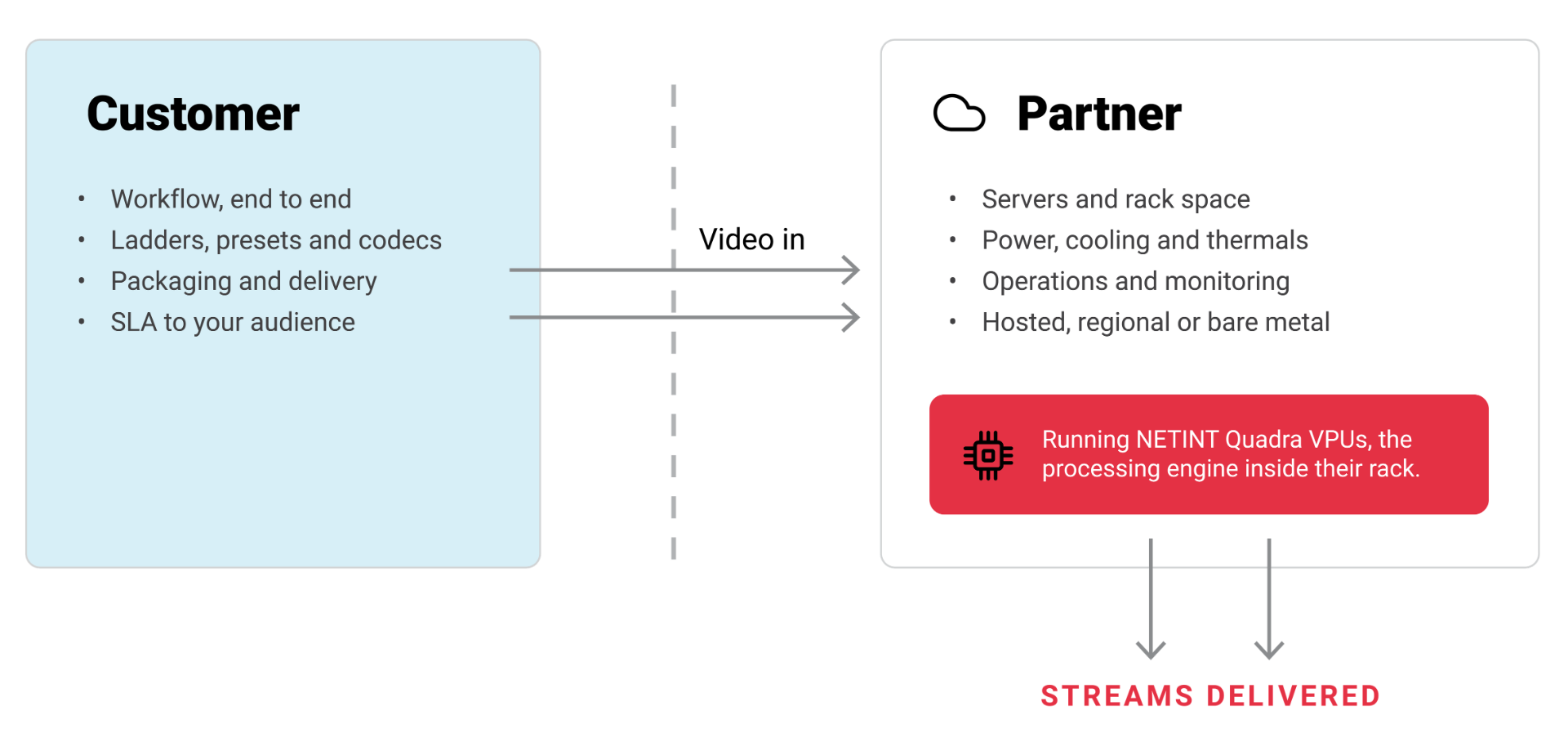
Diagram showing a customer sending video to a partner that provides servers, rack space, power, cooling, operations, and NETINT Quadra VPU processing to deliver video streams.

Figure 2. Who owns what. The customer keeps the workflow and the SLAs; the partner carries servers, power, and operations; NETINT provides the processing engine.

Where this fits

This model is for customers who need capacity now but cannot wait for a full purchase, deployment, and validation cycle. Good candidates include platforms expanding into new regions, live providers with peak needs, cloud and CDN transcoding workflows, interactive and gaming video, and teams trying to reduce dependence on expensive CPU-based processing.

The common thread is straightforward. The customer needs more video processing, and the fastest practical path runs through a partner that already operates the infrastructure. In the pavilion, that path connects most directly to NetActuate for distributed reach and i3D for high-performance, latency-sensitive workloads.

What customers should ask

The first question is not whether capacity as a service beats owned infrastructure. It is whether it is the right model for the current bottleneck. Teams should ask where they need capacity, how quickly, whether demand is steady or peak, whether regional placement matters, and what they are really trying to reduce: cost, power, deployment time, or operational burden.

If the answers point toward speed, flexibility, regional reach, or reduced ownership, a partner-powered model is likely the right path. If they point toward strict control, custom integration, or steady high-volume demand, owned infrastructure may still win. The model is a tool for a situation, not a verdict on owned versus hosted in general.

VPU-powered capacity as a service is not about replacing every owned deployment. Some customers will still build their own systems, some will reuse existing servers, and some will use a partner model because it gets them to capacity faster. At IBC 2026 the central point is simply that the choice now exists, on purpose-built video silicon, wherever the workload needs to run.

Sources & further reading

Akamai, Akamai First to Offer VPUs in the Cloud (Mar 27, 2025). https://www.akamai.com/newsroom/press-release/akamai-first-to-offer-vpus-in-the-cloud

Akamai TechDocs, Accelerated Compute Instances (NETINT Quadra T1U). https://techdocs.akamai.com/cloud-computing/docs/accelerated-compute-instances

NETINT, VPU Ecosystem. https://netint.com/vpu-ecosystem/

NETINT VPU ECOSYSTEM · IBC 2026 

As video workloads continue to grow, adding capacity is no longer a single decision, but a set of practical paths depending on the real bottleneck. This series explores how to scale video processing efficiently using NETINT VPUs, whether through infrastructure partners, existing systems, or dedicated deployments designed around video from the start.

1. The New Video Capacity Problem

2. Three Ways to Add Video Capacity

3. VPU-Powered Capacity as a Service

4. Get More from the Servers You Already Own

5. Build Dedicated VPU-Based Video Infrastructure.

6. VPU Capacity Without a Hardware Cycle

7. Scaling Performance-Critical Video Workloads

Coming soon:

8. Building Practical VPU-Based Video Systems

9. Reliable Live Video Meets Efficient Processing

10. Maximizing Encoding Efficiency in Live Streaming Workflows

11. The Next Layer of Video Efficiency

12. From VPU Evaluation to Production Deployment
VPU-Powered Capacity as a Service

Learn how VPU Capacity as a Service delivers encoding capacity faster through hosted infrastructure, reducing deployment time and operational burden.

NETINT graphic titled “VPUaaS: VPU-Powered Capacity-as-a-Service,” set against a blue abstract digital infrastructure background with VPU Ecosystem IBC Edition branding.

Add encoding capacity without owning every server. When demand has a fixed date, time-to-capacity becomes the metric that matters most.

NETINT VPU ECOSYSTEM · IBC 2026

AT A GLANCE

Adding encoding capacity no longer requires purchasing, deploying, and operating every server. When live events, traffic spikes, or new regional launches demand immediate scalability, time-to-capacity becomes more important than infrastructure ownership.

This article explains how VPU Capacity as a Service enables organizations to access hosted encoding capacity through infrastructure partners, reducing deployment time while improving flexibility, efficiency, and scalability for modern video workflows.

Video engineers usually know they need more encoding capacity well before they know how they will get it. The workload is growing, the live calendar is fixed, the transcoding queue is lengthening, and the cloud bill is climbing. The business still needs capacity.

For some platforms, the practical answer is not to buy, rack, power, and operate more servers right away. It is to access the efficiency of NETINT VPUs through an infrastructure partner, without owning every layer of the deployment.

The real problem: capacity is needed before infrastructure is ready

Traditional planning assumes time. Time to approve budget, procure servers, install and validate them, secure power and space, and integrate everything into the workflow. Video does not always wait for that sequence.

Live events happen on fixed dates. Channels launch, traffic spikes, regions change, and a CPU-based pipeline reaches its limit. When that happens, the question becomes direct: how do we add capacity now, without turning it into a full infrastructure project?

The live data does not move. The build schedule does.

Comparison of deployment time: owning the build takes months across budgeting, procurement, power, validation, and integration, while VPU capacity as a service can deliver the first stream in days.

Figure 1. Two clocks. An owned build runs through budget, procurement, power, and validation; a service model gets a team to a real pipeline in days.

What this model changes

VPU-powered capacity as a service separates the need for video processing from the burden of owning and operating every server. The customer still needs encoding or transcoding, but the infrastructure can be delivered through a partner environment, whether hosted, regional, bare metal, or managed.

Convenience is a bonus. The real value is access to video-specific processing without first solving every internal infrastructure condition. For the customer, that means faster deployment, less upfront hardware commitment, and more flexibility in where capacity sits.

For the partner, VPUs improve the economics of offering video processing. More streams per server, lower power per stream, and higher density make hosted video infrastructure more practical to operate and price.

Why VPUs make the economics work

A hosted model only works if the underlying economics make sense. If each stream consumes too much power, rack space, or general-purpose compute, the service becomes hard to scale for both provider and customer.

NETINT VPUs are designed specifically for video. They let infrastructure partners offer high-density encoding and transcoding at lower power than CPU-only approaches. Akamai, the first cloud provider to offer VPUs, runs NETINT Quadra T1U accelerators behind instances that start around 280 dollars per month, with each card handling roughly 32 live 1080p30 streams at peak power near 13 watts. That is what video-specific infrastructure looks like when it is designed around video from the beginning.

Treating video as a general-purpose compute workload is what makes hosted transcoding expensive. When the infrastructure is designed around video instead, predictable cost, density, and power efficiency follow, which is what lets a provider price the service and a customer trust the economics. The same purpose-built silicon that lowers a buyer’s owned-infrastructure cost also improves the math for the partner offering it as a service.

The live data does not move. The build schedule does

Diagram showing a customer sending video to a partner that provides servers, rack space, power, cooling, operations, and NETINT Quadra VPU processing to deliver video streams.

Figure 2. Who owns what. The customer keeps the workflow and the SLAs; the partner carries servers, power, and operations; NETINT provides the processing engine.

Where this fits

This model is for customers who need capacity now but cannot wait for a full purchase, deployment, and validation cycle. Good candidates include platforms expanding into new regions, live providers with peak needs, cloud and CDN transcoding workflows, interactive and gaming video, and teams trying to reduce dependence on expensive CPU-based processing.

The common thread is straightforward. The customer needs more video processing, and the fastest practical path runs through a partner that already operates the infrastructure. In the pavilion, that path connects most directly to NetActuate for distributed reach and i3D for high-performance, latency-sensitive workloads.

What customers should ask

The first question is not whether capacity as a service beats owned infrastructure. It is whether it is the right model for the current bottleneck. Teams should ask where they need capacity, how quickly, whether demand is steady or peak, whether regional placement matters, and what they are really trying to reduce: cost, power, deployment time, or operational burden.

If the answers point toward speed, flexibility, regional reach, or reduced ownership, a partner-powered model is likely the right path. If they point toward strict control, custom integration, or steady high-volume demand, owned infrastructure may still win. The model is a tool for a situation, not a verdict on owned versus hosted in general.

VPU-powered capacity as a service is not about replacing every owned deployment. Some customers will still build their own systems, some will reuse existing servers, and some will use a partner model because it gets them to capacity faster. At IBC 2026 the central point is simply that the choice now exists, on purpose-built video silicon, wherever the workload needs to run.

Sources & further reading

Akamai, Akamai First to Offer VPUs in the Cloud (Mar 27, 2025). https://www.akamai.com/newsroom/press-release/akamai-first-to-offer-vpus-in-the-cloud

Akamai TechDocs, Accelerated Compute Instances (NETINT Quadra T1U). https://techdocs.akamai.com/cloud-computing/docs/accelerated-compute-instances

NETINT, VPU Ecosystem. https://netint.com/vpu-ecosystem/

NETINT VPU ECOSYSTEM · IBC 2026 

As video workloads continue to grow, adding capacity is no longer a single decision, but a set of practical paths depending on the real bottleneck. This series explores how to scale video processing efficiently using NETINT VPUs, whether through infrastructure partners, existing systems, or dedicated deployments designed around video from the start.

1. The New Video Capacity Problem

2. Three Ways to Add Video Capacity

3. VPU-Powered Capacity as a Service

4. Get More from the Servers You Already Own

5. Build Dedicated VPU-Based Video Infrastructure.

6. VPU Capacity Without a Hardware Cycle

7. Scaling Performance-Critical Video Workloads

Coming soon:

8. Building Practical VPU-Based Video Systems

9. Reliable Live Video Meets Efficient Processing

10. Maximizing Encoding Efficiency in Live Streaming Workflows

11. The Next Layer of Video Efficiency

12. From VPU Evaluation to Production Deployment