Media Server Software for VPU-Accelerated Video Infrastructure
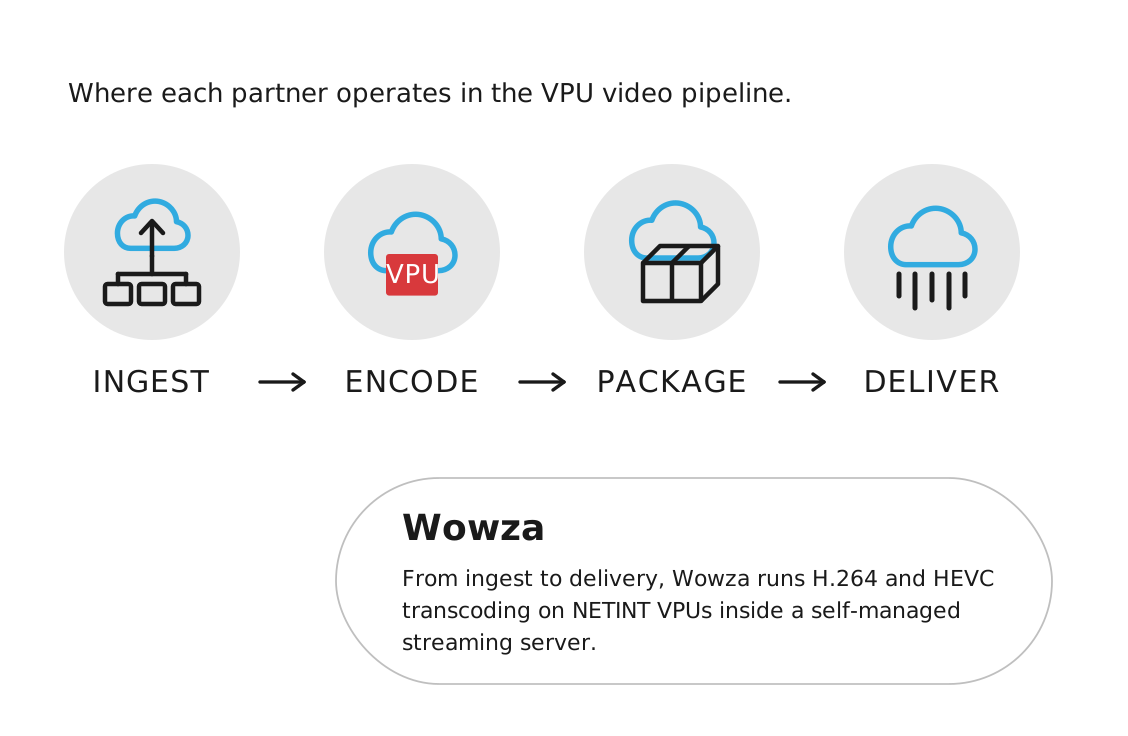
Wowza Streaming Engine is a self-managed media server that handles ingest, transcoding, packaging, and origin inside a single software layer. Within the NETINT VPU Ecosystem, Wowza runs H.264 and HEVC transcoding directly on NETINT VPUs. The accelerated encode happens inside the same process that accepts the contribution feed, packages the output, and hands it to a CDN.
That matters because most density gains get spent again on integration. An encode running on separate hardware, driven by a separate process, has to be handed back into the workflow, and that handoff is where latency, failure modes, and operational complexity accumulate. When the transcode runs natively inside the media server, the density is simply available to the pipeline already in production.
That density creates a second problem: more channels means more feeds than any team can realistically watch. Wowza’s Video Intelligence Framework reduces time to action by pointing operators to the moments that matter as they happen, rather than asking them to monitor every stream.
The pairing suits teams building their own streaming infrastructure rather than renting it. Wowza runs on-premises, in a private cloud, in Docker, at the edge, or on managed bare metal. These are the same places NETINT VPUs are deployed.
Role in the VPU Ecosystem
Wowza represents the streaming workflow layer of the NETINT VPU Ecosystem and, with native VPU transcoding, the encode layer alongside it. Silicon determines how many channels a server can process. The workflow layer determines whether those channels can be ingested, transcoded, packaged, and delivered without a custom build around them.
Wowza Streaming Engine covers that span in one process: contribution ingest over RTMP, RTSP, SRT, WebRTC, and MPEG-TS; VPU-accelerated transcoding to multiple renditions in H.264 and HEVC; packaging to HLS, Low-Latency HLS, MPEG-DASH, CMAF, and WebRTC; and origin behavior for CDN pull or push publishing. Its REST API automates operations, and its Java API allows the pipeline itself to be extended. Wowza used that same mechanism to build its own CMAF-to-MoQ relay as a module, with no core code changes. The Video Intelligence Framework (VIF) uses the same extensibility to route encoded and transcoded feeds to AI models for analysis, without interrupting the video path.
For an operator standing up VPU-based infrastructure, this shortens the distance between “we have encoding capacity” and “we have a running service.”
Company Type
Streaming software and video infrastructure vendor
Core Focus
Self-managed live streaming media server, packaging, and workflow extensibility
Primary Workloads
Live streaming, security and surveillance, government and public safety, sports and events, enterprise and edge video
Customer Profile:
Streaming platforms, broadcasters, CDNs, system integrators, government agencies, and enterprises operating their own video infrastructure
Deployment Models:
On-premises, private cloud, public cloud, Docker, edge and ARM, air-gapped
At scale:
More than 35,000 video deployments and over 200,000 running instances across 170+ countries.
Who to Talk to About VPUs at Wowza
Connect with the Wowza team to discuss self-managed streaming infrastructure, building your own streaming cloud, and how VPU-accelerated transcoding fits an existing Wowza deployment.
Joint Workflow and Platform Capabilities
NETINT VPUs provide the encoding density. Wowza Streaming Engine drives it, and handles everything around it in the same pipeline.
- H.264 and HEVC transcoding running natively on NETINT VPUs inside Wowza Streaming Engine
- Higher channel density per server and per rack unit, at lower power per stream than CPU or GPU transcoding
- Contribution ingest over RTMP, RTSP, SRT, WebRTC, and MPEG-TS
- Packaging to HLS, LL-HLS, MPEG-DASH, CMAF, and WebRTC from a single origin
- Origin behavior for CDN pull or push publishing to one or many CDNs
- DRM, captions, ad insertion, and metadata handled in the same pipeline
- Deployment parity across on-premises, private cloud, Docker, and managed bare metal
- REST API for operational automation; Java API for pipeline extension
- Real-time data extraction from live feeds with Wowza’s Video Intelligence Framework, delivered as HLS ID3 metadata, JSONL logs, webhooks, overlays, or Java listeners
- Model Context Protocol (MCP) support for building intelligent workflows
Most teams building their own streaming platform hit the same two walls: transcoding cost and workflow complexity. Software transcoding on CPUs is flexible but thins out fast on density and power. GPUs are strong at AI inference and handle volume well, but only a fraction of the die is dedicated to video, and the cost per channel follows. VPUs are purpose-built for video processing, which is what makes high-density streaming economical per channel and per watt.
Solving the density problem does not solve the workflow problem. Ingest, packaging, DRM, captions, and CDN handoff all still have to exist, and increasingly so do intelligent video analysis and synthetic video detection. Wowza supplies that layer in software that deploys where the hardware is. And because the VPU transcode runs inside Wowza Streaming Engine rather than beside it, the density arrives without a separate integration to build and operate.
News, Articles and Videos
Featuring Wowza
Simplify Building Your Own Streaming Cloud
Barry Owen of Wowza walks through using Wowza Streaming Engine as the origin, transcoder, and packager for a self-managed streaming cloud, including how CPU, GPU, and VPU transcoding compare in density, power, and price per channel.
Three Ways to Add Video Capacity in a Constrained Market
How operators add encoding capacity when supply is tight, and where each ecosystem layer fits, Wowza included, in getting VPU capacity into production.
Start Streaming in Minutes with Wowza Streaming Engine
Barry Owen, Chief Solutions Architect at Wowza, deploys Wowza Streaming Engine with Docker and has it running in under five minutes, covering multi-codec and multi-protocol support, captioning, ad insertion, DRM, LL-HLS/LL-DASH, and WebRTC. (20 min)
Scaling Live Video Infrastructure with AI and VPUs
Wowza’s Mike Vitale and Barry Owen join Mark Donnigan to talk about what changes when stream counts climb: where hardware acceleration stops being optional, how VPUs improve transcoding density and efficiency, and why live video is becoming a source of real-time data rather than just content.
Learn more about Wowza and its live streaming, transcoding and packaging platform.