NETINT · Creator of the VPU

Video encoding silicon.
Built for scale.

A VPU is a chip that does one job: encode video. NETINT invented it. Run VPUs in servers you own or on partner clouds using open source and commercial software integrations.

225,000+

VPUs in production

1.1 Trillion+

Minutes of video encoded

Close-up of a black textured hardware enclosure with NETINT and QUADRATI labels and red cables.

RECOGNITION

VPU Emmy®, alongside Google, Meta and AMD.

The 2024 Technology and Engineering Emmy® Award recognized NETINT for Design and Deployment of Efficient Hardware Video Accelerators for Cloud. The other recipients built chips for themselves. NETINT sells VPUs to everyone.

Decorative gold ribbon sculpture with intertwined loops on a black background

Tech Emmy® 2024 Winner: Design and Deployment of Efficient Hardware Video Accelerators for Cloud

National Academy of Television Arts & Sciences

Why a VPU?

General-purpose compute can no longer keep up with codec complexity and power limitations.

Grid view icon: rounded square with a grid of small squares inside

CPU

No video silicon

AV1 and HEVC buy smaller streams with far more computing work. Software encoders rack up the bill in CPU cores. VPUs do the work in fixed-function logic, so AV1 costs no more to encode than HEVC or H.264.

Grid of light gray squares forming a larger square, with three red squares in the top-right corner.

GPU

Small video IP block

Platforms can encode hundreds and thousands of streams at once. CPU cost climbs with every stream. GPUs are slightly better because they are built for graphics and AI. VPU servers encode more than 320 streams.

Grid of small red squares arranged in a neat mosaic on a light gray background

VPU

Entire chip dedicated
to video 

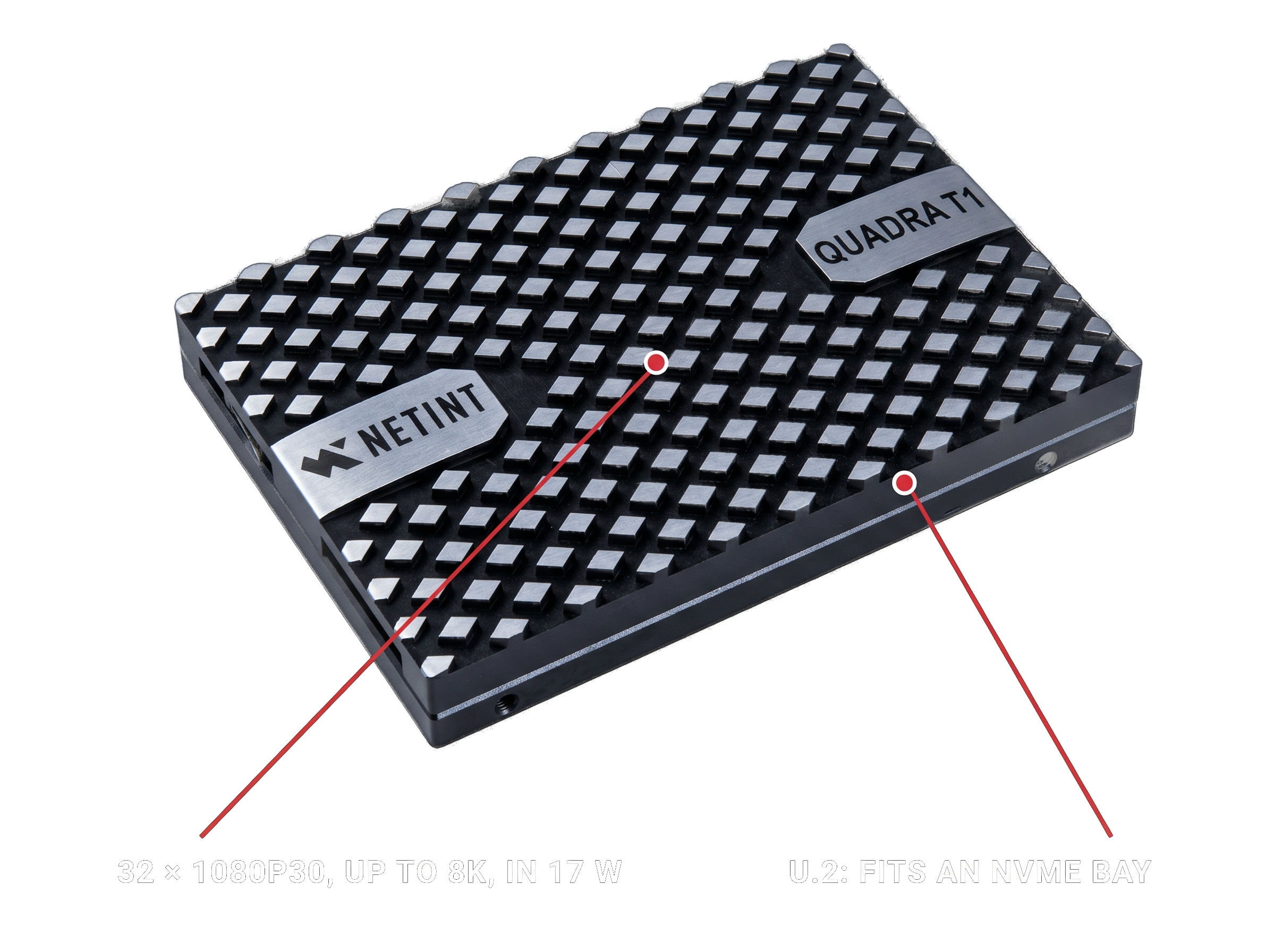
Racks are capped by watts, not slots. A card that encodes 32 HD streams at 17 W changes what one rack can carry. A 1RU VPU server encodes 320 streams in a power envelope of less than 500 watts.

MEASURED, NOT MODELLED

Tested against CPU and GPU.

VPU compared to x265

7.6xgreater density

Quadra
19.0
NVENC P7
8.5
x265 medium
2.5

HEVC at 32 concurrent 1080p sessions on identical Akamai hosts.

Source: NETINT Akamai Throughput and Quality Report, SDK V5.7.2.

VPU compared to GPU

4.7xfewer watts

Quadra T1U
13 W
RTX 4000 Ada
51 - 82 W

Peak VPU power 13 W against 51 to 82 W for an NVIDIA RTX 4000 Ada on a live ABR ladder.

Akamai independent test results, Frankfurt, 19 August 2025.

VPU compared to x264

3xenergy efficiency

VPU
2 - 5 W
CPU
15 - 20 W

15 clips, H.264, HEVC and AV1, energy logged through OpenBMC.

Independent test by G&L Systemhaus, 9 July 2025.

PRICE AND PERFORMANCE

Cost per live HD stream, per month.

Same 1080p channel. Three ways to run it.

CPU, 8-core instance
$72.00
AWS VT1 (Xilinx U30)
$59.38
VPU (2× Quadra T1U, Akamai Cloud)
$27.11

Monthly instance list price divided by sustained live 1080p streams: 2 on the CPU plan, 8 on VT1, 18 on the VPU plan. September 2025 prices. Your inputs will differ.

Where VPUs run

Built for the video you run.

Thousands of concurrent encodes, AV1 and HEVC, at a flat cost per stream.

Peak-event capacity with low-delay encoding and no rebuild of the pipeline.

Encoder latency under 5 ms at 1080p for gaming, betting and auctions.

SDI in, IP out, in a 1RU server or a half-rack appliance.

Decode, downscale and run inference on hundreds of camera streams per chip.

One VPU: card, server or cloud.

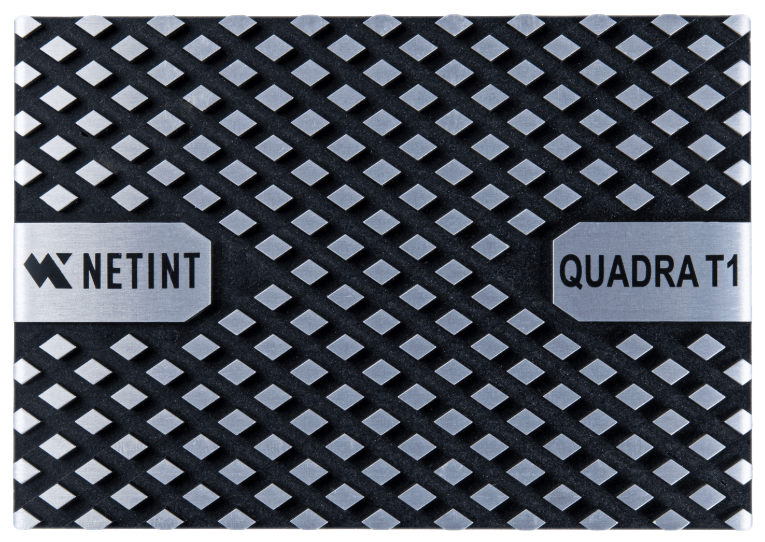
Black metal plate with a diamond lattice pattern and two silver labels reading NETINT and QUADRATI on opposite sides

M.2, U.2 and PCIe form factors. 20 to 64 HD streams per card for servers you own.

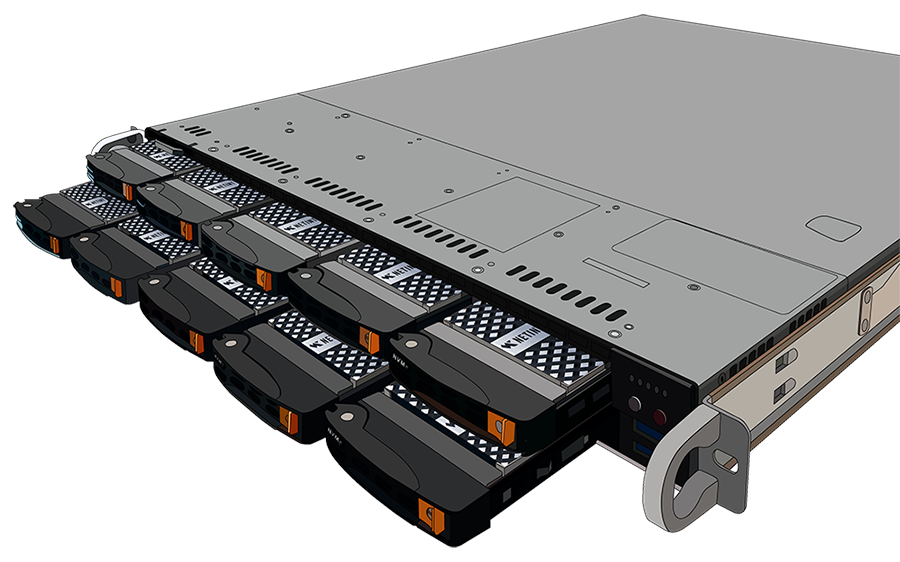
Front view of a server chassis with multiple hot-swappable hard drives in a drive bay enclosure.

1RU with ten VPUs, 320 HD or 80 4K streams. Half-rack Mini Server for the edge.

The same card on Akamai Cloud, i3D.net, and NetActuate VPUaaS. 

Send us your stream count, codecs, resolutions, and latency target. A NETINT engineer will spec the cards, servers, or cloud instances to match, and show the power and rack-space math.

LEADERSHIP AND INNOVATION

A decade building the VPU category.

2015

NETINT founded in Vancouver, Canada to build video-only silicon

2019

Codensity G4, Logan ships as the T408 and T432

2021

Codensity G5, the Quadra family adds AV1, 8K and on-chip AI engine

2024

Technology and Engineering Emmy Award, alongside Google, Meta and AMD

2025

Akamai becomes the first infrastructure for video cloud to offer VPUs

2026

More than 225,000 VPUs deployed, encoding greater than 1 trillion minutes
What only a video-first chip can do

Encode AV1 at the same density as HEVC and H.264.

Decode, downscale and run an AI model on the same die.

Move frames straight from a GPU into the encoder.

Fit ten cards in one rack unit, enabling 320 live channels at broadcast quality.

VPU Ecosystem Partners

CDN & Platform

Akamai Cloud logo with a blue curved arc and dot beside the dark blue Akamai wordmark.
CDN77 logo: dark blue location pin with a yellow circle inside, followed by the bold text CDN77.
i3D.net logo: dark blue wordmark with circular paper-plane icon on the left
Solid black image that may be used as a placeholder or divider in the layout.
Solid black image with a barely visible watermark along the bottom edge.

Software

Capella logo: blue starburst icon to the left of the word CAPELLA with the slogan 'Designed to evolve'
EasyTools logo with a black triangular icon containing a cloud, followed by the word EASYTOOLS on the right.
V-NOVA logo: circular emblem with an abstract figure beside the text V-NOVA in dark blue.
WOWZA logo: orange circular emblem with white abstract mark next to the orange word WOWZA

Integrators & Services

Small blue right-triangle logo in the lower-left corner on a black background
MISAO Network logo in yellow on blue background, with a paw-print inside the O.

Servers & Systems

Advantech logo in white on a dark blue background.
Dell Technologies logo