The New Economics of Video Infrastructure

Global map with data flow representing cost and efficiency shifts in video infrastructure
Why efficiency, not flexibility, is becoming the primary design constraint for modern video systems

The Constraint Has Moved

To understand why VPUs matter, it helps to understand what changed. In the early era of streaming, the challenge was capability: could your system encode, package, and deliver video at all? Hardware was expensive, but workloads were modest. Software encoders running on commodity servers were good enough.

Today, the problem is different. Platforms are not struggling to process video. They are struggling to process it economically at sustained scale. A single live sporting event can require thousands of concurrent transcode sessions. Each session demands multiple output renditions across an expanding set of resolutions, codecs, and device profiles. The math compounds quickly: more streams, more renditions, more power, more cooling, more cost.

KEY INSIGHT
The question is no longer “Can our infrastructure handle the load?” It is “Can our infrastructure handle the load without the cost curve outpacing the revenue curve?”

This is not a theoretical concern. Operations teams across the industry report the same pattern: scaling transcoding workloads on general-purpose compute is hitting diminishing returns. The flexibility that once made software encoders attractive is now a liability when the priority is predictable, efficient throughput at density.

What a VPU Actually Is, and What It Is Not

A Video Processing Unit is purpose-built silicon designed specifically for video encoding and media processing workloads. Unlike a CPU, which is optimized for general computation, or a GPU, which is optimized for parallel graphics and AI tasks, a VPU is architected to do one thing exceptionally well: transcode video streams efficiently and deterministically.

That distinction matters. VPUs do not replace software encoders or GPUs universally. They are not a silver bullet for every video workload. What they do is change the economics of where and how transcoding gets deployed. In environments where sustained concurrency, power efficiency, and predictable throughput are the primary concerns (live production, large-scale OTT, real-time interactive video), VPUs offer a fundamentally different cost curve.

In the VPU Ecosystem framework, VPUs are treated not as a product feature but as an infrastructure primitive: an architectural lever that reshapes how teams think about capacity, power, and operational predictability.

The shared Video Pipeline Model

Exhibit 2: The shared video pipeline model, a common reference framework across the VPU Ecosystem.

A Shared Pipeline, Different Pressures

The VPU Ecosystem organizes the modern video stack around a shared pipeline: Ingest, Transcode and Process, Package and Origin, Deliver, and Secure and Optimize. Every company in the ecosystem operates somewhere along this chain. Some design and supply infrastructure. Others operate platforms at scale. Still others orchestrate, integrate, or govern how video processing is deployed within existing systems.

Not every partner in the ecosystem directly deploys VPUs. But all of them are influenced by the constraints VPUs introduce, particularly around density, power efficiency, predictability, and deployment friction. This enables the partner to compete in a whole new way by offering higher quality, lower cost, and better value than their competitors.

This is the critical insight: the value of the VPU Ecosystem lies in how efficiency-driven constraints ripple across every stage of the pipeline, reshaping architectural and operational decisions for everyone involved. VPUs are driving improved end user experiences, while opening new monetization opportunities for platforms, streaming services, and the technology providers powering these systems.

Three Effects That Change Everything

Across environments (cloud, on-premise, hybrid), introducing VPUs consistently changes three system properties. Understanding these effects is essential for any leader evaluating video infrastructure strategy

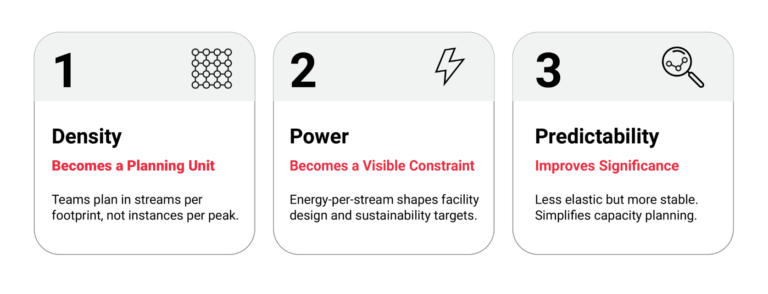
Density becomes a planning unit. When VPUs enter the stack, teams stop thinking in instances-per-peak and start thinking in streams-per-footprint. This is a subtle but profound shift. It means infrastructure planning moves from reactive scaling to proactive capacity design, a change that affects procurement, facility planning, and long-term capital allocation.

Power becomes a visible constraint. Energy consumption per stream has historically been an afterthought, buried in operational budgets and ignored in system design. VPUs make it a first-order variable. Energy per stream now influences facility design, sustainability reporting, and long-term cost modeling, even in cloud environments where power costs are embedded in compute pricing.

Predictability improves. General-purpose compute is elastic by design, which introduces variability. VPU-based transcoding trades some of that elasticity for stability. The result is more deterministic performance, simpler capacity planning, and fewer surprises during peak load events. For operations teams, this is not a minor benefit. It is transformational.

Three System Effects of VPU Introduction
Three systems effects of vpu introduction

Exhibit 3: Three system-level effects observed consistently when VPUs are introduced into video workflows.

What This Means for Decision-Makers

The shift toward efficiency-first video infrastructure is not a future possibility. It is already underway. The organizations that recognize it earliest will have the clearest advantage, not because they adopted a specific technology, but because they redesigned their systems around the right constraints.

For platform engineers, this means evaluating transcoding architecture not just on throughput but on density and power per stream. For operations leaders, it means building capacity plans around deterministic baselines rather than elastic headroom. For finance and strategy teams, it means modeling infrastructure costs with sustainability and energy efficiency as explicit variables, not opaque line items.

THE BIGGER PICTURE
The VPU Ecosystem is not a vendor story. It is a design philosophy, one in which efficiency, density, and predictability are treated as first-class architectural principles, not afterthoughts.

The essays and case studies that follow in this series each examine one specific dimension of this ecosystem. They explore how the pressures of economics, latency, orchestration, production reality, deployment risk, and operational scale play out differently depending on where a company sits in the pipeline. Read together, they form a comprehensive picture of an industry in transition, and a practical framework for navigating it.

From Akamai you will learn how pairing VPU-accelerated transcoding with their Distributed Cloud creates a highly cost-effective and energy-efficient architecture for global video delivery.

Dell shows how integrating efficient VPUs into validated server platforms translates silicon-level power and density gains into deployable, scalable, and supportable datacenter level video infrastructure.

i3D.net shares how the efficiency and density of VPUs enable latency-sensitive video processing to be geographically distributed closer to users without multiplying infrastructure costs.

Scalstrm shows how advanced orchestration and control planes are essential for managing complex, VPU-accelerated video pipelines to turn raw hardware efficiency into operational reliability.

Cires21 details how to fairly measure and validate efficiency, quality, and scale in heterogeneous video environments by focusing on system-level behavior and stability under sustained loads.

Arcadian explains how the predictable behavior and bounded power consumption of VPUs provide the necessary operational margin and reliability to survive unpredictable, real-world live production constraints.

Misao Network presents a case study showing the combination of low-latency WebRTC video transport with VPUs enables the delivery of broadcast-quality 8K video for real-time live environments.

V-Nova shares how MPEG-5 LCEVC technology enable video streaming platforms to deliver superior visual quality at lower bitrates across a wide range of video streaming and entertainment services architectures.

This article is the first in the VPU Ecosystem Series, a collection of feature articles and case studies examining how efficiency-driven design decisions are reshaping modern video infrastructure. Each piece focuses on one operational pressure and is intended to be read as a complementary perspective within the broader ecosystem framework.


ACCESS NOW: ASIC-Based Transcoding
for High-volume Use Cases
Including social media, broadcast, interactive platforms, and service providers


ACCESS NOW

The New Economics of Video Infrastructure

Video infrastructure economics is shifting toward efficiency, density, and predictability as VPUs reshape cost, power, and scalability models.

Global map with data flow representing cost and efficiency shifts in video infrastructure
Why efficiency, not flexibility, is becoming the primary design constraint for modern video systems

The Constraint Has Moved

To understand why VPUs matter, it helps to understand what changed. In the early era of streaming, the challenge was capability: could your system encode, package, and deliver video at all? Hardware was expensive, but workloads were modest. Software encoders running on commodity servers were good enough.

Today, the problem is different. Platforms are not struggling to process video. They are struggling to process it economically at sustained scale. A single live sporting event can require thousands of concurrent transcode sessions. Each session demands multiple output renditions across an expanding set of resolutions, codecs, and device profiles. The math compounds quickly: more streams, more renditions, more power, more cooling, more cost.

KEY INSIGHT
The question is no longer “Can our infrastructure handle the load?” It is “Can our infrastructure handle the load without the cost curve outpacing the revenue curve?”

This is not a theoretical concern. Operations teams across the industry report the same pattern: scaling transcoding workloads on general-purpose compute is hitting diminishing returns. The flexibility that once made software encoders attractive is now a liability when the priority is predictable, efficient throughput at density.

What a VPU Actually Is, and What It Is Not

A Video Processing Unit is purpose-built silicon designed specifically for video encoding and media processing workloads. Unlike a CPU, which is optimized for general computation, or a GPU, which is optimized for parallel graphics and AI tasks, a VPU is architected to do one thing exceptionally well: transcode video streams efficiently and deterministically.

That distinction matters. VPUs do not replace software encoders or GPUs universally. They are not a silver bullet for every video workload. What they do is change the economics of where and how transcoding gets deployed. In environments where sustained concurrency, power efficiency, and predictable throughput are the primary concerns (live production, large-scale OTT, real-time interactive video), VPUs offer a fundamentally different cost curve.

In the VPU Ecosystem framework, VPUs are treated not as a product feature but as an infrastructure primitive: an architectural lever that reshapes how teams think about capacity, power, and operational predictability.

The shared Video Pipeline Model

Exhibit 2: The shared video pipeline model, a common reference framework across the VPU Ecosystem.

A Shared Pipeline, Different Pressures

The VPU Ecosystem organizes the modern video stack around a shared pipeline: Ingest, Transcode and Process, Package and Origin, Deliver, and Secure and Optimize. Every company in the ecosystem operates somewhere along this chain. Some design and supply infrastructure. Others operate platforms at scale. Still others orchestrate, integrate, or govern how video processing is deployed within existing systems.

Not every partner in the ecosystem directly deploys VPUs. But all of them are influenced by the constraints VPUs introduce, particularly around density, power efficiency, predictability, and deployment friction. This enables the partner to compete in a whole new way by offering higher quality, lower cost, and better value than their competitors.

This is the critical insight: the value of the VPU Ecosystem lies in how efficiency-driven constraints ripple across every stage of the pipeline, reshaping architectural and operational decisions for everyone involved. VPUs are driving improved end user experiences, while opening new monetization opportunities for platforms, streaming services, and the technology providers powering these systems.

Three Effects That Change Everything

Across environments (cloud, on-premise, hybrid), introducing VPUs consistently changes three system properties. Understanding these effects is essential for any leader evaluating video infrastructure strategy

Density becomes a planning unit. When VPUs enter the stack, teams stop thinking in instances-per-peak and start thinking in streams-per-footprint. This is a subtle but profound shift. It means infrastructure planning moves from reactive scaling to proactive capacity design, a change that affects procurement, facility planning, and long-term capital allocation.

Power becomes a visible constraint. Energy consumption per stream has historically been an afterthought, buried in operational budgets and ignored in system design. VPUs make it a first-order variable. Energy per stream now influences facility design, sustainability reporting, and long-term cost modeling, even in cloud environments where power costs are embedded in compute pricing.

Predictability improves. General-purpose compute is elastic by design, which introduces variability. VPU-based transcoding trades some of that elasticity for stability. The result is more deterministic performance, simpler capacity planning, and fewer surprises during peak load events. For operations teams, this is not a minor benefit. It is transformational.

Three System Effects of VPU Introduction

Three systems effects of vpu introduction

Exhibit 3: Three system-level effects observed consistently when VPUs are introduced into video workflows.

What This Means for Decision-Makers

The shift toward efficiency-first video infrastructure is not a future possibility. It is already underway. The organizations that recognize it earliest will have the clearest advantage, not because they adopted a specific technology, but because they redesigned their systems around the right constraints.

For platform engineers, this means evaluating transcoding architecture not just on throughput but on density and power per stream. For operations leaders, it means building capacity plans around deterministic baselines rather than elastic headroom. For finance and strategy teams, it means modeling infrastructure costs with sustainability and energy efficiency as explicit variables, not opaque line items.

THE BIGGER PICTURE
The VPU Ecosystem is not a vendor story. It is a design philosophy, one in which efficiency, density, and predictability are treated as first-class architectural principles, not afterthoughts.

The essays and case studies that follow in this series each examine one specific dimension of this ecosystem. They explore how the pressures of economics, latency, orchestration, production reality, deployment risk, and operational scale play out differently depending on where a company sits in the pipeline. Read together, they form a comprehensive picture of an industry in transition, and a practical framework for navigating it.

From Akamai you will learn how pairing VPU-accelerated transcoding with their Distributed Cloud creates a highly cost-effective and energy-efficient architecture for global video delivery.

Dell shows how integrating efficient VPUs into validated server platforms translates silicon-level power and density gains into deployable, scalable, and supportable datacenter level video infrastructure.

i3D.net shares how the efficiency and density of VPUs enable latency-sensitive video processing to be geographically distributed closer to users without multiplying infrastructure costs.

Scalstrm shows how advanced orchestration and control planes are essential for managing complex, VPU-accelerated video pipelines to turn raw hardware efficiency into operational reliability.

Cires21 details how to fairly measure and validate efficiency, quality, and scale in heterogeneous video environments by focusing on system-level behavior and stability under sustained loads.

Arcadian explains how the predictable behavior and bounded power consumption of VPUs provide the necessary operational margin and reliability to survive unpredictable, real-world live production constraints.

Misao Network presents a case study showing the combination of low-latency WebRTC video transport with VPUs enables the delivery of broadcast-quality 8K video for real-time live environments.

V-Nova shares how MPEG-5 LCEVC technology enable video streaming platforms to deliver superior visual quality at lower bitrates across a wide range of video streaming and entertainment services architectures.

This article is the first in the VPU Ecosystem Series, a collection of feature articles and case studies examining how efficiency-driven design decisions are reshaping modern video infrastructure. Each piece focuses on one operational pressure and is intended to be read as a complementary perspective within the broader ecosystem framework.
ACCESS NOW: ASIC-Based Transcoding
for High-volume Use Cases
Including social media, broadcast, interactive platforms, and service providers


ACCESS NOW