This conversation is designed for teams scaling video infrastructure beyond initial deployments.
The calendar does not display? Use this link: https://meetings.hubspot.com/randal-horne/nab
As video volumes grow, resolutions increase, and workloads diversify, infrastructure – not the application – has become the primary scaling challenge.
NETINT VPUs enable 10x more streams per server while reducing compute overhead, power consumption, and operational cost.
Video infrastructure demands measurable density and efficiency, not incremental CPU scaling. A 1RU Quadra Video Server supports:
Explosive growth in video volume and resolution
More content, formats, and higher resolutions increase processing demand
Unpredictable cloud and compute costs
Software-based transcoding scales linearly, VPUs scale cost-effectively
Inefficient resource utilization across CPU and GPU
Video processing competes with other workloads, reducing system efficiency
Rising power, rack space, and cooling constraints
Scaling with general-purpose compute increases operational
Fragmented workflows and inconsistent encoding pipelines
Multi-vendor complexity in codecs, profiles, and formats
Live and on-demand workloads converging at scale
Platforms must support both real-time and batch processing
AI workloads competing for compute resources
Inference and video processing create bottlenecks driving unnecessary cost
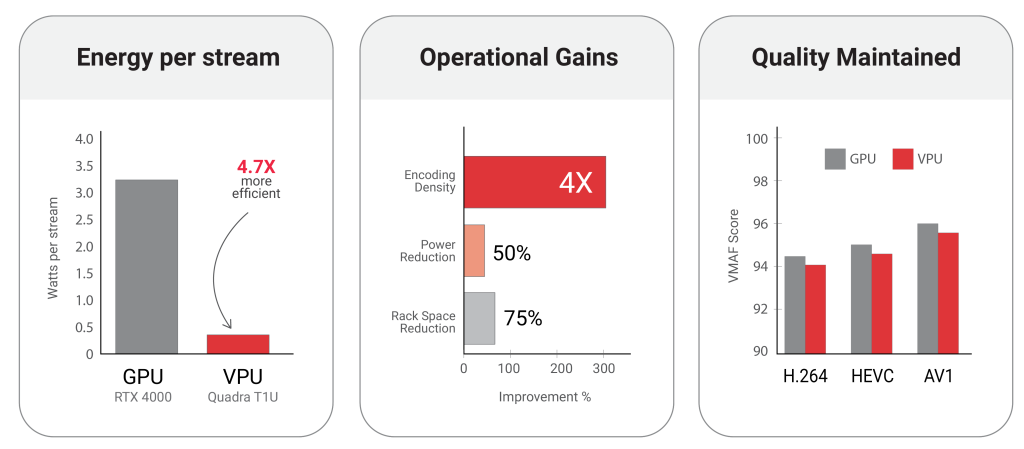
Modern video workloads demand more than incremental gains. As resolution, codec complexity, and stream volumes increase, traditional GPU-based encoding becomes increasingly inefficient, driving up power consumption, rack density, and operational overhead. NETINT VPUs are purpose-built for video, delivering deterministic performance and significantly higher efficiency while maintaining consistent quality across modern codecs.
In real-world deployments, this translates into measurable infrastructure advantages: up to 4.7× better energy efficiency, 4× higher encoding density, and 50% lower power consumption, all without compromising video quality. The result is a more scalable and predictable video pipeline, enabling operators to reduce cost per stream, simplify capacity planning, and support growth without proportional increases in infrastructure.
Storage Optimization at Scale
Transcode and normalize video after ingestion to reduce storage footprint without changing existing workflows or source formats.
Efficient Proxy Streams for Monitoring
Deliver low-bitrate proxy streams for operations, QC, and monitoring while preserving full-resolution video for distribution and archive.
Video Pre-Processing for Scalable Workflows
Pre-process and optimize video before downstream processing to reduce bandwidth, compute load, and overall infrastructure cost.
Offload for Scalable Infrastructure
Move encode and decode workloads off general-purpose compute so video pipelines scale predictably and efficiently.
200,000+ VPUs deployed
1+ trillion minutes of video processed
Powering large-scale streaming, cloud, and video platforms
Meet the ecosystem in action. At NAB, eight partners will join NETINT at the VPU Ecosystem Pavilion (Booth W2713), bringing together proven solutions across cloud, hardware, and system integration. This is where the ecosystem moves from concept to deployment—demonstrating how VPU-based architectures are built, integrated, and scaled in real-world environments.
Type: Cloud / CDN deployment, IaaS
Type: Hardware platforms, capture, edge compute
Type: Systems integration, workflow deployment
Integration Type: Transcoding stack, live workflow integration
Integration Type: CDN, Cloud compute
Integration Type: xx
Integration Type: ABR Optimization, Processing Control
Integration Type: Standardizing technology