SECURITY TECHNOLOGY
Security leaders are spending heavily on video analytics. Many will discover that the constraint is not the AI model. It is the unglamorous work of turning compressed video back into frames to feed the AI model.
Mark Donnigan, CMO, NETINT
The arithmetic of always-on video
The scale is easy to underestimate. IHS Markit counted roughly 770 million surveillance cameras worldwide in 2019 and projected more than one billion by the end of 2021. Five years on, is it possible that there are more than two billion cameras in the world. I believe, the answer is yes. And, unlike most enterprise workloads, these streams never stop; they run 24 hours a day, every day of the year.
Codec progress makes the problem sharper, not easier as shown in Figure 1. HEVC reduces bandwidth and storage relative to H.264, but decoding it can demand up to ten times the compute at 4K resolution. AV1, which began shipping in security cameras with the Axis ARTPEC-9 processor, cuts bitrate a further 20 to 30 percent below HEVC and can reduce storage needs by roughly 40 percent. Each codec generation trades cheaper network and storage for costlier compute. The savings show up on one budget line while the cost quietly moves to another.
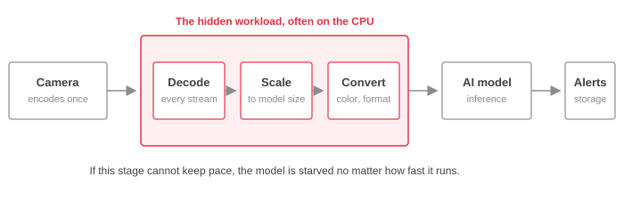
Figure 1. Inference is the last step in the pipeline, not the first. Decode, scaling, and format conversion must happen for every analyzed stream, around the clock.
The case for dedicated silicon
The semiconductor industry settled this question in consumer devices long ago. No phone decodes video on its CPU; a fixed-function block does the work. The gap is not subtle. As early as 2013, MIT researchers demonstrated a decoder chip that processed 4K HEVC video in real time on less than 0.1 watt. Published software benchmarks from the same era show a 3.5 GHz quad-core desktop CPU barely managing a single 4K HEVC stream. Server CPUs have improved since, but the arithmetic across hundreds of always-on streams remains punishing.
Video processing units, or VPUs as popularized by NETINT, apply the same principle at server scale: dedicated encode, decode, and scaling silicon on a card, leaving the CPU for the application and the GPU for inference. Benchmarks published by Cires21 report 0.4 to 0.7 watts per stream on ASIC-based VPUs against 2.5 to 3.6 watts per stream on GPUs (see Figure 2). One configuration produced 270 streams from a single server using six cards. The direction of these savings are consistent with what fixed-function silicon has delivered in every other video market.
The financial logic has two parts. Capital cost falls because higher stream density means fewer servers and less rack space for the same camera count. Operating cost falls because power is a per-stream, per-hour expense. US commercial electricity averaged about 19 cents per kilowatt-hour by the end of 2025, roughly 27 percent higher than in 2019. For a workload that runs 8,760 hours a year, a watt saved per stream is not a rounding error. It compounds across every camera, every server, and every hour of operation.
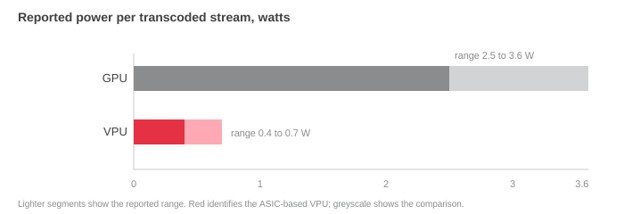
Figure 2. Power per stream as reported in a 2025 NETINT and Cires21 benchmark white paper. Vendor-published; treat as directional and validate against your own streams.
A tangible test case: ZoneMinder
It helps to see where the cost lands in a real system. ZoneMinder, an open-source video management system in continuous development for more than two decades, is unusually transparent about its internals. Its documentation and community forums are candid that decoding the camera streams is the dominant CPU cost. The project offers a passthrough mode that writes H.264 to disk without re-encoding. But the moment an operator views live video, or analytics needs frames, the stream must be decoded anyway.
ZoneMinder also illustrates the upgrade path. Its video handling runs through FFmpeg’s libavcodec libraries, the same foundation used across much of the video industry, including support by NETINT for their entire VPU family of products. Hardware acceleration arrives through that FFmpeg layer rather than through a rewrite of the application. A deployment that is decode-bound can therefore add dedicated video silicon beneath software it already trusts. That pattern, acceleration under a familiar software layer, is what turns modernization into a focused upgrade instead of a replacement project.
Why the edge raises the stakes
The pressure is moving toward the edge. Gartner projected that 75 percent of enterprise data would be created and processed outside traditional data centers by 2025. If recent silicon company acquisitions by NVIDIA with Groq and the mouthwatering Cerebras IPO are any indication, this prediction may be possible. IDC research suggests organizations can cut bandwidth costs 30 to 40 percent by processing data locally rather than shipping everything upstream. For video, the logic is stronger still: decode and analyze on site, send only events and metadata to the cloud.
But edge sites have hard limits on power, cooling, and physical space. A closet in a retail store cannot host a rack of general-purpose servers. When the budget is measured in watts rather than cores, watts per stream stops being a benchmark statistic and becomes the design constraint.
The question for security IT and ops teams planning their next analytics project is not only which model to run. It is a simpler, harder question: how many watts, and how many dollars, does it take to move one frame from the lens to the model? Before AI can see, the video must be decoded. Systems that answer that question efficiently will be the ones that scale.