An enhancement layer that fits the workflow you already run
NETINT VPU ECOSYSTEM · IBC 2026
AT A GLANCE
This article explains how MPEG-5 LCEVC improves video efficiency by combining a lightweight enhancement layer with existing codecs such as H.264, HEVC, AV1, and VVC. It reviews published subjective studies, addresses common technical objections, and examines how LCEVC reduces bitrate while maintaining visual quality.
The article also explores why pairing MPEG-5 LCEVC with NETINT VPUs creates a more efficient streaming workflow by reducing both encoding costs and CDN bandwidth, helping video platforms optimize compute resources and delivery efficiency at scale.
MPEG-5 LCEVC adds efficiency to a codec you have already deployed. This article explains what the two layers carry, what happens on devices that do not support LCEVC, what changes in an encoding and delivery workflow, and where the impact is strongest.
Delivery bitrate is a cost that does not show up on a server invoice. It shows up as CDN egress, cache efficiency, time to first picture, rebuffer rate, and the quality a viewer sees on a congested network at 8pm. Every lever against it has been some version of the same two moves: encode harder, or encode with something newer. Encoding harder costs compute and eventually costs quality. Encoding with something newer requires a device transition, and device transitions run on a timescale that nobody in the room controls.
MPEG-5 LCEVC (ISO/IEC 23094-2) takes a third route. It does not replace the codec. It enhances one.
That distinction is more than positioning. It is an architectural fact with practical consequences for packaging, playback, compute, and the way you should evaluate the technology. Those consequences are the subject of this article.
What the two layers carry
An LCEVC encode produces two outputs.
The base layer is an ordinary, fully compliant stream in a conventional codec: H.264, HEVC, AV1, VVC, or another base codec. The only unusual property is resolution. In the typical configuration it is encoded at one quarter of the output resolution, so a 4K output carries a 1080p base and a 1080p output carries a 540p base.
The enhancement layer carries compact residual data that describes the detail lost when the picture was downscaled and reconstructed. It travels either as SEI metadata inside the base stream or as a separate track alongside it. In Brazil’s SBTVD Phase 3 broadcast tests, the enhancement layer accounted for 9% to 14% of total bitrate at the 8.08 Mbps operating point; the base layer carried the rest.
At playback, an LCEVC-capable decoder decodes the base, upscales it, applies the residuals, and outputs the full-resolution picture.
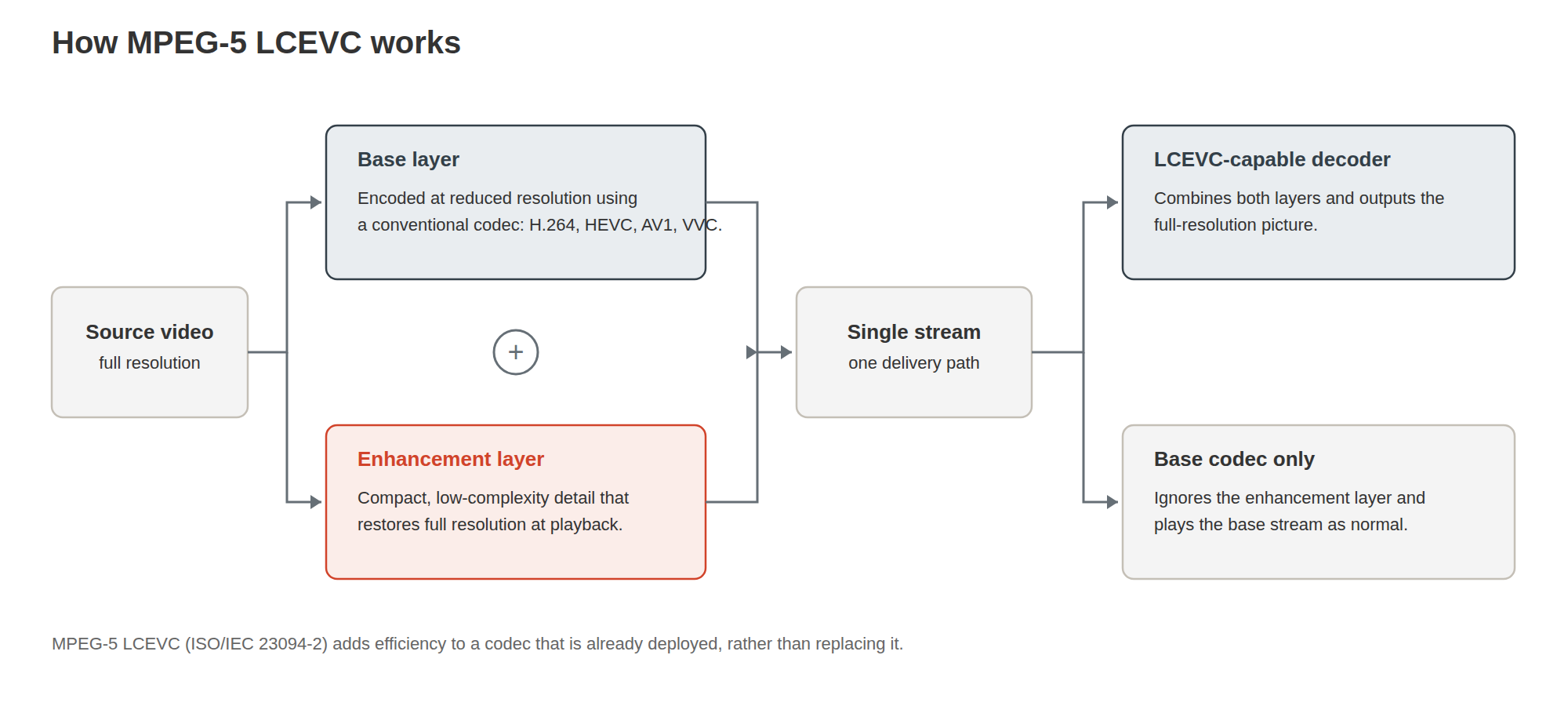
Figure 1. How MPEG-5 LCEVC works. A conventional base layer and a compact enhancement layer travel as one stream. The enhancement is optional at playback.
The proportions are worth a moment, because they are counterintuitive in both directions. The base layer occupies a quarter of the output frame area and carries the large majority of the bits. The enhancement layer carries roughly a tenth of the bits and restores all of the resolution.
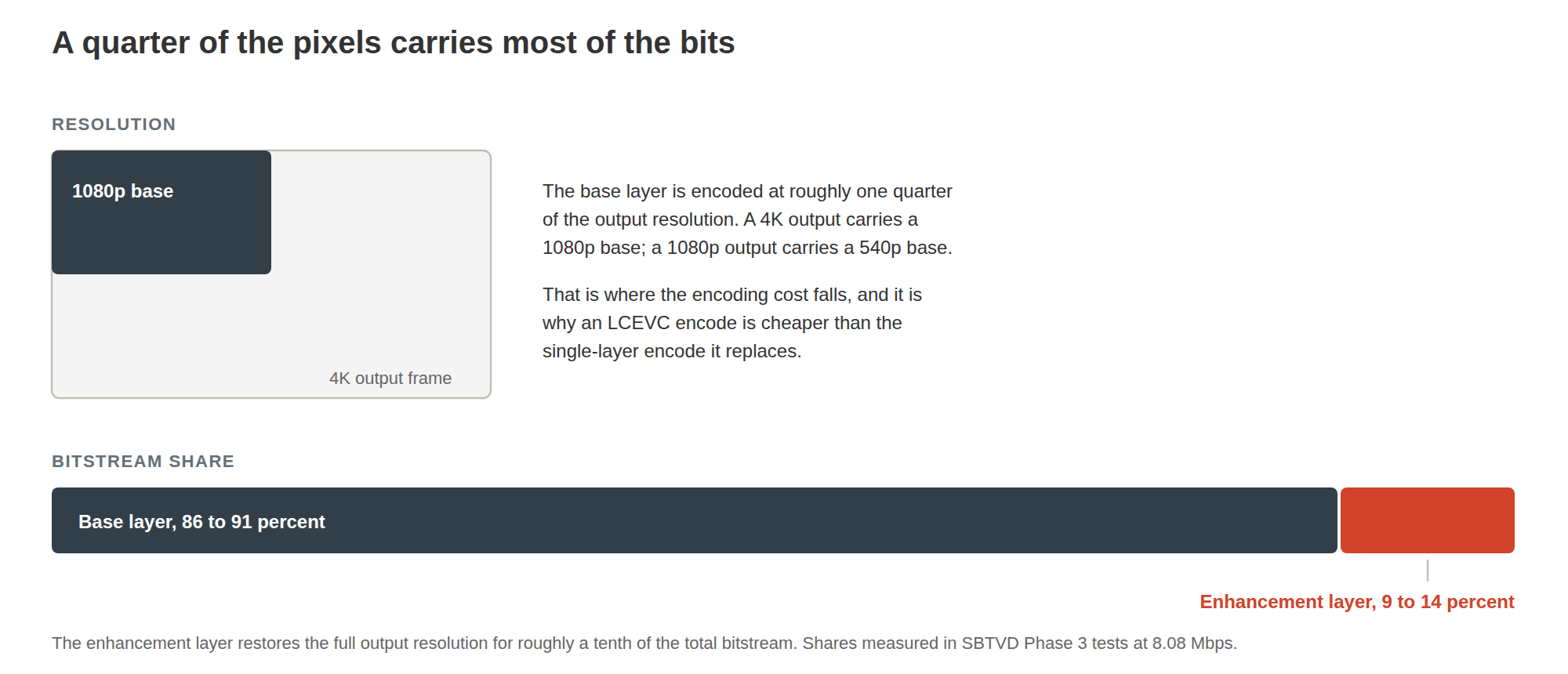
Figure 2. A quarter of the pixels carries most of the bits. In the SBTVD Phase 3 tests at 8.08 Mbps, the enhancement layer restored full 4K output for 9% to 14% of the total bitstream.
What happens on devices that do not support LCEVC
They play the base layer. Not an error, not a black screen, and not a fallback ladder you have to author separately. A device without LCEVC support sees a compliant H.264, HEVC, AV1 or VVC stream, decodes it at the base resolution, and renders it exactly as it would any other stream. The enhancement data is simply ignored.
This behaviour is what separates LCEVC from earlier layered-coding approaches. SVC and SHVC asked the whole ecosystem to absorb overhead and complexity before delivering any benefit, and neither achieved broad adoption. LCEVC runs the sequence in the other direction. Legacy decoders play the base layer today, and the enhancement reaches whatever share of devices supports it, growing as that share grows. You do not need a second encoding ladder, a second set of manifests, or a device-detection step to serve both populations.
The supported side of that split is not hypothetical. FFmpeg 7.1 (September 2024) added LCEVC decoding through an external library. GStreamer 1.26 (March 2025) added LCEVC encoder and decoder elements, including extraction of the enhancement layer from H.264 streams. Shaka Player has carried an LCEVC integration since 2023. ATSC A/345 lists LCEVC-based scalability as an option for NextGen TV, and Brazil’s DTV+ standard requires it.
What changes in the workflow, and what does not
The practical question for an operations team is where LCEVC touches the pipeline. The answer is narrower than most people expect.
The encoder changes. The encoder needs LCEVC support, either as an integrated capability or as a library that wraps your existing base encoder. The base encode itself is unchanged in kind; it is the same codec at a lower resolution.
Packaging does not change in any material way. Because the enhancement rides as SEI metadata or as a parallel track, the base stream remains an ordinary bitstream to every component downstream of the encoder. Segmenters, packagers and manifest generators handle it as they would any other stream of that codec.
CDN behavior does not change. The CDN caches and delivers segments. It has no reason to know whether an enhancement layer is inside them.
DRM does not change. The base stream is encrypted as it would be without LCEVC. The enhancement travels with it.
Playback changes only where you want it to. Players with LCEVC support decode both layers. Players without it decode the base. Both are served from the same stream.
This matters more than it sounds. A change that forces a packaging or DRM rework is a change most teams will never schedule, regardless of its compression merits. LCEVC is designed so that the rework is confined to the encoder and, optionally, the player.
What the enhancement layer delivers
The headline numbers are the ones against full-resolution single-layer encoding. MPEG’s 2021 verification testing, run under BT.500 methodology with 50 screened viewers across two laboratories, measured 45.9% MOS BD-rate savings against an AVC anchor at UHD and 28.5% at HD. Against HEVC, the savings were 30.9% and 24.1%.
Those are the numbers that get quoted. They are not the only ones a video engineer should ask about.
Anyone who has built an encoding ladder will ask a sharper question: my ladder already drops resolution at lower rungs and upscales on playback, so what is LCEVC adding beyond a standardized upsampler?
MPEG tested that as a second anchor: the same codec at half resolution, upscaled with a Lanczos filter, no enhancement layer. LCEVC beat it by 21% to 38% depending on codec and resolution. A University of the West of Scotland study published in January 2026 reproduced the finding for VVC, and found LCEVC-enhanced VVC comparable to multilayer VVC, with both ahead of base-layer upsampling.
The mechanism explains the result. A resolution-aware ladder throws detail away and hopes the upscaler approximates it. LCEVC throws the same detail away and then ships a compact, standardized description of what was discarded. The instinct behind the ladder is correct. LCEVC adds the channel the ladder never had.
Encode compute goes down, not up
This is the least intuitive property of the technology. Adding an encoding stage sounds like it should add compute. In practice the base encode runs at a quarter of the output resolution, so the expensive part of the job shrinks faster than the enhancement stage adds to it.
V-Nova’s peer-reviewed QoMEX 2026 study measured LCEVC-enhanced VVenC encoding 2.6 times faster than single-layer VVenC at equal subjective quality. Work published with Intel and Meta at SPIE in 2022 measured SVT-AV1 using roughly 40% fewer computations at equal quality. The direction of the compute effect is the opposite of what earlier layered coding conditioned people to expect.
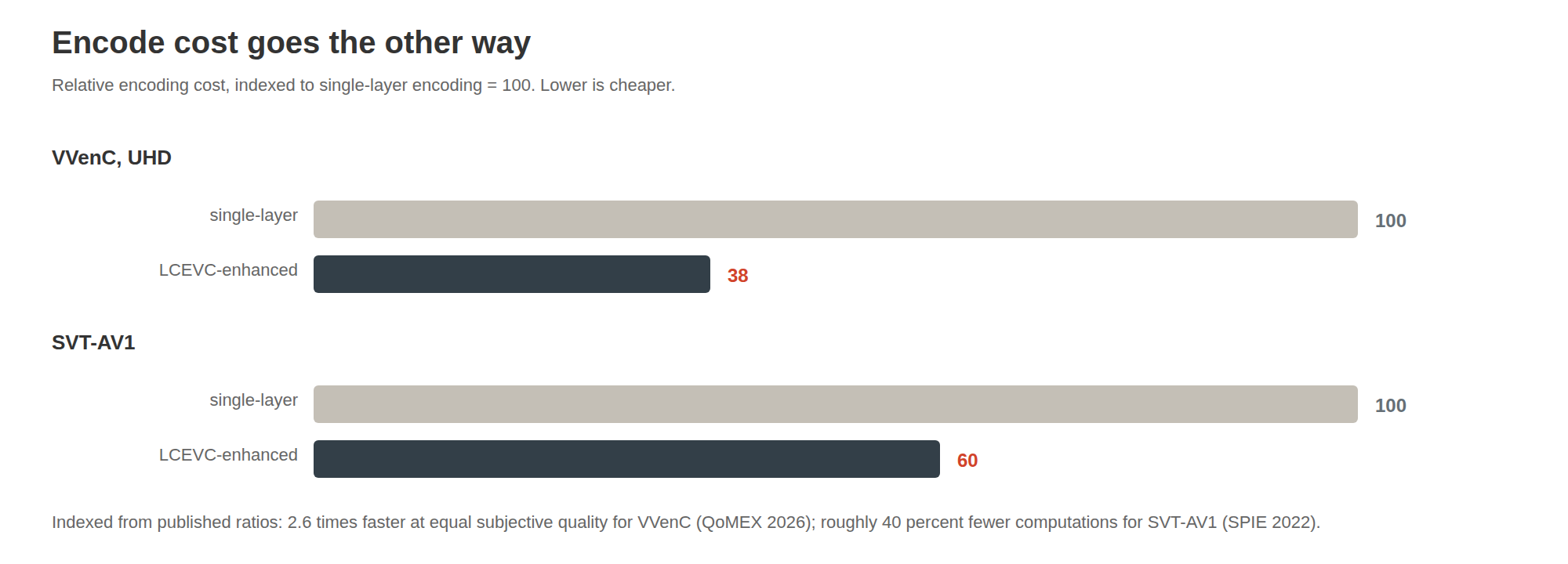
Figure 3. Encode cost goes the other way. Relative encoding cost indexed to single-layer encoding = 100, derived from published ratios in the QoMEX 2026 and SPIE 2022 papers.
Where the savings are largest
The savings are real, and they are also a function of operating point, content and metric. Knowing the boundaries is what lets you design a trial that produces a number your team will trust.
Operating point. The University of Surrey measured 18.7% savings over H.264 and 15.8% over HEVC at CRF 19, and found the gains held under packet loss. The H.264 gains reversed at CRF 27 and CRF 35, where the enhancement layer stops earning the bits it costs. Push compression far enough and a fixed overhead becomes the dominant term.
The opposite end behaves differently for a different reason. MediaTek (Picture Coding Symposium 2024) and Leibniz University Hannover (ICASSP 2025) ran reference encoders well above delivery bitrates and scored on PSNR. MediaTek reported no clear visual benefit at 4K, and Hannover found that even optimized LCEVC trails full-resolution VTM by roughly 15% in PSNR-domain BD-rate.
Those two sets of results are sometimes quoted against each other. They are not in conflict. They are the two edges of the same window. Every favourable measurement in the literature, from MPEG’s verification testing through Brazil’s Phase 3 rounds to Surrey’s CRF 19 numbers, sits between them. That band is where commercial delivery happens, which is convenient, but it is a band rather than a general property and should be treated as one.
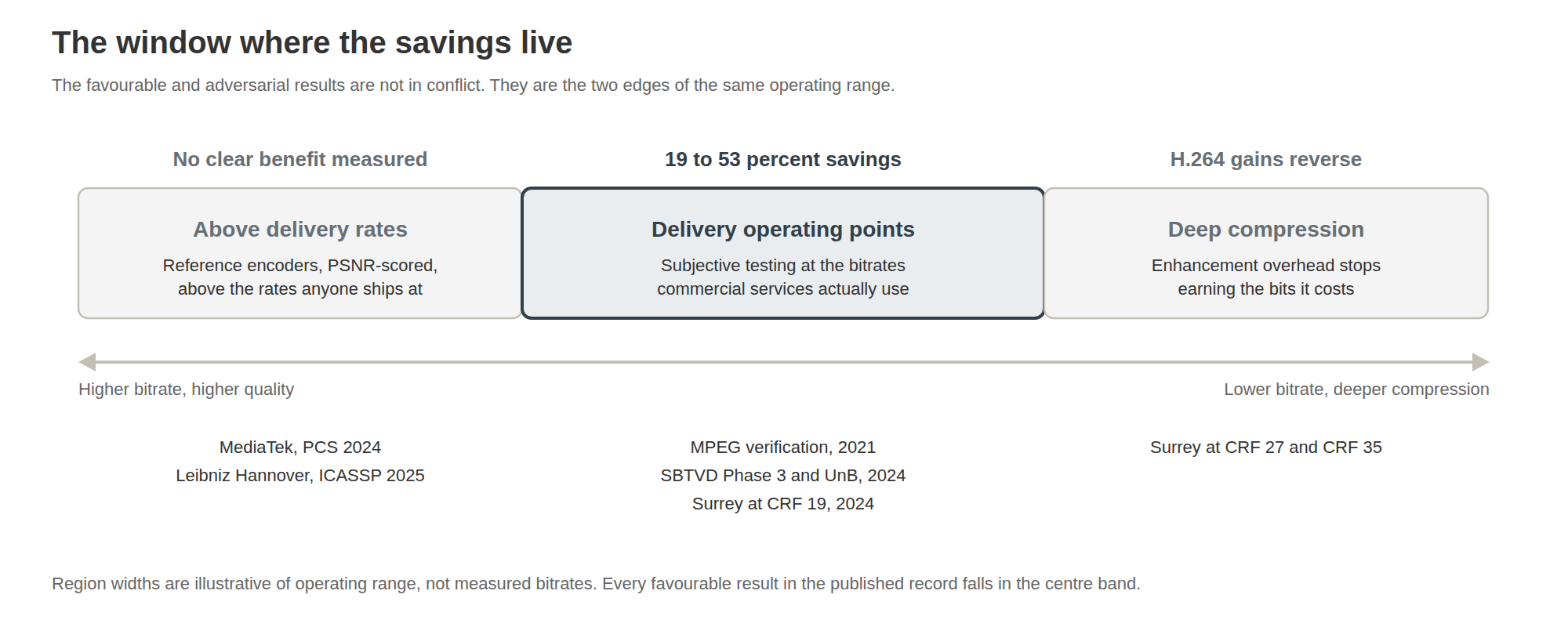
Figure 4. The window where the savings live. Region widths are illustrative of operating range, not measured bitrates.
Content. Per-content savings in Brazil’s SBTVD Phase 3 round ranged from 14% to 75% across five test clips. A follow-up round with matched encoders narrowed the spread to 46% to 53.5%. Kingston University and TU Berlin measured a 42% VMAF BD-rate saving against x264 and 39% against x265 for 1080p60 gaming content. A two-clip trial will tell you about two clips.
Metric. LCEVC optimizes perceptual reconstruction, and PSNR penalizes precisely that behavior. In the QoMEX study, the same encodes that saved 23% with human viewers and 30% on VMAF lost 77% on PSNR. In that test, VMAF correlated with viewer scores at 0.89 and PSNR at 0.49. If your acceptance testing gates on PSNR, LCEVC will fail the gate, and you should know that before you run anything. The practical conclusion is not that one camp is wrong. It is that a PSNR-gated evaluation produces a result you cannot interpret, and the gate is the thing to resolve first.
None of these boundaries is a disqualification. All three are reasons a trial designed without them produces a number nobody trusts.
Where LCEVC runs today
Brazil’s TV 3.0, branded DTV+, was established by presidential decree published on 27 August 2025 with LCEVC as a core component of the video system. The SBTVD Forum’s Phase 3 testing found a 4K stream reaching parity with a 1080p reference at 8.08 Mbps using VVC plus LCEVC, against 12.54 Mbps for single-layer VVC. A follow-up round at the University of Brasília with matched encoders in both arms measured 7.79 Mbps against 16.58 Mbps, a 53% reduction at equal subjective quality. Commercial DTV+ service launched on 11 June 2026 in Rio de Janeiro, São Paulo and Brasília, and V-Nova reports 4K HDR channels running under 10 Mbps.
A national broadcast standard is a demanding proving ground. It has to work on hardware nobody controls, at scale, under regulatory scrutiny. That is a materially different bar from a vendor demonstration, and it is the reason the Brazil results carry more weight than their sample sizes alone would justify.
Before you run a trial
Test at your delivery operating point. Not at your quality ceiling, and not at the bottom rung of your ladder. This single choice accounts for most of the apparent disagreement in the published literature. Encode at the bitrates you actually ship.
Resolve your metric before you start. If acceptance is PSNR-gated, decide whether the gate or the technology is the thing under review. Running the test without deciding produces an uninterpretable result and a month of argument.
Know your device floor. The value of graceful fallback depends on what the base layer delivers to devices that ignore the enhancement. If your base resolution is already acceptable for those devices, the enhancement is pure upside. If it is not, that is the problem to solve first.
Use enough content. A spread of 14% to 75% means a small sample is a lottery, not a measurement.
What an engineer can count on
The following statements summarize what the published record and production deployments support. Each is discussed in more detail above.
LCEVC reduces encode compute rather than adding it. The base encode runs at a quarter of the output resolution, and that saving outweighs the cost of the enhancement stage. Measured results: 2.6 times faster for VVenC at equal subjective quality (QoMEX 2026) and roughly 40% fewer computations for SVT-AV1 (SPIE 2022).
Packaging, CDN and DRM stay as they are. The enhancement rides as SEI metadata or as a parallel track, so the base stream is an ordinary bitstream to every component downstream of the encoder. The change is confined to the encoder and, where you choose to enable it, the player.
Devices without LCEVC support play the base layer normally. They decode a compliant stream at the base resolution and render it. No separate ladder, no separate manifests, and no device detection are required to serve both populations from one stream.
Support exists in mainstream open-source tooling and in a national broadcast standard. FFmpeg 7.1, GStreamer 1.26 and Shaka Player carry LCEVC upstream. ATSC A/345 lists it as an option for NextGen TV. Brazil’s DTV+ requires it and has been in commercial service since June 2026.
LCEVC outperforms a half-resolution encode with a good upscaler, not only a full-resolution encode. MPEG measured 21% to 38% savings against Lanczos-upscaled half-resolution anchors. The enhancement layer is a standardized description of the discarded detail, which an upscaler alone cannot recover.
PSNR is not a valid acceptance gate for LCEVC. The technology optimizes perceptual quality, and PSNR penalizes that. Subjective testing and VMAF track viewer scores; PSNR does not. Resolve the metric before the trial, not after.
The savings are largest at delivery operating points and vary by content. Published gains sit between the very-high-bitrate reference-encoder tests and the deep-compression end of the ladder. Test at the bitrates you ship, with enough content to cover your catalogue.
An enhancement layer does not make the codec question go away. It changes what you are waiting for, and for most operators that is the more useful change.
Silicon support: NETINT and V-Nova
The base layer is where the compute sits, and the base layer is conventional encoding. That is a well-understood workload for dedicated video silicon, which is why the pairing was being discussed before LCEVC had a national standard behind it.
NETINT and V-Nova announced a collaboration in August 2020. Six years on, the standard has gone from proposal to a national broadcast standard in Brazil and from a vendor SDK to upstream FFmpeg. VPU support for LCEVC follows the commercial adoption and deployment for the technology.
Where the enhancement layer eventually runs, in software alongside the encoder or on dedicated silicon beside the base encode, remains a roadmap question rather than a settled one. The arithmetic that makes it interesting has not changed: silicon that encodes N channels at 4K encodes roughly 4N base layers at 1080p.
Sources
ISO/IEC JTC 1/SC 29/WG 04 N0076, Verification Test Report on the Compression Performance of LCEVC, May 2021. lcevc.org. Peer-reviewed as Battista et al., IEEE Transactions on Circuits and Systems for Video Technology, 2023.
SBTVD Forum, TV 3.0 Project, Phase 3: Real-Time Video Coding Subjective Quality Assessment, 29 February 2024.
University of Brasília, Additional Tests for TV 3.0, August 2024. Commissioned by V-Nova.
Razaak, Tahir and Cobianchi (V-Nova), Compression Efficiency and Complexity Evaluation of MPEG-5 LCEVC-enhanced VVenC for UHD Video Delivery, QoMEX 2026.
Cobianchi et al. (V-Nova, Intel, Meta), Enhancing SVT-AV1 with LCEVC, SPIE Applications of Digital Image Processing XLV, 2022.
Barman, Schmidt, Zadtootaghaj and Martini (Kingston University, TU Berlin), Evaluation of MPEG-5 Part 2 for Live Gaming Video Streaming, ACM Mile-High Video 2022.
Roberts and Adeyemi-Ejeye (University of Surrey), Multimedia Tools and Applications, January 2024.
Ramzan et al. (University of the West of Scotland), Subjective evaluation of UHD video coded using VVC with LCEVC and ML-VVC, arXiv 2601.10448, January 2026.
Chubach et al. (MediaTek), LCEVC evaluation under JVET common test conditions, Picture Coding Symposium 2024.
Benjak and Ostermann (Leibniz University Hannover), LCEVC parameter optimization study, IEEE ICASSP 2025.
V-Nova, DTV+ goes live in Brazil with MPEG-5 LCEVC, 11 June 2026. v-nova.com (vendor source).
V-Nova and NETINT Technologies, joint press release, 4 August 2020. v-nova.com.
FFmpeg 7.1 release notes, 30 September 2024, ffmpeg.org. GStreamer 1.26 release notes, 11 March 2025, gstreamer.freedesktop.org. Shaka Player v4.5.0 release notes, 4 October 2023, github.com/shaka-project. ATSC A/345:2026.
NETINT VPU ECOSYSTEM · IBC 2026
As video workloads continue to grow, adding capacity is no longer a single decision, but a set of practical paths depending on the real bottleneck. This series explores how to scale video processing efficiently using NETINT VPUs, whether through infrastructure partners, existing systems, or dedicated deployments designed around video from the start.
1. The New Video Capacity Problem
2. Three Ways to Add Video Capacity in a Constrained Market
3. VPU-Powered Capacity as a Service
4. Get More From the Servers You Already Own
5. Build Dedicated VPU-Based Video Infrastructure
6. VPU Capacity Without a Hardware Cycle
7. Scaling Performance-Critical Video Workloads
8. Beyond General-Purpose Compute
9. Reliable Live Video Meets Efficient Processing
10. Maximizing Encoding Efficiency in Live Streaming Workflows
11. Pairing VPUs with MPEG-5 LCEVC Delivers The Next Layer of Video Efficiency
12. From Concept to Production: A Field-Proven Methodology for Deploying NETINT Quadra VPUs
Subscribe to the NETINT blog
One email a week with our latest articles on VPUs, encoding efficiency, and video infrastructure.