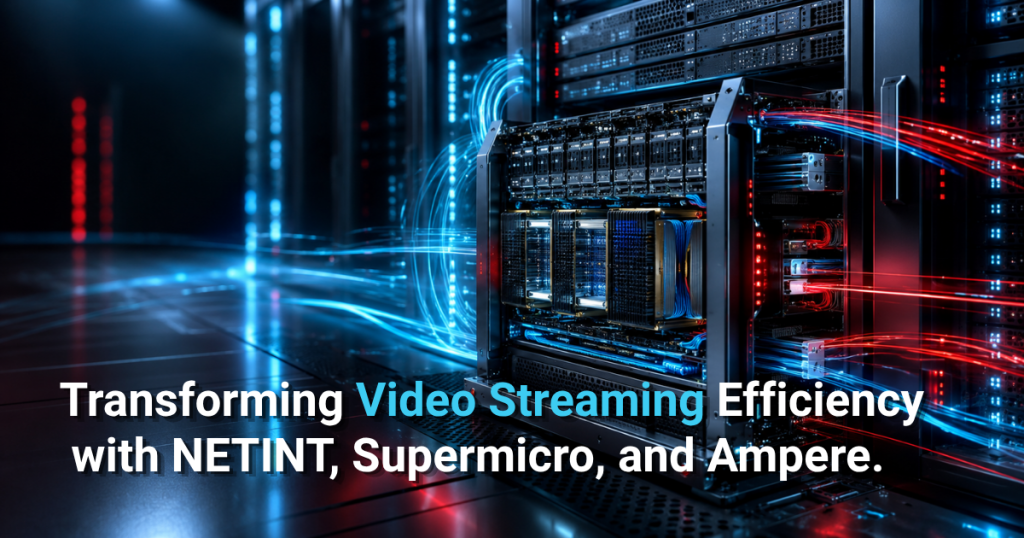
Transforming Video Streaming Efficiency with NETINT, Supermicro, and Ampere

Integrated system improving streaming efficiency.

Traditional solutions often fall short and cannot meet the demands of modern streaming platforms, gaming services, and video-intensive applications like surveillance and decoding for AI inferencing. NETINT collaborated with Supermicro and Ampere to build a groundbreaking solution that redefines video encoding, decoding, and streaming efficiency.

This article is for video streaming engineers looking to optimize their workflows and gain insights into cutting-edge technologies that improve performance while reducing costs: NETINT Video Processing Units (VPUs), modular server designs from Supermicro, and the unparalleled core density of Ampere CPUs.

The VPU Advantage: A New Era of Video Processing

What is a VPU?

A Video Processing Unit (VPU) is a purpose-built chip designed exclusively for video processing. Unlike CPUs and GPUs, which allocate only a fraction of their silicon to video encoding tasks, VPUs dedicate 100% of their silicon to video processing. This specialized focus enables unparalleled efficiency and scalability by reducing hardware requirements by up to 80%, using 80% less energy than traditional CPU-based solutions, and excelling in tasks like live OTT and broadcast streaming, AR/VR 8K encoding, and high-density decoding and processing for AI.

Why VPUs Matter

VPUs offer unprecedented cost efficiency by significantly lowering operational costs and enabling scalable, high-performance video encoding. Their energy savings make them an eco-friendly choice while efficiently handling demanding applications, such as live streaming, cloud gaming, and AI inferencing. As video standards like 8K become more prevalent, VPUs are poised to adapt seamlessly to these requirements. Their specialized design will enable them to handle these high-resolution workloads without significantly increasing energy consumption or hardware costs. Simply put, VPUs are the optimum way to reliably and economically encode and decode video for most workflows.

Supermicro Servers: The Modular Backbone of Video Solutions

The Power of Modular Design

Supermicro’s modular server architecture provides unparalleled flexibility, allowing engineers to configure hardware precisely to their application needs. This modularity ensures cost-effectiveness and performance optimization.

Supermicro servers enable engineers to tailor configurations to specific requirements, seamlessly scale operations, and reduce downtime by easily swapping components for maintenance or upgrades. Streaming providers in India use 1RU Supermicro servers to deliver 95 1080i30 video streams, 195 720p30 video streams, or 365 576p30 video streams per server. This migration from legacy systems to modern infrastructure minimized hardware investment and maximized cost savings.

Modular server designs with hot-swappable modules for tasks like transcoding, storage expansion, or AI acceleration enable customization based on changing workloads, making Supermicro servers indispensable to highly adaptive video processing ecosystems.

Ampere CPUs: Redefining Core Density and Energy Efficiency

Why Core Density Matters

Ampere’s ARM-based CPUs are redefining server performance with up to 192 physical cores, enabling greater parallelism for high-density workloads. They also consume significantly less power than x86 alternatives, making them a more sustainable option.

By integrating Ampere CPUs with NETINT VPUs and Supermicro servers, customers achieved real-time deinterlacing of 95 1080i30 streams in a single server, drastically reduced energy consumption, and enhanced video quality compared to traditional hardware video solutions. ARM-based processors like Ampere’s offer a scalable and cost-effective alternative to conventional x86 CPUs.

In the coming years, Ampere CPUs are being seen as contenders to lead the charge in distributed computing for video workloads, where clusters of high-density, low-power CPUs handle tasks across multiple edge locations. This would reduce latency and bring computing closer to the user, a critical factor for live streaming and interactive applications like cloud gaming and real-time AR experiences.

A Case Study in Excellence: Transforming Video Delivery in India

A pay-TV provider in India transitioned from legacy technologies to a modern streaming infrastructure to support mobile and browser-based viewing while enhancing video quality and reducing operational costs. By deploying NETINT VPUs, Supermicro servers, and Ampere CPUs, the provider could deliver 300 video channels from a single server. This setup improved customer satisfaction through higher resolution and achieved significant cost reductions.

Collaboration between hardware and software vendors was critical, as pre-engineered solutions minimized customization time and deployment complexity.

This case study serves as a blueprint for the future: an era where integrated solutions are not just an option but a necessity. Providers could soon integrate AI-powered analytics directly into their streaming workflows, enabling proactive quality adjustments and predictive load balancing to ensure flawless delivery, even during peak traffic times.

The Future of Video Streaming Engineering

Engineers must leverage purpose-built video encoding hardware like NETINT VPUs to optimize video processing efficiency and scalability. Modular server designs from Supermicro allow precise configuration and seamless scaling, while ARM-based CPUs like Ampere offer sustainable performance for high-density workloads. Partnering with vendors that provide well-integrated systems reduces engineering overhead and ensures rapid deployment.

Efficiency isn’t just about cutting costs; it’s about unlocking potential.

Efficiency isn’t just about cutting costs; it’s about unlocking potential. Embracing technologies like VPUs and leveraging the strengths of Supermicro and Ampere enables video streaming engineers to transform their operations from costly bottlenecks into competitive advantages. Looking to the horizon, the confluence of these technologies could catalyze entirely new possibilities in video delivery.

Next Steps for Implementation

The journey to transforming your video streaming infrastructure begins with thoroughly evaluating your current workflows. Dive deep into your video processing pipeline to uncover inefficiencies, bottlenecks, and outdated practices. Identifying these gaps is the foundation for meaningful change. With a clear understanding of your needs, consult with experts at NETINT to explore how VPUs can seamlessly integrate into your existing systems and elevate your capabilities.

Start small by implementing prototypes that test the impact of these technologies on a manageable scale. This phased approach allows you to measure the return on investment (ROI) while refining your strategy based on real-world results. As you build confidence in the system’s effectiveness, gradually scale operations to meet broader organizational goals. NETINT’s team can provide invaluable guidance throughout this process, ensuring a smooth transition.

NETINT offers a comprehensive case study on building a 300-channel video encoding server for those eager to dive deeper into proven methodologies.

This resource provides actionable insights and a step-by-step breakdown of how cutting-edge solutions have transformed video streaming workflows.

Visit https://info.netint.com/hubfs/downloads/Building-a-300-Channel-Video-Encoding-Server.pdf to access this essential guide.

Ampere Case Study

Schedule a meeting to learn how NETINT VPUs can enhance live streaming with energy-efficient, scalable solutions.

ACCESS NOW: ASIC-Based Transcoding
for High-volume Use Cases
Including social media, broadcast, interactive platforms, and service providers


ACCESS NOW

Transforming Video Streaming Efficiency with NETINT, Supermicro, and Ampere

Optimize video streaming efficiency with NETINT VPUs, Supermicro modular servers, and Ampere ARM-based CPUs, enhancing performance, scalability, and energy savings for modern streaming workflows.

Integrated system improving streaming efficiency.

Traditional solutions often fall short and cannot meet the demands of modern streaming platforms, gaming services, and video-intensive applications like surveillance and decoding for AI inferencing. NETINT collaborated with Supermicro and Ampere to build a groundbreaking solution that redefines video encoding, decoding, and streaming efficiency.

This article is for video streaming engineers looking to optimize their workflows and gain insights into cutting-edge technologies that improve performance while reducing costs: NETINT Video Processing Units (VPUs), modular server designs from Supermicro, and the unparalleled core density of Ampere CPUs.

The VPU Advantage: A New Era of Video Processing

What is a VPU?

A Video Processing Unit (VPU) is a purpose-built chip designed exclusively for video processing. Unlike CPUs and GPUs, which allocate only a fraction of their silicon to video encoding tasks, VPUs dedicate 100% of their silicon to video processing. This specialized focus enables unparalleled efficiency and scalability by reducing hardware requirements by up to 80%, using 80% less energy than traditional CPU-based solutions, and excelling in tasks like live OTT and broadcast streaming, AR/VR 8K encoding, and high-density decoding and processing for AI.

Why VPUs Matter

VPUs offer unprecedented cost efficiency by significantly lowering operational costs and enabling scalable, high-performance video encoding. Their energy savings make them an eco-friendly choice while efficiently handling demanding applications, such as live streaming, cloud gaming, and AI inferencing. As video standards like 8K become more prevalent, VPUs are poised to adapt seamlessly to these requirements. Their specialized design will enable them to handle these high-resolution workloads without significantly increasing energy consumption or hardware costs. Simply put, VPUs are the optimum way to reliably and economically encode and decode video for most workflows.

Supermicro Servers: The Modular Backbone of Video Solutions

The Power of Modular Design

Supermicro’s modular server architecture provides unparalleled flexibility, allowing engineers to configure hardware precisely to their application needs. This modularity ensures cost-effectiveness and performance optimization.

Supermicro servers enable engineers to tailor configurations to specific requirements, seamlessly scale operations, and reduce downtime by easily swapping components for maintenance or upgrades. Streaming providers in India use 1RU Supermicro servers to deliver 95 1080i30 video streams, 195 720p30 video streams, or 365 576p30 video streams per server. This migration from legacy systems to modern infrastructure minimized hardware investment and maximized cost savings.

Modular server designs with hot-swappable modules for tasks like transcoding, storage expansion, or AI acceleration enable customization based on changing workloads, making Supermicro servers indispensable to highly adaptive video processing ecosystems.

Ampere CPUs: Redefining Core Density and Energy Efficiency

Why Core Density Matters

Ampere’s ARM-based CPUs are redefining server performance with up to 192 physical cores, enabling greater parallelism for high-density workloads. They also consume significantly less power than x86 alternatives, making them a more sustainable option.

By integrating Ampere CPUs with NETINT VPUs and Supermicro servers, customers achieved real-time deinterlacing of 95 1080i30 streams in a single server, drastically reduced energy consumption, and enhanced video quality compared to traditional hardware video solutions. ARM-based processors like Ampere’s offer a scalable and cost-effective alternative to conventional x86 CPUs.

In the coming years, Ampere CPUs are being seen as contenders to lead the charge in distributed computing for video workloads, where clusters of high-density, low-power CPUs handle tasks across multiple edge locations. This would reduce latency and bring computing closer to the user, a critical factor for live streaming and interactive applications like cloud gaming and real-time AR experiences.

A Case Study in Excellence: Transforming Video Delivery in India

A pay-TV provider in India transitioned from legacy technologies to a modern streaming infrastructure to support mobile and browser-based viewing while enhancing video quality and reducing operational costs. By deploying NETINT VPUs, Supermicro servers, and Ampere CPUs, the provider could deliver 300 video channels from a single server. This setup improved customer satisfaction through higher resolution and achieved significant cost reductions.

Collaboration between hardware and software vendors was critical, as pre-engineered solutions minimized customization time and deployment complexity.

This case study serves as a blueprint for the future: an era where integrated solutions are not just an option but a necessity. Providers could soon integrate AI-powered analytics directly into their streaming workflows, enabling proactive quality adjustments and predictive load balancing to ensure flawless delivery, even during peak traffic times.

The Future of Video Streaming Engineering

Engineers must leverage purpose-built video encoding hardware like NETINT VPUs to optimize video processing efficiency and scalability. Modular server designs from Supermicro allow precise configuration and seamless scaling, while ARM-based CPUs like Ampere offer sustainable performance for high-density workloads. Partnering with vendors that provide well-integrated systems reduces engineering overhead and ensures rapid deployment.

Efficiency isn’t just about cutting costs; it’s about unlocking potential.

Efficiency isn’t just about cutting costs; it’s about unlocking potential. Embracing technologies like VPUs and leveraging the strengths of Supermicro and Ampere enables video streaming engineers to transform their operations from costly bottlenecks into competitive advantages. Looking to the horizon, the confluence of these technologies could catalyze entirely new possibilities in video delivery.

Next Steps for Implementation

The journey to transforming your video streaming infrastructure begins with thoroughly evaluating your current workflows. Dive deep into your video processing pipeline to uncover inefficiencies, bottlenecks, and outdated practices. Identifying these gaps is the foundation for meaningful change. With a clear understanding of your needs, consult with experts at NETINT to explore how VPUs can seamlessly integrate into your existing systems and elevate your capabilities.

Start small by implementing prototypes that test the impact of these technologies on a manageable scale. This phased approach allows you to measure the return on investment (ROI) while refining your strategy based on real-world results. As you build confidence in the system’s effectiveness, gradually scale operations to meet broader organizational goals. NETINT’s team can provide invaluable guidance throughout this process, ensuring a smooth transition.

NETINT offers a comprehensive case study on building a 300-channel video encoding server for those eager to dive deeper into proven methodologies.

This resource provides actionable insights and a step-by-step breakdown of how cutting-edge solutions have transformed video streaming workflows.

Visit https://info.netint.com/hubfs/downloads/Building-a-300-Channel-Video-Encoding-Server.pdf to access this essential guide.


Ampere Case Study

Schedule a meeting to learn how NETINT VPUs can enhance live streaming with energy-efficient, scalable solutions.

ACCESS NOW: ASIC-Based Transcoding
for High-volume Use Cases
Including social media, broadcast, interactive platforms, and service providers


ACCESS NOW