The traditional model of satellite-based, hardware-heavy infrastructure is no longer enough to meet the growing demands for scalability, flexibility, and cost efficiency. While some companies have fully embraced cloud workflows, many broadcasters are caught between their legacy investments and the need to modernize. The big question is no longer whether to move to IP-based workflows but how to transition in a way that is both cost-effective and seamless.
The Future of Broadcast is Hybrid and Cost-Effective
In a recent discussion on Voices of Video, Adam Nilsson and Pierre Le Fèvre of Net Insight shed light on this transition. They explored how broadcasters can evolve their workflows without the risk of disruption, how cloud-based video transport solutions like Nimbra Edge are bridging the gap between traditional and modern infrastructures, and why the role of transcoding is rapidly changing. One of the most eye-opening insights was how hardware-accelerated transcoding, particularly with NETINT VPUs, slashes costs by 67% compared to standard cloud-based encoding.
For video engineers navigating these industry changes, the key takeaways revolve around the hybrid future of broadcasting, the efficiency of cloud-native transport, and the strategic use of transcoding as more than just a bitrate conversion tool. If you’re involved in video processing, live streaming, or broadcast distribution, understanding these shifts can help you optimize workflows and reduce costs without compromising quality.
Broadcast Modernization: A Gradual Shift, Not an Overnight Overhaul
Many broadcasters recognize the importance of modernization, yet they hesitate to leap into cloud-native workflows. This reluctance is understandable, given that most have invested significantly in satellite and fiber-based transport. Historically, these systems have provided unmatched reliability, a key factor for mission-critical live broadcasting. However, the challenge is that transitioning to IP-based workflows often requires retraining teams, rethinking existing infrastructure, and ensuring that reliability remains uncompromised.
The idea that modernization means replacing an entire workflow overnight is a common misconception. The shift towards cloud-based transport is best approached gradually, starting with targeted deployments. Rather than attempting a complete infrastructure overhaul, companies can begin by integrating cloud-native tools like Nimbra Edge for specific use cases such as remote production or live event contribution. By taking a phased approach, broadcasters can adopt new technology without disrupting ongoing operations, allowing for a smoother and more controlled transition.
Cloud-Based Video Transport: Why It’s No Longer Optional
Transporting live, high-quality video has traditionally relied on dedicated hardware and satellite networks, but these solutions are becoming increasingly difficult to scale. The shift toward IP-based transport is inevitable, yet many organizations still have concerns about reliability, scalability, and integration. The fear of potential network failures during live events or the complexity of connecting cloud-based tools with on-prem solutions often discourages companies from transitioning.
Net Insight’s Nimbra Edge addresses these concerns by offering a cloud-native approach to video transport. With IP-based routing, end-to-end monitoring, and support for multiple input and output formats, Nimbra Edge enables flexibility that traditional hardware solutions cannot match. The misconception that cloud-based transport sacrifices reliability is no longer valid. In reality, modern IP workflows can provide both the adaptability of cloud infrastructure and the dependability that broadcasters expect.
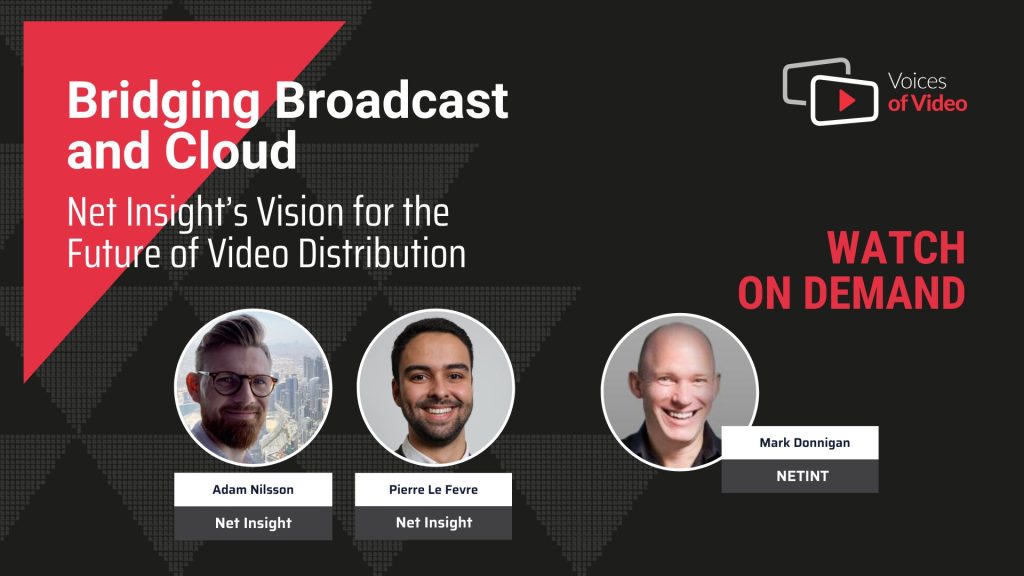
Voices of Video – on-demand:
Bridging Broadcast and Cloud: Net Insight’s Vision for the Future of Video Distribution
with Adam Nilsson and Pierre Le Fevre from Net Insight
Transcoding as a Workflow Enabler, Not Just a Bitrate Converter
The traditional purpose of a transcoder was straightforward: take a high-bitrate source and generate multiple renditions for streaming or broadcast distribution. However, transcoding has evolved far beyond basic bitrate conversion in today’s video landscape. It has become a key enabler of seamless video transport, allowing media organizations to bridge the gap between legacy and next-generation formats.
Modern transcoding workflows must do more than compress video efficiently. They must adapt to different formats and standards, perform real-time video optimizations such as frame rate conversion and HDR adjustments, and support distributed processing for lower latency. As workflows become more complex, transcoding is increasingly used as an adapter that ensures seamless connectivity between otherwise incompatible systems.
One of the biggest mistakes in modern workflows is treating transcoding as a post-processing step rather than an integral part of the video transport process. Instead of relying on a single transcoder at the end of the pipeline, organizations should strategically place transcoding at different points in the workflow. By leveraging solutions like Nimbra Edge, transcoding can occur at the edge, in the cloud, or at key distribution points, optimizing efficiency and reducing overall latency.
The Cost-Saving Power of Hardware-Accelerated Transcoding
Cloud-based transcoding has long been one of the most expensive aspects of video processing, particularly for companies that rely on CPU-based solutions like AWS Elemental. While GPUs have been widely adopted for transcoding, they have significant inefficiencies. A GPU usually consists of only about 15% of its surface area dedicated to video processing, with the remaining space devoted to functions irrelevant to media workloads like LLM training and inferencing. This results in organizations paying for computational power they don’t need.
Net Insight’s integration with NETINT VPUs provides a more efficient alternative. Purpose-built for video workloads, VPUs deliver higher quality and lower latency at a fraction of the cost. Compared to traditional cloud transcoding solutions, VPU-powered transcoding offers a 67% cost reduction over three years. This level of savings is critical for broadcasters and streaming companies looking to optimize their operating expenses while maintaining the highest possible video quality.
By transitioning from general-purpose GPUs to dedicated VPUs, organizations can achieve significant cost reductions without sacrificing performance.
The Road Ahead: A Hybrid Future for Video Streaming
Modernizing broadcast and streaming workflows requires a strategic, phased approach, not a rushed leap into the cloud. The best way forward is to adopt hybrid models like Net Insight’s Nimbra Edge, which allow broadcasters to integrate cloud-based transport while maintaining their existing infrastructure. A complete cloud migration may not be necessary, and for many companies, a hybrid setup provides the best balance of flexibility, reliability, and cost control.
One of the most critical shifts in video workflows is understanding that transcoding is no longer just about compression. In today’s landscape, transcoding is a media transformation tool, enabling seamless adaptation between legacy and next-generation formats. Engineers who still view transcoding as a basic bitrate conversion step may miss opportunities to optimize workflows, reduce latency, and ensure cross-platform compatibility.
Another significant cost-saving opportunity is moving away from general-purpose GPUs for video processing. While GPUs have been widely used for transcoding, they are often inefficient because only a small portion of the hardware is optimized for video workloads. VPUs offer a far more targeted and cost-effective solution for engineers looking to optimize expenses without compromising quality than traditional GPUs.
As the next step, video engineers should evaluate their current video transport setup to determine whether they still rely on legacy satellite-based workflows that could be enhanced or replaced with cloud-native transport solutions. Reviewing cloud costs is another critical step, as many companies may be overpaying for CPU or GPU-based transcoding without realizing that more efficient alternatives exist. Finally, experimenting with automation-driven optimizations can unlock significant efficiency, cost savings, and scalability improvements, even when applied incrementally to existing workflows.
For an in-depth discussion on these topics, listen to the whole conversation on Voices of Video: https://netint.biz/VoV-NetInsight
Schedule a meeting to learn how NETINT VPUs can enhance live streaming with energy-efficient, scalable solutions.