
Download NETINT's 2026 VPU Buyer's Guide to compare Quadra VPUs, AV1 hardware encoding, video transcoding hardware, and deployment options.

Discover how Zapping scaled Live Streaming with NETINT VPUs, cutting server count, reducing power consumption, and improving low-latency OTT delivery.

Learn how Video Efficiency combines VPUs and MPEG-5 LCEVC to reduce bitrate, lower CDN costs, and improve streaming quality at scale.

Learn how Video Efficiency combines VPUs and MPEG-5 LCEVC to reduce bitrate, lower CDN costs, and improve streaming quality at scale.

Learn how Wowza Streaming Engine and NETINT VPUs improve Live Streaming Encoding Efficiency with scalable transcoding, ABR workflows, and lower compute costs..

Learn how Zixi Broadcaster, ZEN Master, and NETINT VPUs create Reliable Live Video workflows with scalable transcoding, monitoring, and failover.

Discover how Advantech and NETINT use General-Purpose Compute, GPUs, and VPUs to build scalable immersive video and high-density streaming infrastructure..
Learn how NETINT Quadra and i3D.net support Performance-Critical Video Workloads with low-latency infrastructure, VPU encoding, and scalable video processing.
Deploy VPU Capacity with NetActuate and NETINT Quadra to test hosted video encoding, accelerate deployment, and scale without new hardware.
Build Dedicated VPU Video Infrastructure with Quadra VPUs, validated systems, and Bitstreams to create scalable video processing platforms.
Learn how to get more from the servers you already own by adding VPU acceleration to increase encoding capacity and video processing efficiency.
Learn how VPU Capacity as a Service delivers encoding capacity faster through hosted infrastructure, reducing deployment time and operational burden.
Learn three practical ways to add video capacity by using hosted VPUs, upgrading existing infrastructure, or deploying dedicated VPU systems.
Learn why video capacity is now an architecture challenge and how streaming infrastructure with VPUs helps overcome power, density, and growth limits.
Learn how encoding efficiency improves power use, resilience, rack density, and streaming infrastructure while reducing watts per stream.
Learn how carrier-grade live streaming combines VPU acceleration, video orchestration, and a control plane to improve reliability and scalability.
Learn how to build an efficient FFmpeg hardware encoding pipeline with h265_ni_quadra_enc while reducing frame transfers and improving performance.
Learn a practical 7-step approach for validating performance, reducing migration risk, and preserving production workflows.
The difference between CPU and VPU encoding becomes clear when the pipeline is viewed as a sequence of frame-processing stages and resource transfers.
Encoder comparisons are useful only after the workload has been matched to the compute architecture that will carry it.
Encoders should be evaluated as infrastructure: by sustained throughput, power, density, predictability, and operational cost, not compression quality alone.
Scaling AV1 video encoding with hardware video encoding and VPU transcoding reduces power, rack density, and operational cost at infrastructure scale.
Expanding video encoding capacity may not require new servers. Adding VPUs to existing hardware recovers dense capacity in a constrained supply market.
The C-Band transition is finished, but the IP video work is not. How spectrum policy became an infrastructure challenge solved at the edge with VPUs.
AI video analytics stall on decode, not the model. Why turning compressed surveillance video back into frames is the real constraint, and how VPUs fix it.

VPU-as-a-Service delivers purpose-built video acceleration through a cloud consumption model, cutting cost per stream and power beyond what CPU or GPU cloud instances can offer.

A decade inside the rise of the video processing unit, from industry skepticism to Emmy recognition, and how the VPU reshaped streaming infrastructure.

The 2026 State of Video Encoding Report draws on 286 professionals to reveal how codec, hardware, and cost decisions are reshaping streaming infrastructure.

How TMPS and Misao Network used NETINT VPUs to deliver ultra-low-latency 8K video over WebRTC, proving real-time 8K streaming is achievable today.

MPEG-5 LCEVC enhances existing codecs instead of replacing them. How V-Nova's approach rewrites the economics of video quality and compression.

VPU system architecture determines whether accelerator-dense video infrastructure delivers sustained performance across PCIe, power, and thermal limits.

Rigorous video benchmarking reveals true VPU energy efficiency, cost per stream, and real-world performance for scalable video infrastructure.
Why video pipelines fail at scale is not compute power but coordination. See how NETINT VPUs and Scalstrm deliver 80% less power per stream.
Latency-sensitive video workloads demand compute closer to users. Distributed video transcoding with VPU acceleration makes edge deployment viable and efficient.
Deployable video infrastructure requires more than efficient silicon. Learn how VPU accelerated video processing and server design reshape data center scale.

Discover how VPU acceleration and distributed cloud reshape video infrastructure economics by lowering egress costs and power per stream.
Video infrastructure economics is shifting toward efficiency, density, and predictability as VPUs reshape cost, power, and scalability models.

Energy efficiency in Europe is reshaping video infrastructure as power constraints redefine scalability, cost models, and long-term competitiveness.
Watts per stream is reshaping video infrastructure costs in Europe, linking energy efficiency to smarter financial planning and long-term platform growth
Power constraints are redefining video infrastructure scaling in Europe, shifting platform growth from compute expansion to energy-efficient architectures.
Discover how Watts per Stream measures video encoding efficiency and improves power consumption, performance, and sustainability in streaming.
Why AI inference and hardware video encoding are shifting from CPUs and GPUs to specialized silicon—and what this means for performance, cost, and scale.
Why AWS is the wrong foundation for video transcoding at scale. See how VPU-enabled clouds cut costs 2–4x, slash egress by 18x, and unlock advanced features.
Why AWS is the wrong foundation for video transcoding at scale. See how VPU-enabled clouds cut costs 2–4x, slash egress by 18x, and unlock advanced features.
Discover how Jet-Stream’s MaelStrom pairs VPU hardware with hybrid cloud to cut video encoding costs, trim power use by up to 90%, and scale streaming workflows sustainably.
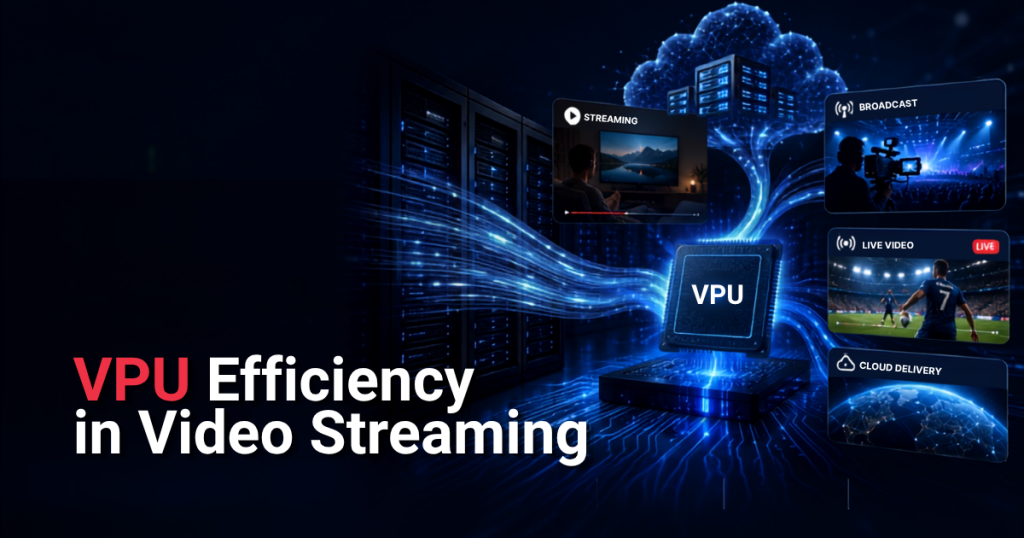
Discover how Easy Tools leverages NETINT VPU technology to slash power use, cut costs, and deliver broadcast-grade video encoding and multi-viewer streaming at scale.

G&L built a secure, scalable Cloud Streaming platform for the EU Parliament using NETINT VPUs, Ampere CPUs, and Akamai for real-time, multi-language delivery.
Discover how VPUs and hybrid cloud workflows are transforming video encoding. Learn from Cires 21’s real-world insights to scale efficiently, reduce costs, and boost streaming performance.
Scalstrm shows how just-in-time transcoding and VPUs reduce storage, cut power use, and improve efficiency in modern video streaming workflows.
Net Insight and NETINT modernize broadcast workflows with cloud transport, hybrid setups, and VPU-powered transcoding that slashes costs by 67%.
Learn how gaming infrastructure optimizes video streaming by reducing latency, cutting costs, and scaling smarter with insights from i3D.net.